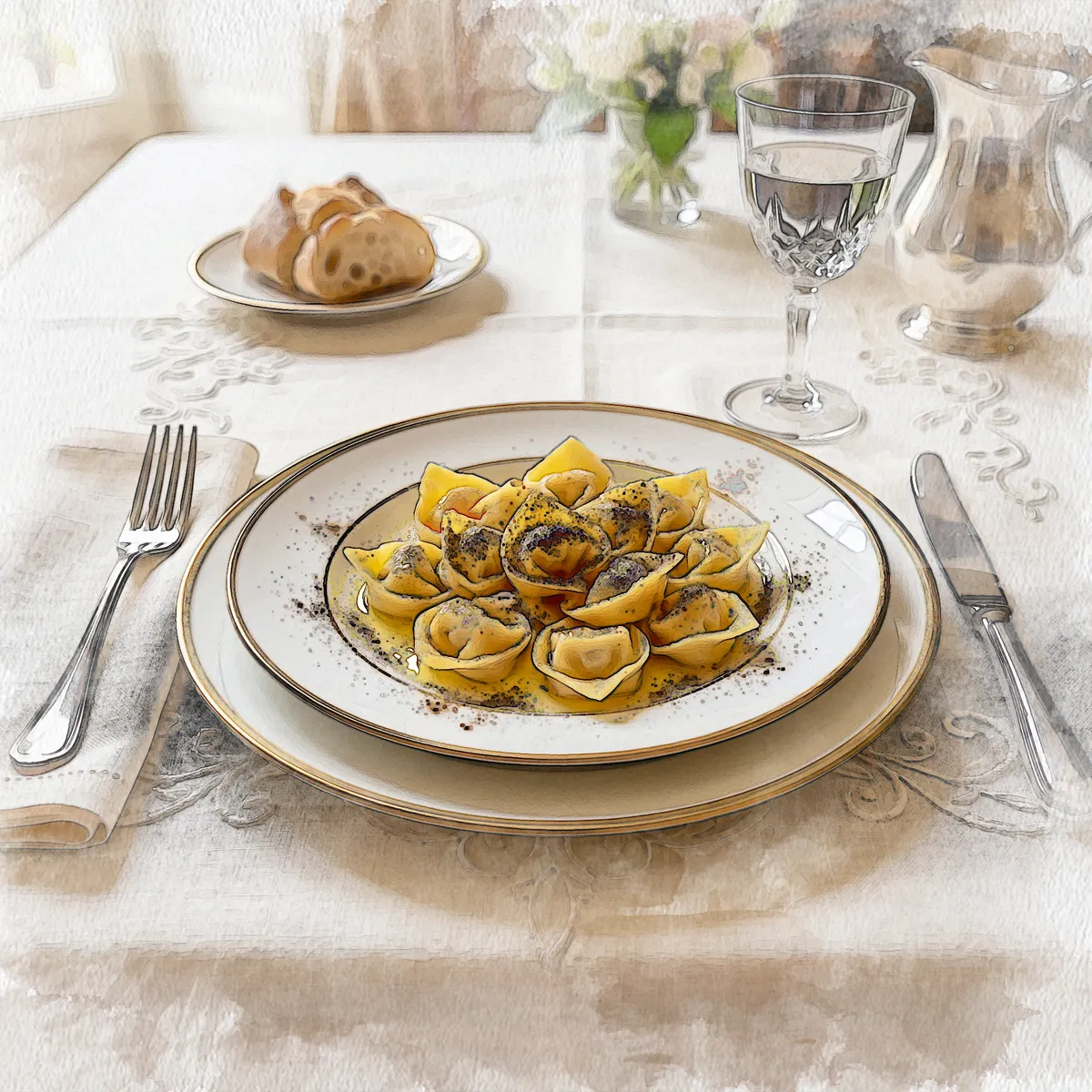
TORTELLETTI OF RICOTTA AND SUGAR
Sheep's milk ricotta, Type 00 flour, Eggs, Sugar, Cinnamon, Parmigiano Reggiano, Butter
A demanding pursuit
Lazio
A journey of ninety minutes
640 Kilocalories
TORTELLETTI OF RICOTTA AND SUGAR
Sheep's milk ricotta, Type 00 flour, Eggs, Sugar, Cinnamon, Parmigiano Reggiano, Butter
A demanding pursuit
Lazio
A journey of ninety minutes
640 Kilocalories
TORTELLETTI OF RICOTTA AND SUGAR
Sheep's milk ricotta, Type 00 flour, Eggs, Sugar, Cinnamon, Parmigiano Reggiano, Butter
A demanding pursuit
Lazio
A journey of ninety minutes
640 Kilocalories
GENESIS
The recipe for tortelletti with ricotta and sugar traces its historical origins back to the monumental treatise entitled "Opera dell'arte del cucinare," published in 1570 by Bartolomeo Scappi. Scappi, revered as one of the culinary titans of the Italian Renaissance, rendered his services to various cardinal courts and was the private chef to Pope Pius V. His magnum opus stands as a cornerstone of European gastronomy, cataloging hundreds of ingredients and culinary techniques while offering a detailed window into the noble cuisine of the sixteenth century. During this historical epoch, the palate of the Italian aristocracy was profoundly defined by the marriage of the sweet and the savory—a pairing that may seem unusual today, yet in that era represented the pinnacle of refinement and social distinction.
The deployment of spices, particularly cinnamon and sugar, was by no means confined solely to desserts, but was extended with grand artistery to pasta dishes, meat pies, and fish preparations. The tortelletti described by Scappi beautifully mirror this gastronomic aesthetic. Sheep's milk ricotta, characteristic of the Roman countryside and the Lazio region, forms the very soul of the filling, enriched by the savory depth of aged cheese and the aromatic crescendo of cinnamon and pepper. The preparation demands consummate manual mastery, especially in the rolling of the golden dough and the sealing of the small pasta parcels, which must be whisper-thin so as not to overpower the delicacy of their contents. These tortelletti were frequently presented at papal banquets or during sacred festivities, where the lavish abundance of sugar and butter bore testament to the elevated rank of the assembled guests. Today, this dish survives in a few regional variations that have preserved the memory of that Renaissance palate, offering a tasting experience that unites the milky creaminess of ricotta with the piquancy of spices and the sweet grace of its final dusting.
PORTIONS (FOR 4 PERSONS)
FOR THE PASTA
Flour 00
Medium eggs
200 g
2
FOR THE CREATION'S HEART
Fresh sheep's milk ricotta
Parmigiano Reggiano
Granulated sugar
Powdered cinnamon
Black pepper
Salt
250 g
50 g
40 g
1 teaspoon
1 pinch
To taste
FOR THE EMBELLISHMENT
Butter
Castor sugar
Powdered cinnamon
50 gr
30 gr
To taste
CURATION
For the fresh pasta:
Arrange the flour in a fountain traditional mound upon a wooden board, fashioning a hollow at its heart. Crack the eggs, pouring them into the center. With a fork, begin to whisk the eggs, gradually drawing the flour from the inner borders. As the mixture coheres, knead it with bare hands for some ten minutes, until it yields a dough that is smooth, elastic, and harmonious. Wrap this precious sphere in cling film and let it rest at room temperature for at least thirty minutes.For the filling:
Within a spacious bowl, pass the fresh sheep's milk ricotta through a sieve to render it creamy, smooth, and free of any grain. Bestow upon it the grated Parmigiano Reggiano, the granulated sugar, and the dust of ground cinnamon. Add a pinch of black pepper and salt to taste. Gently fold the elements together until they unite into a well-blended, fragrant filling. Transfer this preparation into a pastry bag or cover with cling film, and let it rest in the cool sanctuary of the refrigerator until needed.For the tortelletti:
Return to the rested dough and roll it out with a rolling pin or a pasta machine until you achieve a sheet of ethereal thinness. Using a pastry wheel or a sharp blade, carve squares of approximately 4 to 5 centimeters per side. Deposit a small dollop of the fragrant filling in the center of each square. Fold the square into a triangle, sealing the edges firmly with the pressure of your fingertips to ensure the filling remains encased during cooking. Join the two corners of the triangle's base to forge the classic form of the tortelletto. Arrange these crafted jewels upon a lightly floured tray.For the sauce:
In a wide pan, gently melt the butter over a low flame, ensuring it does not brown. In a small separate bowl, combine the granulated sugar with the cinnamon for the final adornment. Bring a pot of abundant salted water to a rolling boil. Gently immerse the tortelletti and cook them for but a few minutes, until they ascend to the surface. Lift them delicately with a slotted spoon and transfer them directly into the pan of melted butter. Toss the pasta for a fleeting moment, so that each piece is finely veiled in the golden butter.To serve:
Grace individual plates with the cooked tortelletti. Sprinkle them generously with the prepared alchemy of sugar and cinnamon. Serve immediately, while the pasta remains hot and the aromas are at their most vibrant.
aspiration
Ensure the ricotta is thoroughly drained of its whey before sifting, lest the filling be compromised by excess moisture.
Should the dough prove too dry whilst sealing, gently moisten the edges with a mere droplet of water.
You may substitute Parmigiano Reggiano with Fiore Sardo for a more robust character, remaining faithful to the culinary heritage of Lazio.
Employ cinnamon freshly ground from the quill to release a more enduring, evocative aroma.


GENESIS
The recipe for tortelletti with ricotta and sugar traces its historical origins back to the monumental treatise entitled "Opera dell'arte del cucinare," published in 1570 by Bartolomeo Scappi. Scappi, revered as one of the culinary titans of the Italian Renaissance, rendered his services to various cardinal courts and was the private chef to Pope Pius V. His magnum opus stands as a cornerstone of European gastronomy, cataloging hundreds of ingredients and culinary techniques while offering a detailed window into the noble cuisine of the sixteenth century. During this historical epoch, the palate of the Italian aristocracy was profoundly defined by the marriage of the sweet and the savory—a pairing that may seem unusual today, yet in that era represented the pinnacle of refinement and social distinction.
The deployment of spices, particularly cinnamon and sugar, was by no means confined solely to desserts, but was extended with grand artistery to pasta dishes, meat pies, and fish preparations. The tortelletti described by Scappi beautifully mirror this gastronomic aesthetic. Sheep's milk ricotta, characteristic of the Roman countryside and the Lazio region, forms the very soul of the filling, enriched by the savory depth of aged cheese and the aromatic crescendo of cinnamon and pepper. The preparation demands consummate manual mastery, especially in the rolling of the golden dough and the sealing of the small pasta parcels, which must be whisper-thin so as not to overpower the delicacy of their contents. These tortelletti were frequently presented at papal banquets or during sacred festivities, where the lavish abundance of sugar and butter bore testament to the elevated rank of the assembled guests. Today, this dish survives in a few regional variations that have preserved the memory of that Renaissance palate, offering a tasting experience that unites the milky creaminess of ricotta with the piquancy of spices and the sweet grace of its final dusting.
PORTIONS (FOR 4 PERSONS)
FOR THE PASTA
Flour 00
Medium eggs
200 g
2
FOR THE CREATION'S HEART
Fresh sheep's milk ricotta
Parmigiano Reggiano
Granulated sugar
Powdered cinnamon
Black pepper
Salt
250 g
50 g
40 g
1 teaspoon
1 pinch
To taste
FOR THE EMBELLISHMENT
Butter
Castor sugar
Powdered cinnamon
50 gr
30 gr
To taste
CURATION
For the fresh pasta:
Arrange the flour in a fountain traditional mound upon a wooden board, fashioning a hollow at its heart. Crack the eggs, pouring them into the center. With a fork, begin to whisk the eggs, gradually drawing the flour from the inner borders. As the mixture coheres, knead it with bare hands for some ten minutes, until it yields a dough that is smooth, elastic, and harmonious. Wrap this precious sphere in cling film and let it rest at room temperature for at least thirty minutes.For the filling:
Within a spacious bowl, pass the fresh sheep's milk ricotta through a sieve to render it creamy, smooth, and free of any grain. Bestow upon it the grated Parmigiano Reggiano, the granulated sugar, and the dust of ground cinnamon. Add a pinch of black pepper and salt to taste. Gently fold the elements together until they unite into a well-blended, fragrant filling. Transfer this preparation into a pastry bag or cover with cling film, and let it rest in the cool sanctuary of the refrigerator until needed.For the tortelletti:
Return to the rested dough and roll it out with a rolling pin or a pasta machine until you achieve a sheet of ethereal thinness. Using a pastry wheel or a sharp blade, carve squares of approximately 4 to 5 centimeters per side. Deposit a small dollop of the fragrant filling in the center of each square. Fold the square into a triangle, sealing the edges firmly with the pressure of your fingertips to ensure the filling remains encased during cooking. Join the two corners of the triangle's base to forge the classic form of the tortelletto. Arrange these crafted jewels upon a lightly floured tray.For the sauce:
In a wide pan, gently melt the butter over a low flame, ensuring it does not brown. In a small separate bowl, combine the granulated sugar with the cinnamon for the final adornment. Bring a pot of abundant salted water to a rolling boil. Gently immerse the tortelletti and cook them for but a few minutes, until they ascend to the surface. Lift them delicately with a slotted spoon and transfer them directly into the pan of melted butter. Toss the pasta for a fleeting moment, so that each piece is finely veiled in the golden butter.To serve:
Grace individual plates with the cooked tortelletti. Sprinkle them generously with the prepared alchemy of sugar and cinnamon. Serve immediately, while the pasta remains hot and the aromas are at their most vibrant.
aspiration
Ensure the ricotta is thoroughly drained of its whey before sifting, lest the filling be compromised by excess moisture.
Should the dough prove too dry whilst sealing, gently moisten the edges with a mere droplet of water.
You may substitute Parmigiano Reggiano with Fiore Sardo for a more robust character, remaining faithful to the culinary heritage of Lazio.
Employ cinnamon freshly ground from the quill to release a more enduring, evocative aroma.
latest culinary creations
GENESIS
The recipe for tortelletti with ricotta and sugar traces its historical origins back to the monumental treatise entitled "Opera dell'arte del cucinare," published in 1570 by Bartolomeo Scappi. Scappi, revered as one of the culinary titans of the Italian Renaissance, rendered his services to various cardinal courts and was the private chef to Pope Pius V. His magnum opus stands as a cornerstone of European gastronomy, cataloging hundreds of ingredients and culinary techniques while offering a detailed window into the noble cuisine of the sixteenth century. During this historical epoch, the palate of the Italian aristocracy was profoundly defined by the marriage of the sweet and the savory—a pairing that may seem unusual today, yet in that era represented the pinnacle of refinement and social distinction.
The deployment of spices, particularly cinnamon and sugar, was by no means confined solely to desserts, but was extended with grand artistery to pasta dishes, meat pies, and fish preparations. The tortelletti described by Scappi beautifully mirror this gastronomic aesthetic. Sheep's milk ricotta, characteristic of the Roman countryside and the Lazio region, forms the very soul of the filling, enriched by the savory depth of aged cheese and the aromatic crescendo of cinnamon and pepper. The preparation demands consummate manual mastery, especially in the rolling of the golden dough and the sealing of the small pasta parcels, which must be whisper-thin so as not to overpower the delicacy of their contents. These tortelletti were frequently presented at papal banquets or during sacred festivities, where the lavish abundance of sugar and butter bore testament to the elevated rank of the assembled guests. Today, this dish survives in a few regional variations that have preserved the memory of that Renaissance palate, offering a tasting experience that unites the milky creaminess of ricotta with the piquancy of spices and the sweet grace of its final dusting.
PORTIONS (FOR 4 PERSONS)
FOR THE PASTA
Flour 00
Medium eggs
200 g
2
FOR THE CREATION'S HEART
Fresh sheep's milk ricotta
Parmigiano Reggiano
Granulated sugar
Powdered cinnamon
Black pepper
Salt
250 g
50 g
40 g
1 teaspoon
1 pinch
To taste
FOR THE EMBELLISHMENT
Butter
Castor sugar
Powdered cinnamon
50 gr
30 gr
To taste
CURATION
For the fresh pasta:
Arrange the flour in a fountain traditional mound upon a wooden board, fashioning a hollow at its heart. Crack the eggs, pouring them into the center. With a fork, begin to whisk the eggs, gradually drawing the flour from the inner borders. As the mixture coheres, knead it with bare hands for some ten minutes, until it yields a dough that is smooth, elastic, and harmonious. Wrap this precious sphere in cling film and let it rest at room temperature for at least thirty minutes.For the filling:
Within a spacious bowl, pass the fresh sheep's milk ricotta through a sieve to render it creamy, smooth, and free of any grain. Bestow upon it the grated Parmigiano Reggiano, the granulated sugar, and the dust of ground cinnamon. Add a pinch of black pepper and salt to taste. Gently fold the elements together until they unite into a well-blended, fragrant filling. Transfer this preparation into a pastry bag or cover with cling film, and let it rest in the cool sanctuary of the refrigerator until needed.For the tortelletti:
Return to the rested dough and roll it out with a rolling pin or a pasta machine until you achieve a sheet of ethereal thinness. Using a pastry wheel or a sharp blade, carve squares of approximately 4 to 5 centimeters per side. Deposit a small dollop of the fragrant filling in the center of each square. Fold the square into a triangle, sealing the edges firmly with the pressure of your fingertips to ensure the filling remains encased during cooking. Join the two corners of the triangle's base to forge the classic form of the tortelletto. Arrange these crafted jewels upon a lightly floured tray.For the sauce:
In a wide pan, gently melt the butter over a low flame, ensuring it does not brown. In a small separate bowl, combine the granulated sugar with the cinnamon for the final adornment. Bring a pot of abundant salted water to a rolling boil. Gently immerse the tortelletti and cook them for but a few minutes, until they ascend to the surface. Lift them delicately with a slotted spoon and transfer them directly into the pan of melted butter. Toss the pasta for a fleeting moment, so that each piece is finely veiled in the golden butter.To serve:
Grace individual plates with the cooked tortelletti. Sprinkle them generously with the prepared alchemy of sugar and cinnamon. Serve immediately, while the pasta remains hot and the aromas are at their most vibrant.
aspiration
Ensure the ricotta is thoroughly drained of its whey before sifting, lest the filling be compromised by excess moisture.
Should the dough prove too dry whilst sealing, gently moisten the edges with a mere droplet of water.
You may substitute Parmigiano Reggiano with Fiore Sardo for a more robust character, remaining faithful to the culinary heritage of Lazio.
Employ cinnamon freshly ground from the quill to release a more enduring, evocative aroma.