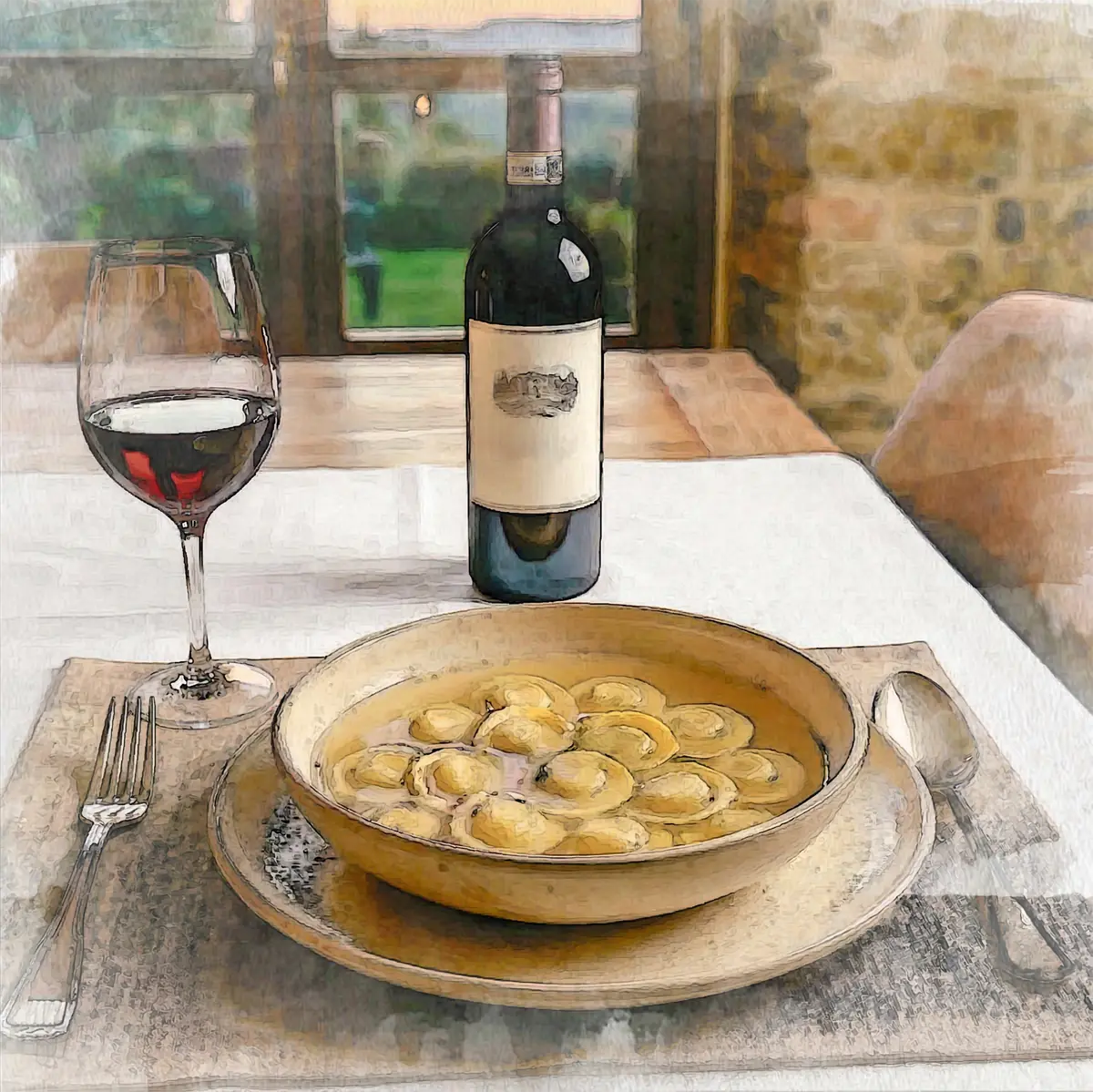
TORTELETI DE ENULA
Flour, Saffron, Pork loin, Elecampane leaves, Parmigiano Reggiano, Eggs, Pepper, Cinnamon, Ginger, Cloves, Beef broth
Moderate
Emilia-Romagna
A journey of ninety minutes
450 Kcal
TORTELETI DE ENULA
Flour, Saffron, Pork loin, Elecampane leaves, Parmigiano Reggiano, Eggs, Pepper, Cinnamon, Ginger, Cloves, Beef broth
Moderate
Emilia-Romagna
A journey of ninety minutes
450 Kcal
TORTELETI DE ENULA
Flour, Saffron, Pork loin, Elecampane leaves, Parmigiano Reggiano, Eggs, Pepper, Cinnamon, Ginger, Cloves, Beef broth
Moderate
Emilia-Romagna
A journey of ninety minutes
450 Kcal
GENESIS
The recipe for Tortelli of elecampane, also chronicled as "Torteleti de enula," stands as a fascinating and precious testament to the evolution of Italian gastronomy from its medieval cradle to the present day. Born from an anonymous manuscript of likely Venetian origin, penned between the twilight of the fourteenth and the dawn of the fifteenth century—now safely guarded within the Biblioteca Casanatense in Rome—this preparation illustrates with exquisite clarity the tenets of late medieval culinary art. A sovereign feature of that historical epoch was the creation of savory pies and their myriad miniature iterations, such as tortelli and ravioli, which were baked, fried, or gently poached in broth.
The very name of this dish is derived from the elecampane, botanically classified as Inula helenium, a plant belonging to the Asteraceae family that was once a familiar guest upon noble tables, yet is now almost entirely vanished from our contemporary culinary lexicon. Far removed from the rich egg pastas of the modern era, the sheath of these ancient tortelli was in all likelihood composed of a humble dough of soft wheat flour and water alone, to which saffron was introduced to bestow that signature golden hue, described in the original manual by the poetic expression "pasta zalla."
The filling offers a luminous window into the palate of the era, defined by the audacious counterpoint of meat—here, pork loin—with aged cheeses, fresh eggs, and a lavish abundance of spices. The required assortment of aromatics, characterized by the anonymous scribe as "fine and sweet," comprised pepper, cinnamon, ginger, cloves, and saffron, thereby testifying to the economic power and exalted social prestige closely bound to the consumption of these precious treasures of the Orient. The original measures called for spices equaling roughly one-twelfth of the meat's total weight, an opulent quantity that imbued the dish with a flavor both intensely bold and harmonious.
Below is the text of the original recipe, faithfully transcribed from the manuscript (Libro per cuoco – Biblioteca Casanatense of Rome, Codex No. 225):
"If thou wilt make tortelli of elecampane in broth, take capons or take of the beef for XII persons, take III pounds of pork loin and take three fine aged cheeses, and take three ounces of fine spices, sweet and strong mixed and well yellowed, and take two pence worth of elecampane and take XX eggs; and take the pork loin and set it to boil with the well-cleaned elecampane, and when it is well cooked, mince the loin and the elecampane together, but put not in all of the elecampane. Take the cheese that thou hast and grind it with the loin, and cast therein the spices and the eggs as much as sufficeth, and see that it taste not too much of elecampane, and stir all together and make a filling, and then make small tortelli in sheets of yellow pasta. These tortelli must be well golden and potent with spices.
Fine spices for all things.
Take one ounce of pepper and one of cinnamon and one of ginger and half a quarter of cloves and a quarter of saffron."
PORTIONS (FOR 4 PERSONS)
FOR THE PASTA
Soft wheat flour
Tepid water
Saffron
250 g
150 g
0.1 g
FOR THE CREATION'S HEART
Pork loin in a single, noble cut
Fresh leaves of elecampane
Grated Parmigiano Reggiano
Freshly gathered eggs
Freshly milled pepper
Ground cinnamon
Dry ground ginger
Saffron filaments
Ground cloves of intense aroma
160 g
60 g
100 g
3
4 g
4 g
4 g
1 g
0.5 g
FOR THE EMBELLISHMENT
Consommé of beef or of capon
To taste
CURATION
For the fresh pasta:
Arrange the flour in a sacred well upon your wooden board, and into its heart pour the warm water wherein you have previously dissolved the golden saffron. Begin to marry them with the aid of a fork, then resume kneading by hand until a smooth, harmonious dough is born. Let the sphere of pasta rest, cradled under a damp cloth in a cool sanctuary, for at least half an hour.For the filling:
Gather the leaves of the elecampane, discarding their coarser parts, and let them simmer in water alongside the pork loin for some 20 to 25 minutes. Once their culinary journey is complete, drain the ingredients, thoroughly wring the water from the elecampane leaves, and mince them finely with the meat. Place this mixture into a vessel, granting it the riches of shelled eggs, grated Parmigiano Reggiano, and the full symphony of spices (pepper, cinnamon, ginger, saffron, and cloves). Stir with devotion to harmonize every element.For the dressing and the shaping of the tortelli:
Stretch the dough with a rolling pin into a fine, ethereal sheet. Upon one half of this golden veil, deposit small, delicate mounds of filling spaced just over two centimeters apart, guided by a spoon or a piping bag. Fold the remaining half of the pasta over to cover them; should the dough prove too dry, gently moisten the borders around the spheres of filling with a brush dipped in water before sealing. Press firmly with your fingers, banishing all air from within. Now, carve the pasta into your desired form, letting them remain small and elegant; a circular pastry cutter about 2 centimeters in diameter will serve you beautifully. Gently immerse the tortelli into a rolling boil of rich beef or capon broth. Allow them to rise gracefully to the surface before extinguishing the flame, and serve them steaming hot in a deep, welcoming bowl.
aspiration
Should fresh elecampane elude your harvest, you may substitute it with another wild herb of gently herbaceous and pleasantly bitter notes, such as the leaves of the dandelion.
Ensure you express every drop of moisture from the boiled greens before marrying them with the meat, lest the excess water render the filling too humid, compromising the sacred seal of the pasta.
Prepare a rich, deeply flavored homemade meat broth, for it is the principal elixir destined to elevate the spiced aromas of the dish.


GENESIS
The recipe for Tortelli of elecampane, also chronicled as "Torteleti de enula," stands as a fascinating and precious testament to the evolution of Italian gastronomy from its medieval cradle to the present day. Born from an anonymous manuscript of likely Venetian origin, penned between the twilight of the fourteenth and the dawn of the fifteenth century—now safely guarded within the Biblioteca Casanatense in Rome—this preparation illustrates with exquisite clarity the tenets of late medieval culinary art. A sovereign feature of that historical epoch was the creation of savory pies and their myriad miniature iterations, such as tortelli and ravioli, which were baked, fried, or gently poached in broth.
The very name of this dish is derived from the elecampane, botanically classified as Inula helenium, a plant belonging to the Asteraceae family that was once a familiar guest upon noble tables, yet is now almost entirely vanished from our contemporary culinary lexicon. Far removed from the rich egg pastas of the modern era, the sheath of these ancient tortelli was in all likelihood composed of a humble dough of soft wheat flour and water alone, to which saffron was introduced to bestow that signature golden hue, described in the original manual by the poetic expression "pasta zalla."
The filling offers a luminous window into the palate of the era, defined by the audacious counterpoint of meat—here, pork loin—with aged cheeses, fresh eggs, and a lavish abundance of spices. The required assortment of aromatics, characterized by the anonymous scribe as "fine and sweet," comprised pepper, cinnamon, ginger, cloves, and saffron, thereby testifying to the economic power and exalted social prestige closely bound to the consumption of these precious treasures of the Orient. The original measures called for spices equaling roughly one-twelfth of the meat's total weight, an opulent quantity that imbued the dish with a flavor both intensely bold and harmonious.
Below is the text of the original recipe, faithfully transcribed from the manuscript (Libro per cuoco – Biblioteca Casanatense of Rome, Codex No. 225):
"If thou wilt make tortelli of elecampane in broth, take capons or take of the beef for XII persons, take III pounds of pork loin and take three fine aged cheeses, and take three ounces of fine spices, sweet and strong mixed and well yellowed, and take two pence worth of elecampane and take XX eggs; and take the pork loin and set it to boil with the well-cleaned elecampane, and when it is well cooked, mince the loin and the elecampane together, but put not in all of the elecampane. Take the cheese that thou hast and grind it with the loin, and cast therein the spices and the eggs as much as sufficeth, and see that it taste not too much of elecampane, and stir all together and make a filling, and then make small tortelli in sheets of yellow pasta. These tortelli must be well golden and potent with spices.
Fine spices for all things.
Take one ounce of pepper and one of cinnamon and one of ginger and half a quarter of cloves and a quarter of saffron."
PORTIONS (FOR 4 PERSONS)
FOR THE PASTA
Soft wheat flour
Tepid water
Saffron
250 g
150 g
0.1 g
FOR THE CREATION'S HEART
Pork loin in a single, noble cut
Fresh leaves of elecampane
Grated Parmigiano Reggiano
Freshly gathered eggs
Freshly milled pepper
Ground cinnamon
Dry ground ginger
Saffron filaments
Ground cloves of intense aroma
160 g
60 g
100 g
3
4 g
4 g
4 g
1 g
0.5 g
FOR THE EMBELLISHMENT
Consommé of beef or of capon
To taste
CURATION
For the fresh pasta:
Arrange the flour in a sacred well upon your wooden board, and into its heart pour the warm water wherein you have previously dissolved the golden saffron. Begin to marry them with the aid of a fork, then resume kneading by hand until a smooth, harmonious dough is born. Let the sphere of pasta rest, cradled under a damp cloth in a cool sanctuary, for at least half an hour.For the filling:
Gather the leaves of the elecampane, discarding their coarser parts, and let them simmer in water alongside the pork loin for some 20 to 25 minutes. Once their culinary journey is complete, drain the ingredients, thoroughly wring the water from the elecampane leaves, and mince them finely with the meat. Place this mixture into a vessel, granting it the riches of shelled eggs, grated Parmigiano Reggiano, and the full symphony of spices (pepper, cinnamon, ginger, saffron, and cloves). Stir with devotion to harmonize every element.For the dressing and the shaping of the tortelli:
Stretch the dough with a rolling pin into a fine, ethereal sheet. Upon one half of this golden veil, deposit small, delicate mounds of filling spaced just over two centimeters apart, guided by a spoon or a piping bag. Fold the remaining half of the pasta over to cover them; should the dough prove too dry, gently moisten the borders around the spheres of filling with a brush dipped in water before sealing. Press firmly with your fingers, banishing all air from within. Now, carve the pasta into your desired form, letting them remain small and elegant; a circular pastry cutter about 2 centimeters in diameter will serve you beautifully. Gently immerse the tortelli into a rolling boil of rich beef or capon broth. Allow them to rise gracefully to the surface before extinguishing the flame, and serve them steaming hot in a deep, welcoming bowl.
aspiration
Should fresh elecampane elude your harvest, you may substitute it with another wild herb of gently herbaceous and pleasantly bitter notes, such as the leaves of the dandelion.
Ensure you express every drop of moisture from the boiled greens before marrying them with the meat, lest the excess water render the filling too humid, compromising the sacred seal of the pasta.
Prepare a rich, deeply flavored homemade meat broth, for it is the principal elixir destined to elevate the spiced aromas of the dish.
latest culinary creations
GENESIS
The recipe for Tortelli of elecampane, also chronicled as "Torteleti de enula," stands as a fascinating and precious testament to the evolution of Italian gastronomy from its medieval cradle to the present day. Born from an anonymous manuscript of likely Venetian origin, penned between the twilight of the fourteenth and the dawn of the fifteenth century—now safely guarded within the Biblioteca Casanatense in Rome—this preparation illustrates with exquisite clarity the tenets of late medieval culinary art. A sovereign feature of that historical epoch was the creation of savory pies and their myriad miniature iterations, such as tortelli and ravioli, which were baked, fried, or gently poached in broth.
The very name of this dish is derived from the elecampane, botanically classified as Inula helenium, a plant belonging to the Asteraceae family that was once a familiar guest upon noble tables, yet is now almost entirely vanished from our contemporary culinary lexicon. Far removed from the rich egg pastas of the modern era, the sheath of these ancient tortelli was in all likelihood composed of a humble dough of soft wheat flour and water alone, to which saffron was introduced to bestow that signature golden hue, described in the original manual by the poetic expression "pasta zalla."
The filling offers a luminous window into the palate of the era, defined by the audacious counterpoint of meat—here, pork loin—with aged cheeses, fresh eggs, and a lavish abundance of spices. The required assortment of aromatics, characterized by the anonymous scribe as "fine and sweet," comprised pepper, cinnamon, ginger, cloves, and saffron, thereby testifying to the economic power and exalted social prestige closely bound to the consumption of these precious treasures of the Orient. The original measures called for spices equaling roughly one-twelfth of the meat's total weight, an opulent quantity that imbued the dish with a flavor both intensely bold and harmonious.
Below is the text of the original recipe, faithfully transcribed from the manuscript (Libro per cuoco – Biblioteca Casanatense of Rome, Codex No. 225):
"If thou wilt make tortelli of elecampane in broth, take capons or take of the beef for XII persons, take III pounds of pork loin and take three fine aged cheeses, and take three ounces of fine spices, sweet and strong mixed and well yellowed, and take two pence worth of elecampane and take XX eggs; and take the pork loin and set it to boil with the well-cleaned elecampane, and when it is well cooked, mince the loin and the elecampane together, but put not in all of the elecampane. Take the cheese that thou hast and grind it with the loin, and cast therein the spices and the eggs as much as sufficeth, and see that it taste not too much of elecampane, and stir all together and make a filling, and then make small tortelli in sheets of yellow pasta. These tortelli must be well golden and potent with spices.
Fine spices for all things.
Take one ounce of pepper and one of cinnamon and one of ginger and half a quarter of cloves and a quarter of saffron."
PORTIONS (FOR 4 PERSONS)
FOR THE PASTA
Soft wheat flour
Tepid water
Saffron
250 g
150 g
0.1 g
FOR THE CREATION'S HEART
Pork loin in a single, noble cut
Fresh leaves of elecampane
Grated Parmigiano Reggiano
Freshly gathered eggs
Freshly milled pepper
Ground cinnamon
Dry ground ginger
Saffron filaments
Ground cloves of intense aroma
160 g
60 g
100 g
3
4 g
4 g
4 g
1 g
0.5 g
FOR THE EMBELLISHMENT
Consommé of beef or of capon
To taste
CURATION
For the fresh pasta:
Arrange the flour in a sacred well upon your wooden board, and into its heart pour the warm water wherein you have previously dissolved the golden saffron. Begin to marry them with the aid of a fork, then resume kneading by hand until a smooth, harmonious dough is born. Let the sphere of pasta rest, cradled under a damp cloth in a cool sanctuary, for at least half an hour.For the filling:
Gather the leaves of the elecampane, discarding their coarser parts, and let them simmer in water alongside the pork loin for some 20 to 25 minutes. Once their culinary journey is complete, drain the ingredients, thoroughly wring the water from the elecampane leaves, and mince them finely with the meat. Place this mixture into a vessel, granting it the riches of shelled eggs, grated Parmigiano Reggiano, and the full symphony of spices (pepper, cinnamon, ginger, saffron, and cloves). Stir with devotion to harmonize every element.For the dressing and the shaping of the tortelli:
Stretch the dough with a rolling pin into a fine, ethereal sheet. Upon one half of this golden veil, deposit small, delicate mounds of filling spaced just over two centimeters apart, guided by a spoon or a piping bag. Fold the remaining half of the pasta over to cover them; should the dough prove too dry, gently moisten the borders around the spheres of filling with a brush dipped in water before sealing. Press firmly with your fingers, banishing all air from within. Now, carve the pasta into your desired form, letting them remain small and elegant; a circular pastry cutter about 2 centimeters in diameter will serve you beautifully. Gently immerse the tortelli into a rolling boil of rich beef or capon broth. Allow them to rise gracefully to the surface before extinguishing the flame, and serve them steaming hot in a deep, welcoming bowl.
aspiration
Should fresh elecampane elude your harvest, you may substitute it with another wild herb of gently herbaceous and pleasantly bitter notes, such as the leaves of the dandelion.
Ensure you express every drop of moisture from the boiled greens before marrying them with the meat, lest the excess water render the filling too humid, compromising the sacred seal of the pasta.
Prepare a rich, deeply flavored homemade meat broth, for it is the principal elixir destined to elevate the spiced aromas of the dish.