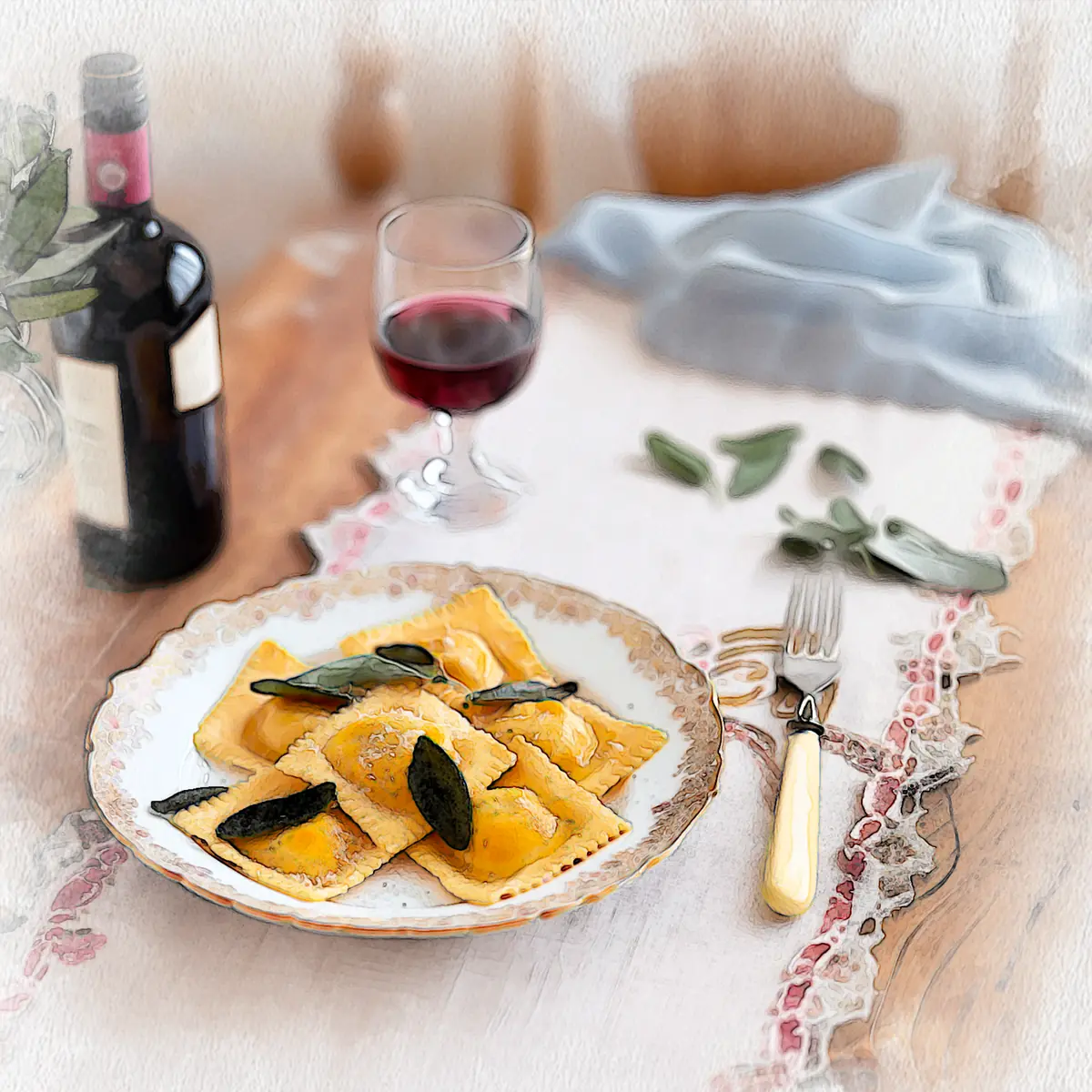
MANTOVAN PUMPKIN TORTELLI
Mantuan Pumpkin, Amaretti, Mostarda of Mantua, Parmigiano Reggiano, Flour, Eggs
A demanding pursuit
Lombardy
120 minutes
550 Kcal
MANTOVAN PUMPKIN TORTELLI
Mantuan Pumpkin, Amaretti, Mostarda of Mantua, Parmigiano Reggiano, Flour, Eggs
A demanding pursuit
Lombardy
120 minutes
550 Kcal
MANTOVAN PUMPKIN TORTELLI
Mantuan Pumpkin, Amaretti, Mostarda of Mantua, Parmigiano Reggiano, Flour, Eggs
A demanding pursuit
Lombardy
120 minutes
550 Kcal
GENESIS
Mantuan pumpkin tortelli stand as a true and noble symbol of Lombardy's culinary heritage, particularly of the city of Mantua and its surrounding lands.
Their history traces its roots deep into a distant past, an era when the kitchen was governed by the rhythms of the seasons and the simple bounty of the local earth.
The pumpkin, cultivated in abundance across the Mantuan countryside, soon became a foundational element, prized for its natural sweetness and versatile grace.
The origin of these pumpkin tortelli is veiled in legends and lore, yet it remains certain that this dish has journeyed through the centuries, evolving and refining its essence. In the beginning, the recipe was likely simpler, perhaps crafted with fewer ingredients and a more rustic hand. Over time, the introduction of amaretti, fruit mostarda, and nutmeg bestowed upon the tortelli that unmistakable sweet-savory and spiced character, rendering them peerless within the Italian gastronomic landscape.
This symphony of flavors, seemingly unorthodox, is indeed the secret of their enduring triumph. The gentle sweetness of the pumpkin marries exquisitely with the bitter nuance of the amaretti, the piquant whisper of the mostarda, and the fragrant warmth of the nutmeg, orchestrating a harmonious and surprisingly sublime sensory balance.
PORTIONS (FOR 4 PERSONS)
FOR THE PASTA
Flour 00
Medium eggs
300 g
3
FOR THE CREATION'S HEART
Flesh of the Mantuan pumpkin
Crisp amaretti biscuits
Mantuan fruit mostarda
Parmigiano Reggiano
Grated zest
Nutmeg
Salt
500 g
100 g
50 g
100 g
1 organic lemon
to taste
to taste
FOR THE SEASONING
Butter
Parmigiano Reggiano
Fresh sage leaves
100 g
50 g
to taste
CURATION
For the Farce:
Begin the creation of your tortelli by coaxing forth the filling, a sacred process requiring time and devotion. Slice the pumpkin, stripping away its seeds and internal fibers. Place the golden wedges upon a baking sheet lined with parchment paper, committing them to a preheated oven at 180°C for some 30 to 40 minutes, until the flesh yields in tender submission. Once baked, allow it to cool slightly, then gently scoop out the pulp with a spoon. Pass it through a potato ricer or press with a fork to coax it into a silken, smooth puree. Let this golden essence cool completely, preferably spread upon a wide platter to allow the excess moisture to escape into the ether.
Meanwhile, finely crush the amaretti crisp macaroons and the historic Mostarda di Mantova (of mixed fruits or solely of pears). In a vessel of generous proportions, marry the cooled, dry pumpkin puree with the crushed amaretti, the finely chopped mostarda, grated Parmigiano Reggiano, the freshly rasped zest of a lemon, and a generous grating of warm nutmeg. Entwine these ingredients with devotion until a harmonious, compact union is achieved. Taste, and let salt correct the balance. The filling must sing with a precise alchemy of sweet and sour. Cover the vessel to seal its secrets and rest it in the chill of the refrigerator for at least 30 minutes, allowing the flavors to fuse and deepen.For the Sacred Pasta:
While the filling rests in quiet contemplation, turn your hands to the creation of the fresh pasta. Upon a wooden kneading board or in a spacious bowl, shape the flour into a classic well. Place the eggs into this hollowed heart and, with the aid of a fork, begin to whisk them, gradually drawing in the flour from the perimeter. As the dough gathers mass and purpose, begin to knead with your hands for 10 to 15 minutes, until you obtain a ball of dough that is supple, smooth, and resilient. Should it prove too sticky, bestow upon it a dusting of flour; if too parched, a few drops of water. Wrap the dough in plastic film and let it rest undisturbed at room temperature for at least 30 minutes.For the Sculpting of the Tortelli:
Once the resting time has elapsed, divide the dough into small portions. Roll each portion with a pasta machine or a classic rolling pin, drawing it out into delicate, translucent sheets, about 1 to 2 millimeters in thickness. If summoning the aid of the machine, pass the dough through repeatedly, gradually lessening the gap to refine its thinness.
Once the sheets are spread before you, place small, elegant mounds of filling upon one half of the dough, spacing them about 3 to 4 centimeters apart. The ideal portion for each tortello is a generous teaspoon. Fold the remaining half of the sheet over the filling, ensuring the edges align. With careful fingers, press around each mound to expel any trapped air, sealing the pockets shut. With a fluted pastry wheel, cut the tortelli into their traditional form, usually square or rectangular, bordered by festive scalloped edges. Seal the seams of each pocket securely with your fingertips or the tines of a fork, lest the precious filling escape during the ritual of cooking. Lay the completed tortelli upon a floured tray, taking care they do not touch, and drape them in a clean linen cloth to keep them from drying.For the Condiment:
In a wide, shallow pan, allow the butter to melt over a gentle, whispering flame. Add the fresh green sage leaves, letting them steep for a few minutes until the butter blooms into a rich golden hue, releasing an intoxicating, toasted perfume. Guard it closely, ensuring the butter does not burn.For the Sacred Bath:
Bring a generous pot of salted water to a rolling boil. Gently entrust the tortelli to the bubbling depths and cook them for a few fleeting minutes, typically 3 to 5, until they rise triumphantly to the surface, the pasta cooked perfectly al dente. Guard against overcooking, that the delicate envelope does not break.
Lift them gently from the water with a slotted spoon, transferring them directly into the pan holding the golden, sage-scented butter. Toss the tortelli for a minute or two, stirring with utmost gentleness to bathe each piece in this simple, glorious nectar.
Serve these tortelli di zucca piping hot, offering them to your guests with a lavish snowfall of freshly grated Parmigiano Reggiano.
aspiration
For a filling of greater depth and character, you may introduce a whisper of freshly cracked black pepper.
Should the traditional fruit mostarda be absent, it may be omitted; yet, know that the filling will lose its singular complexity and ancestral distinction.
To invite a subtle, texturising crunch, the amaretti may be gently toasted before they are finely crumbled.


GENESIS
Mantuan pumpkin tortelli stand as a true and noble symbol of Lombardy's culinary heritage, particularly of the city of Mantua and its surrounding lands.
Their history traces its roots deep into a distant past, an era when the kitchen was governed by the rhythms of the seasons and the simple bounty of the local earth.
The pumpkin, cultivated in abundance across the Mantuan countryside, soon became a foundational element, prized for its natural sweetness and versatile grace.
The origin of these pumpkin tortelli is veiled in legends and lore, yet it remains certain that this dish has journeyed through the centuries, evolving and refining its essence. In the beginning, the recipe was likely simpler, perhaps crafted with fewer ingredients and a more rustic hand. Over time, the introduction of amaretti, fruit mostarda, and nutmeg bestowed upon the tortelli that unmistakable sweet-savory and spiced character, rendering them peerless within the Italian gastronomic landscape.
This symphony of flavors, seemingly unorthodox, is indeed the secret of their enduring triumph. The gentle sweetness of the pumpkin marries exquisitely with the bitter nuance of the amaretti, the piquant whisper of the mostarda, and the fragrant warmth of the nutmeg, orchestrating a harmonious and surprisingly sublime sensory balance.
PORTIONS (FOR 4 PERSONS)
FOR THE PASTA
Flour 00
Medium eggs
300 g
3
FOR THE CREATION'S HEART
Flesh of the Mantuan pumpkin
Crisp amaretti biscuits
Mantuan fruit mostarda
Parmigiano Reggiano
Grated zest
Nutmeg
Salt
500 g
100 g
50 g
100 g
1 organic lemon
to taste
to taste
FOR THE SEASONING
Butter
Parmigiano Reggiano
Fresh sage leaves
100 g
50 g
to taste
CURATION
For the Farce:
Begin the creation of your tortelli by coaxing forth the filling, a sacred process requiring time and devotion. Slice the pumpkin, stripping away its seeds and internal fibers. Place the golden wedges upon a baking sheet lined with parchment paper, committing them to a preheated oven at 180°C for some 30 to 40 minutes, until the flesh yields in tender submission. Once baked, allow it to cool slightly, then gently scoop out the pulp with a spoon. Pass it through a potato ricer or press with a fork to coax it into a silken, smooth puree. Let this golden essence cool completely, preferably spread upon a wide platter to allow the excess moisture to escape into the ether.
Meanwhile, finely crush the amaretti crisp macaroons and the historic Mostarda di Mantova (of mixed fruits or solely of pears). In a vessel of generous proportions, marry the cooled, dry pumpkin puree with the crushed amaretti, the finely chopped mostarda, grated Parmigiano Reggiano, the freshly rasped zest of a lemon, and a generous grating of warm nutmeg. Entwine these ingredients with devotion until a harmonious, compact union is achieved. Taste, and let salt correct the balance. The filling must sing with a precise alchemy of sweet and sour. Cover the vessel to seal its secrets and rest it in the chill of the refrigerator for at least 30 minutes, allowing the flavors to fuse and deepen.For the Sacred Pasta:
While the filling rests in quiet contemplation, turn your hands to the creation of the fresh pasta. Upon a wooden kneading board or in a spacious bowl, shape the flour into a classic well. Place the eggs into this hollowed heart and, with the aid of a fork, begin to whisk them, gradually drawing in the flour from the perimeter. As the dough gathers mass and purpose, begin to knead with your hands for 10 to 15 minutes, until you obtain a ball of dough that is supple, smooth, and resilient. Should it prove too sticky, bestow upon it a dusting of flour; if too parched, a few drops of water. Wrap the dough in plastic film and let it rest undisturbed at room temperature for at least 30 minutes.For the Sculpting of the Tortelli:
Once the resting time has elapsed, divide the dough into small portions. Roll each portion with a pasta machine or a classic rolling pin, drawing it out into delicate, translucent sheets, about 1 to 2 millimeters in thickness. If summoning the aid of the machine, pass the dough through repeatedly, gradually lessening the gap to refine its thinness.
Once the sheets are spread before you, place small, elegant mounds of filling upon one half of the dough, spacing them about 3 to 4 centimeters apart. The ideal portion for each tortello is a generous teaspoon. Fold the remaining half of the sheet over the filling, ensuring the edges align. With careful fingers, press around each mound to expel any trapped air, sealing the pockets shut. With a fluted pastry wheel, cut the tortelli into their traditional form, usually square or rectangular, bordered by festive scalloped edges. Seal the seams of each pocket securely with your fingertips or the tines of a fork, lest the precious filling escape during the ritual of cooking. Lay the completed tortelli upon a floured tray, taking care they do not touch, and drape them in a clean linen cloth to keep them from drying.For the Condiment:
In a wide, shallow pan, allow the butter to melt over a gentle, whispering flame. Add the fresh green sage leaves, letting them steep for a few minutes until the butter blooms into a rich golden hue, releasing an intoxicating, toasted perfume. Guard it closely, ensuring the butter does not burn.For the Sacred Bath:
Bring a generous pot of salted water to a rolling boil. Gently entrust the tortelli to the bubbling depths and cook them for a few fleeting minutes, typically 3 to 5, until they rise triumphantly to the surface, the pasta cooked perfectly al dente. Guard against overcooking, that the delicate envelope does not break.
Lift them gently from the water with a slotted spoon, transferring them directly into the pan holding the golden, sage-scented butter. Toss the tortelli for a minute or two, stirring with utmost gentleness to bathe each piece in this simple, glorious nectar.
Serve these tortelli di zucca piping hot, offering them to your guests with a lavish snowfall of freshly grated Parmigiano Reggiano.
aspiration
For a filling of greater depth and character, you may introduce a whisper of freshly cracked black pepper.
Should the traditional fruit mostarda be absent, it may be omitted; yet, know that the filling will lose its singular complexity and ancestral distinction.
To invite a subtle, texturising crunch, the amaretti may be gently toasted before they are finely crumbled.
latest culinary creations
GENESIS
Mantuan pumpkin tortelli stand as a true and noble symbol of Lombardy's culinary heritage, particularly of the city of Mantua and its surrounding lands.
Their history traces its roots deep into a distant past, an era when the kitchen was governed by the rhythms of the seasons and the simple bounty of the local earth.
The pumpkin, cultivated in abundance across the Mantuan countryside, soon became a foundational element, prized for its natural sweetness and versatile grace.
The origin of these pumpkin tortelli is veiled in legends and lore, yet it remains certain that this dish has journeyed through the centuries, evolving and refining its essence. In the beginning, the recipe was likely simpler, perhaps crafted with fewer ingredients and a more rustic hand. Over time, the introduction of amaretti, fruit mostarda, and nutmeg bestowed upon the tortelli that unmistakable sweet-savory and spiced character, rendering them peerless within the Italian gastronomic landscape.
This symphony of flavors, seemingly unorthodox, is indeed the secret of their enduring triumph. The gentle sweetness of the pumpkin marries exquisitely with the bitter nuance of the amaretti, the piquant whisper of the mostarda, and the fragrant warmth of the nutmeg, orchestrating a harmonious and surprisingly sublime sensory balance.
PORTIONS (FOR 4 PERSONS)
FOR THE PASTA
Flour 00
Medium eggs
300 g
3
FOR THE CREATION'S HEART
Flesh of the Mantuan pumpkin
Crisp amaretti biscuits
Mantuan fruit mostarda
Parmigiano Reggiano
Grated zest
Nutmeg
Salt
500 g
100 g
50 g
100 g
1 organic lemon
to taste
to taste
FOR THE SEASONING
Butter
Parmigiano Reggiano
Fresh sage leaves
100 g
50 g
to taste
CURATION
For the Farce:
Begin the creation of your tortelli by coaxing forth the filling, a sacred process requiring time and devotion. Slice the pumpkin, stripping away its seeds and internal fibers. Place the golden wedges upon a baking sheet lined with parchment paper, committing them to a preheated oven at 180°C for some 30 to 40 minutes, until the flesh yields in tender submission. Once baked, allow it to cool slightly, then gently scoop out the pulp with a spoon. Pass it through a potato ricer or press with a fork to coax it into a silken, smooth puree. Let this golden essence cool completely, preferably spread upon a wide platter to allow the excess moisture to escape into the ether.
Meanwhile, finely crush the amaretti crisp macaroons and the historic Mostarda di Mantova (of mixed fruits or solely of pears). In a vessel of generous proportions, marry the cooled, dry pumpkin puree with the crushed amaretti, the finely chopped mostarda, grated Parmigiano Reggiano, the freshly rasped zest of a lemon, and a generous grating of warm nutmeg. Entwine these ingredients with devotion until a harmonious, compact union is achieved. Taste, and let salt correct the balance. The filling must sing with a precise alchemy of sweet and sour. Cover the vessel to seal its secrets and rest it in the chill of the refrigerator for at least 30 minutes, allowing the flavors to fuse and deepen.For the Sacred Pasta:
While the filling rests in quiet contemplation, turn your hands to the creation of the fresh pasta. Upon a wooden kneading board or in a spacious bowl, shape the flour into a classic well. Place the eggs into this hollowed heart and, with the aid of a fork, begin to whisk them, gradually drawing in the flour from the perimeter. As the dough gathers mass and purpose, begin to knead with your hands for 10 to 15 minutes, until you obtain a ball of dough that is supple, smooth, and resilient. Should it prove too sticky, bestow upon it a dusting of flour; if too parched, a few drops of water. Wrap the dough in plastic film and let it rest undisturbed at room temperature for at least 30 minutes.For the Sculpting of the Tortelli:
Once the resting time has elapsed, divide the dough into small portions. Roll each portion with a pasta machine or a classic rolling pin, drawing it out into delicate, translucent sheets, about 1 to 2 millimeters in thickness. If summoning the aid of the machine, pass the dough through repeatedly, gradually lessening the gap to refine its thinness.
Once the sheets are spread before you, place small, elegant mounds of filling upon one half of the dough, spacing them about 3 to 4 centimeters apart. The ideal portion for each tortello is a generous teaspoon. Fold the remaining half of the sheet over the filling, ensuring the edges align. With careful fingers, press around each mound to expel any trapped air, sealing the pockets shut. With a fluted pastry wheel, cut the tortelli into their traditional form, usually square or rectangular, bordered by festive scalloped edges. Seal the seams of each pocket securely with your fingertips or the tines of a fork, lest the precious filling escape during the ritual of cooking. Lay the completed tortelli upon a floured tray, taking care they do not touch, and drape them in a clean linen cloth to keep them from drying.For the Condiment:
In a wide, shallow pan, allow the butter to melt over a gentle, whispering flame. Add the fresh green sage leaves, letting them steep for a few minutes until the butter blooms into a rich golden hue, releasing an intoxicating, toasted perfume. Guard it closely, ensuring the butter does not burn.For the Sacred Bath:
Bring a generous pot of salted water to a rolling boil. Gently entrust the tortelli to the bubbling depths and cook them for a few fleeting minutes, typically 3 to 5, until they rise triumphantly to the surface, the pasta cooked perfectly al dente. Guard against overcooking, that the delicate envelope does not break.
Lift them gently from the water with a slotted spoon, transferring them directly into the pan holding the golden, sage-scented butter. Toss the tortelli for a minute or two, stirring with utmost gentleness to bathe each piece in this simple, glorious nectar.
Serve these tortelli di zucca piping hot, offering them to your guests with a lavish snowfall of freshly grated Parmigiano Reggiano.
aspiration
For a filling of greater depth and character, you may introduce a whisper of freshly cracked black pepper.
Should the traditional fruit mostarda be absent, it may be omitted; yet, know that the filling will lose its singular complexity and ancestral distinction.
To invite a subtle, texturising crunch, the amaretti may be gently toasted before they are finely crumbled.