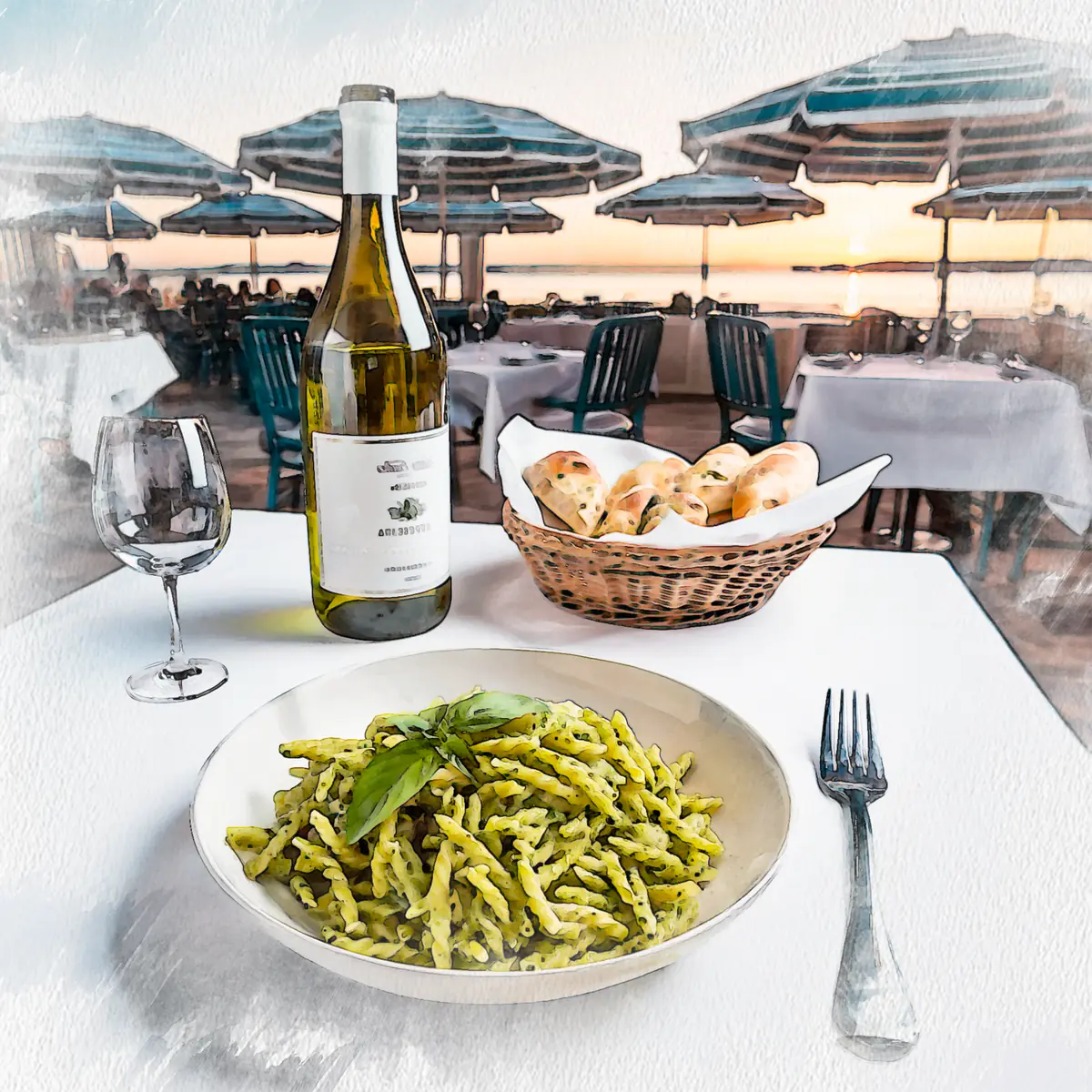
TROFIE ENRICHED WITH GENOVESE PESTO OF ANTIQUE TRADITION
Trofie, Genoese Basil PDO, Pine Nuts, Parmigiano Reggiano, Sardinian Pecorino, Garlic, Potatoes, Green Beans.
Moderate
Liguria
A journey of ninety minutes
680 Kcal
TROFIE ENRICHED WITH GENOVESE PESTO OF ANTIQUE TRADITION
Trofie, Genoese Basil PDO, Pine Nuts, Parmigiano Reggiano, Sardinian Pecorino, Garlic, Potatoes, Green Beans.
Moderate
Liguria
A journey of ninety minutes
680 Kcal
TROFIE ENRICHED WITH GENOVESE PESTO OF ANTIQUE TRADITION
Trofie, Genoese Basil PDO, Pine Nuts, Parmigiano Reggiano, Sardinian Pecorino, Garlic, Potatoes, Green Beans.
Moderate
Liguria
A journey of ninety minutes
680 Kcal
GENESIS
Trofie al Pesto Genovese Avvantaggiato is a sublime expression of Ligurian gastronomy, a dish that embodies the sacred tradition and ingenuity of this coastal land. The term "avvantaggiato" (in the local dialect, "avvantaggè") signifies "enriched" or "improved," denoting in this culinary context the poetic inclusion of potatoes and green beans, simmered in unison with the pasta. This ancient practice not only bestows a noble wholeness and a tapestry of textures upon the dish, but also traces its origin to a rustic heritage of thrift and agrarian wisdom, where a nourishing repast was artfully conjured from the treasures of the kitchen garden.
The history of pesto, the verdant heart of this creation, is ancient and rich with aroma. It is said to descend from "agliata," a medieval sauce of crushed garlic that sustained Ligurian seafarers. Yet, it was with the arrival of basil, thriving and fragrant under the coastal sun, that pesto was born in its true splendor. The word "pesto" speaks directly of its creation: the ingredients are gently crushed in a traditional marble mortar with a wooden pestle, an artisanal ritual that coaxes forth the precious essential oils and souls of the ingredients. The first official recipe appeared in the 19th century, enshrining the communion of Basilico Genovese DOP, pine nuts, Parmigiano Reggiano, Pecorino Sardo, garlic, extra virgin olive oil, and coarse sea salt.
The "avvantaggiata" variant is deeply cherished across Liguria, revered by purists as the most authentic and complete manner in which to honor trofie with pesto. The potatoes, yielding tenderly during the boil, release their starches to weave a velvety creaminess once enfolded by the emerald pesto. The green beans, with their delicate sweetness and subtle crispness, offer food for the senses in a delightful contrast.
Trofie, a fresh pasta sculpted into an elegant, tapering helix, serve as the perfect canvas for this dressing. Their porous and undulating surface "captures" the pesto and the tender morsels of garden vegetables, ensuring that every morsel is a symphony of flavor. Fashioning fresh trofie by hand at home elevates this historic dish to an even higher realm of devotion and authenticity. To partake in a plate of Trofie al Pesto Genovese Avvantaggiato is to commune with the very spirit of Liguria: the vitality of basil, the savory depth of aged cheeses, the silken elegance of olive oil, and the earth's bounty in the potato and bean. It is a masterpiece that whispers of lineage, of time-honored rituals, and the shared joy of the convivial table.
PORTIONS (FOR 4 PERSONS)
THE RECIPE
Flour of type 00
Warm water
Fine salt
400 g
approximately 200 ml
a pinch
For the elixir of flavor:
PDO Genoese Basil
Pine Nuts
PDO Parmigiano Reggiano
PDO Fiore Sardo Pecorino
Garlic of Vessalico
Ligurian Extra Virgin Olive Oil
Coarse Sea Salt
Potatoes
Fresh Green Beans
100 g
30 g
70 g
30 g
1 clove
100 ml
a few peppercorns
200 g
150 g
CURATION
For the fresh pasta:
Upon the wooden pastry board, fashion a mound with the sifted flour and create a well in the center, adding a pinch of salt.
Begin to drizzle the lukewarm water a little at a time, kneading first with the delicate fingertips and then with more vigor, until you obtain a smooth, firm, and elastic dough. You may not require all the water, or perhaps you shall need a little more, depending upon the humidity of the flour.
Once the dough is brought to life, wrap it in cling film or a damp cloth and leave it to rest at room temperature for at least 30 minutes.
After the resting period, pinch off small portions of the dough, the size of a chickpea.
Upon the lightly floured board, shape each fragment by rolling it under the palm of your hand diagonally, creating a small, elongated fusillo, slender at the ends and slightly more swollen at the center. Simultaneously, gently drag the dough towards yourself to impart the characteristic twisted silhouette of the trofia. At first, this may require some practice, but you will soon master the gesture.
Arrange the trofie as they are formed upon a floured tray, well separated from one another, so they may not cling together.For the condiment:
Gently wash the basil leaves in cold water and pat them dry with a clean cloth, without bruising them. It is of absolute importance that they be perfectly dry.
Peel the cloves of garlic and, if present, remove the internal germ, especially if using a less delicate garlic.
Place the garlic cloves in a marble mortar along with a few grains of coarse salt and begin to crush them with the wooden pestle until they are reduced to a cream. The salt will assist in grinding the garlic and prevent the precious basil from oxidizing.
Add the pine nuts and continue to grind until a homogeneous paste is formed.
Incorporate the basil leaves a few at a time, crushing them gently with a rotating movement of the pestle against the walls of the mortar. Do not strike with force from above, but rotate and press to release the essential oils without aggressively tearing the fibers. Continue until the basil has yielded its brilliant green liquid and a creamy compound is achieved.
At this point, introduce the grated Parmigiano Reggiano and Pecorino Sardo, combining them well using the pestle.
Finally, drizzle the extra virgin olive oil in a thin stream, stirring continuously with the pestle or a wooden spoon, until you obtain a harmonious and not too liquid sauce. The pesto must present itself in a beautiful brilliant green, with a texture creamy yet delightfully granular. Taste and, if necessary, adjust the salt (keeping in mind that the cheeses are already savory).
Alternative with the blender (should you lack a mortar): Though the mortar remains the ideal, you may nonetheless obtain a worthy pesto using a blender. To prevent the basil from oxidizing and heating (which renders it dark and bitter), place the blades and the bowl of the blender in the freezer for about 15-20 minutes before use. Blend first the garlic with the pine nuts and a drop of oil. Then add the basil (perfectly dry), the remaining oil, the cheeses, and a pinch of salt. Blend intermittently and in brief pulses, until the desired texture is attained.For the potatoes and green beans:
Peel the potatoes and cut them into small cubes of approximately 1-2 cm.
Trim the green beans, wash them, and cut them into pieces of about 3-4 cm.Cooking and final composition:
Bring a generous amount of water to a boil in a spacious pot. Lightly salt it (for the pesto is already rich in flavor).
When the water boils, plunge the potatoes in first. After about 5 minutes, add the green beans.
After another 5 minutes (the potatoes and green beans should be nearly cooked yet still firm), cast the fresh trofie into the same pot. They will cook in about 4-5 minutes (taste to verify their readiness; they must remain al dente). If using dried trofie, follow the cooking times indicated on the package, adjusting the addition of potatoes and green beans accordingly to cook them together with the pasta in the final minutes.
While the pasta cooks, temper the pesto in a large bowl with 2-3 tablespoons of the pasta cooking water, to render it more fluid and velvety.
Drain the pasta together with the potatoes and green beans, reserving a little of the cooking water.
Pour everything into the bowl containing the pesto and toss gently but thoroughly, until the trofie and vegetables are beautifully enveloped. If necessary, add a little more cooking water to harmonize the dish.
Plate your Trofie al Pesto Genovese
aspiration
For the "advantaged" rendition, selecting slightly floury potatoes may bestow a sublime, enveloping creaminess upon the final masterpiece.
Ever seek the noble Basilico Genovese DOP, whose leaves are small, tender, and intensely fragrant, entirely untouched by any intrusive whisper of mint.
The caliber of the extra virgin olive oil is of paramount importance: select one of Ligurian origin, or at least a delicate and lightly fruity nectar, lest it overshadow the ethereal voice of the basil.
Should the pesto prove too dense, dilute it solely and exclusively with the starchy cooking water of the pasta, never with ordinary water or oil.
To preserve any remaining pesto, cradle it within a glass jar, crowning it with a fine veil of extra virgin olive oil to shield it from oxidation, and let it rest in the cold embrace of the refrigerator for 2-3 days, or freeze it in precious, small portions.
Should you desire a more delicate harmony, you may gently blanch the garlic cloves in boiling water for a fleeting minute before crushing them, or choose to employ but half a clove.


GENESIS
Trofie al Pesto Genovese Avvantaggiato is a sublime expression of Ligurian gastronomy, a dish that embodies the sacred tradition and ingenuity of this coastal land. The term "avvantaggiato" (in the local dialect, "avvantaggè") signifies "enriched" or "improved," denoting in this culinary context the poetic inclusion of potatoes and green beans, simmered in unison with the pasta. This ancient practice not only bestows a noble wholeness and a tapestry of textures upon the dish, but also traces its origin to a rustic heritage of thrift and agrarian wisdom, where a nourishing repast was artfully conjured from the treasures of the kitchen garden.
The history of pesto, the verdant heart of this creation, is ancient and rich with aroma. It is said to descend from "agliata," a medieval sauce of crushed garlic that sustained Ligurian seafarers. Yet, it was with the arrival of basil, thriving and fragrant under the coastal sun, that pesto was born in its true splendor. The word "pesto" speaks directly of its creation: the ingredients are gently crushed in a traditional marble mortar with a wooden pestle, an artisanal ritual that coaxes forth the precious essential oils and souls of the ingredients. The first official recipe appeared in the 19th century, enshrining the communion of Basilico Genovese DOP, pine nuts, Parmigiano Reggiano, Pecorino Sardo, garlic, extra virgin olive oil, and coarse sea salt.
The "avvantaggiata" variant is deeply cherished across Liguria, revered by purists as the most authentic and complete manner in which to honor trofie with pesto. The potatoes, yielding tenderly during the boil, release their starches to weave a velvety creaminess once enfolded by the emerald pesto. The green beans, with their delicate sweetness and subtle crispness, offer food for the senses in a delightful contrast.
Trofie, a fresh pasta sculpted into an elegant, tapering helix, serve as the perfect canvas for this dressing. Their porous and undulating surface "captures" the pesto and the tender morsels of garden vegetables, ensuring that every morsel is a symphony of flavor. Fashioning fresh trofie by hand at home elevates this historic dish to an even higher realm of devotion and authenticity. To partake in a plate of Trofie al Pesto Genovese Avvantaggiato is to commune with the very spirit of Liguria: the vitality of basil, the savory depth of aged cheeses, the silken elegance of olive oil, and the earth's bounty in the potato and bean. It is a masterpiece that whispers of lineage, of time-honored rituals, and the shared joy of the convivial table.
PORTIONS (FOR 4 PERSONS)
THE RECIPE
Flour of type 00
Warm water
Fine salt
400 g
approximately 200 ml
a pinch
For the elixir of flavor:
PDO Genoese Basil
Pine Nuts
PDO Parmigiano Reggiano
PDO Fiore Sardo Pecorino
Garlic of Vessalico
Ligurian Extra Virgin Olive Oil
Coarse Sea Salt
Potatoes
Fresh Green Beans
100 g
30 g
70 g
30 g
1 clove
100 ml
a few peppercorns
200 g
150 g
CURATION
For the fresh pasta:
Upon the wooden pastry board, fashion a mound with the sifted flour and create a well in the center, adding a pinch of salt.
Begin to drizzle the lukewarm water a little at a time, kneading first with the delicate fingertips and then with more vigor, until you obtain a smooth, firm, and elastic dough. You may not require all the water, or perhaps you shall need a little more, depending upon the humidity of the flour.
Once the dough is brought to life, wrap it in cling film or a damp cloth and leave it to rest at room temperature for at least 30 minutes.
After the resting period, pinch off small portions of the dough, the size of a chickpea.
Upon the lightly floured board, shape each fragment by rolling it under the palm of your hand diagonally, creating a small, elongated fusillo, slender at the ends and slightly more swollen at the center. Simultaneously, gently drag the dough towards yourself to impart the characteristic twisted silhouette of the trofia. At first, this may require some practice, but you will soon master the gesture.
Arrange the trofie as they are formed upon a floured tray, well separated from one another, so they may not cling together.For the condiment:
Gently wash the basil leaves in cold water and pat them dry with a clean cloth, without bruising them. It is of absolute importance that they be perfectly dry.
Peel the cloves of garlic and, if present, remove the internal germ, especially if using a less delicate garlic.
Place the garlic cloves in a marble mortar along with a few grains of coarse salt and begin to crush them with the wooden pestle until they are reduced to a cream. The salt will assist in grinding the garlic and prevent the precious basil from oxidizing.
Add the pine nuts and continue to grind until a homogeneous paste is formed.
Incorporate the basil leaves a few at a time, crushing them gently with a rotating movement of the pestle against the walls of the mortar. Do not strike with force from above, but rotate and press to release the essential oils without aggressively tearing the fibers. Continue until the basil has yielded its brilliant green liquid and a creamy compound is achieved.
At this point, introduce the grated Parmigiano Reggiano and Pecorino Sardo, combining them well using the pestle.
Finally, drizzle the extra virgin olive oil in a thin stream, stirring continuously with the pestle or a wooden spoon, until you obtain a harmonious and not too liquid sauce. The pesto must present itself in a beautiful brilliant green, with a texture creamy yet delightfully granular. Taste and, if necessary, adjust the salt (keeping in mind that the cheeses are already savory).
Alternative with the blender (should you lack a mortar): Though the mortar remains the ideal, you may nonetheless obtain a worthy pesto using a blender. To prevent the basil from oxidizing and heating (which renders it dark and bitter), place the blades and the bowl of the blender in the freezer for about 15-20 minutes before use. Blend first the garlic with the pine nuts and a drop of oil. Then add the basil (perfectly dry), the remaining oil, the cheeses, and a pinch of salt. Blend intermittently and in brief pulses, until the desired texture is attained.For the potatoes and green beans:
Peel the potatoes and cut them into small cubes of approximately 1-2 cm.
Trim the green beans, wash them, and cut them into pieces of about 3-4 cm.Cooking and final composition:
Bring a generous amount of water to a boil in a spacious pot. Lightly salt it (for the pesto is already rich in flavor).
When the water boils, plunge the potatoes in first. After about 5 minutes, add the green beans.
After another 5 minutes (the potatoes and green beans should be nearly cooked yet still firm), cast the fresh trofie into the same pot. They will cook in about 4-5 minutes (taste to verify their readiness; they must remain al dente). If using dried trofie, follow the cooking times indicated on the package, adjusting the addition of potatoes and green beans accordingly to cook them together with the pasta in the final minutes.
While the pasta cooks, temper the pesto in a large bowl with 2-3 tablespoons of the pasta cooking water, to render it more fluid and velvety.
Drain the pasta together with the potatoes and green beans, reserving a little of the cooking water.
Pour everything into the bowl containing the pesto and toss gently but thoroughly, until the trofie and vegetables are beautifully enveloped. If necessary, add a little more cooking water to harmonize the dish.
Plate your Trofie al Pesto Genovese
aspiration
For the "advantaged" rendition, selecting slightly floury potatoes may bestow a sublime, enveloping creaminess upon the final masterpiece.
Ever seek the noble Basilico Genovese DOP, whose leaves are small, tender, and intensely fragrant, entirely untouched by any intrusive whisper of mint.
The caliber of the extra virgin olive oil is of paramount importance: select one of Ligurian origin, or at least a delicate and lightly fruity nectar, lest it overshadow the ethereal voice of the basil.
Should the pesto prove too dense, dilute it solely and exclusively with the starchy cooking water of the pasta, never with ordinary water or oil.
To preserve any remaining pesto, cradle it within a glass jar, crowning it with a fine veil of extra virgin olive oil to shield it from oxidation, and let it rest in the cold embrace of the refrigerator for 2-3 days, or freeze it in precious, small portions.
Should you desire a more delicate harmony, you may gently blanch the garlic cloves in boiling water for a fleeting minute before crushing them, or choose to employ but half a clove.
latest culinary creations
GENESIS
Trofie al Pesto Genovese Avvantaggiato is a sublime expression of Ligurian gastronomy, a dish that embodies the sacred tradition and ingenuity of this coastal land. The term "avvantaggiato" (in the local dialect, "avvantaggè") signifies "enriched" or "improved," denoting in this culinary context the poetic inclusion of potatoes and green beans, simmered in unison with the pasta. This ancient practice not only bestows a noble wholeness and a tapestry of textures upon the dish, but also traces its origin to a rustic heritage of thrift and agrarian wisdom, where a nourishing repast was artfully conjured from the treasures of the kitchen garden.
The history of pesto, the verdant heart of this creation, is ancient and rich with aroma. It is said to descend from "agliata," a medieval sauce of crushed garlic that sustained Ligurian seafarers. Yet, it was with the arrival of basil, thriving and fragrant under the coastal sun, that pesto was born in its true splendor. The word "pesto" speaks directly of its creation: the ingredients are gently crushed in a traditional marble mortar with a wooden pestle, an artisanal ritual that coaxes forth the precious essential oils and souls of the ingredients. The first official recipe appeared in the 19th century, enshrining the communion of Basilico Genovese DOP, pine nuts, Parmigiano Reggiano, Pecorino Sardo, garlic, extra virgin olive oil, and coarse sea salt.
The "avvantaggiata" variant is deeply cherished across Liguria, revered by purists as the most authentic and complete manner in which to honor trofie with pesto. The potatoes, yielding tenderly during the boil, release their starches to weave a velvety creaminess once enfolded by the emerald pesto. The green beans, with their delicate sweetness and subtle crispness, offer food for the senses in a delightful contrast.
Trofie, a fresh pasta sculpted into an elegant, tapering helix, serve as the perfect canvas for this dressing. Their porous and undulating surface "captures" the pesto and the tender morsels of garden vegetables, ensuring that every morsel is a symphony of flavor. Fashioning fresh trofie by hand at home elevates this historic dish to an even higher realm of devotion and authenticity. To partake in a plate of Trofie al Pesto Genovese Avvantaggiato is to commune with the very spirit of Liguria: the vitality of basil, the savory depth of aged cheeses, the silken elegance of olive oil, and the earth's bounty in the potato and bean. It is a masterpiece that whispers of lineage, of time-honored rituals, and the shared joy of the convivial table.
PORTIONS (FOR 4 PERSONS)
THE RECIPE
Flour of type 00
Warm water
Fine salt
400 g
approximately 200 ml
a pinch
For the elixir of flavor:
PDO Genoese Basil
Pine Nuts
PDO Parmigiano Reggiano
PDO Fiore Sardo Pecorino
Garlic of Vessalico
Ligurian Extra Virgin Olive Oil
Coarse Sea Salt
Potatoes
Fresh Green Beans
100 g
30 g
70 g
30 g
1 clove
100 ml
a few peppercorns
200 g
150 g
CURATION
For the fresh pasta:
Upon the wooden pastry board, fashion a mound with the sifted flour and create a well in the center, adding a pinch of salt.
Begin to drizzle the lukewarm water a little at a time, kneading first with the delicate fingertips and then with more vigor, until you obtain a smooth, firm, and elastic dough. You may not require all the water, or perhaps you shall need a little more, depending upon the humidity of the flour.
Once the dough is brought to life, wrap it in cling film or a damp cloth and leave it to rest at room temperature for at least 30 minutes.
After the resting period, pinch off small portions of the dough, the size of a chickpea.
Upon the lightly floured board, shape each fragment by rolling it under the palm of your hand diagonally, creating a small, elongated fusillo, slender at the ends and slightly more swollen at the center. Simultaneously, gently drag the dough towards yourself to impart the characteristic twisted silhouette of the trofia. At first, this may require some practice, but you will soon master the gesture.
Arrange the trofie as they are formed upon a floured tray, well separated from one another, so they may not cling together.For the condiment:
Gently wash the basil leaves in cold water and pat them dry with a clean cloth, without bruising them. It is of absolute importance that they be perfectly dry.
Peel the cloves of garlic and, if present, remove the internal germ, especially if using a less delicate garlic.
Place the garlic cloves in a marble mortar along with a few grains of coarse salt and begin to crush them with the wooden pestle until they are reduced to a cream. The salt will assist in grinding the garlic and prevent the precious basil from oxidizing.
Add the pine nuts and continue to grind until a homogeneous paste is formed.
Incorporate the basil leaves a few at a time, crushing them gently with a rotating movement of the pestle against the walls of the mortar. Do not strike with force from above, but rotate and press to release the essential oils without aggressively tearing the fibers. Continue until the basil has yielded its brilliant green liquid and a creamy compound is achieved.
At this point, introduce the grated Parmigiano Reggiano and Pecorino Sardo, combining them well using the pestle.
Finally, drizzle the extra virgin olive oil in a thin stream, stirring continuously with the pestle or a wooden spoon, until you obtain a harmonious and not too liquid sauce. The pesto must present itself in a beautiful brilliant green, with a texture creamy yet delightfully granular. Taste and, if necessary, adjust the salt (keeping in mind that the cheeses are already savory).
Alternative with the blender (should you lack a mortar): Though the mortar remains the ideal, you may nonetheless obtain a worthy pesto using a blender. To prevent the basil from oxidizing and heating (which renders it dark and bitter), place the blades and the bowl of the blender in the freezer for about 15-20 minutes before use. Blend first the garlic with the pine nuts and a drop of oil. Then add the basil (perfectly dry), the remaining oil, the cheeses, and a pinch of salt. Blend intermittently and in brief pulses, until the desired texture is attained.For the potatoes and green beans:
Peel the potatoes and cut them into small cubes of approximately 1-2 cm.
Trim the green beans, wash them, and cut them into pieces of about 3-4 cm.Cooking and final composition:
Bring a generous amount of water to a boil in a spacious pot. Lightly salt it (for the pesto is already rich in flavor).
When the water boils, plunge the potatoes in first. After about 5 minutes, add the green beans.
After another 5 minutes (the potatoes and green beans should be nearly cooked yet still firm), cast the fresh trofie into the same pot. They will cook in about 4-5 minutes (taste to verify their readiness; they must remain al dente). If using dried trofie, follow the cooking times indicated on the package, adjusting the addition of potatoes and green beans accordingly to cook them together with the pasta in the final minutes.
While the pasta cooks, temper the pesto in a large bowl with 2-3 tablespoons of the pasta cooking water, to render it more fluid and velvety.
Drain the pasta together with the potatoes and green beans, reserving a little of the cooking water.
Pour everything into the bowl containing the pesto and toss gently but thoroughly, until the trofie and vegetables are beautifully enveloped. If necessary, add a little more cooking water to harmonize the dish.
Plate your Trofie al Pesto Genovese
aspiration
For the "advantaged" rendition, selecting slightly floury potatoes may bestow a sublime, enveloping creaminess upon the final masterpiece.
Ever seek the noble Basilico Genovese DOP, whose leaves are small, tender, and intensely fragrant, entirely untouched by any intrusive whisper of mint.
The caliber of the extra virgin olive oil is of paramount importance: select one of Ligurian origin, or at least a delicate and lightly fruity nectar, lest it overshadow the ethereal voice of the basil.
Should the pesto prove too dense, dilute it solely and exclusively with the starchy cooking water of the pasta, never with ordinary water or oil.
To preserve any remaining pesto, cradle it within a glass jar, crowning it with a fine veil of extra virgin olive oil to shield it from oxidation, and let it rest in the cold embrace of the refrigerator for 2-3 days, or freeze it in precious, small portions.
Should you desire a more delicate harmony, you may gently blanch the garlic cloves in boiling water for a fleeting minute before crushing them, or choose to employ but half a clove.