
genesis
An emblem born of a family moniker, a boutique open since 1954, and fresh pasta that continues to speak the everyday vernacular of Imperia. U Fratin safeguards a legacy woven of ravioli, tortellini, sauces, and affective geography.
Within the intimate atelier of Piazza San Giovanni, pasta is still fashioned before the very eyes of the passerby. Sfoglia, ravioli, trofie, and gnocchi compose a repertoire belonging not only to the shop, but to the collective memory of those who have frequented it for generations.
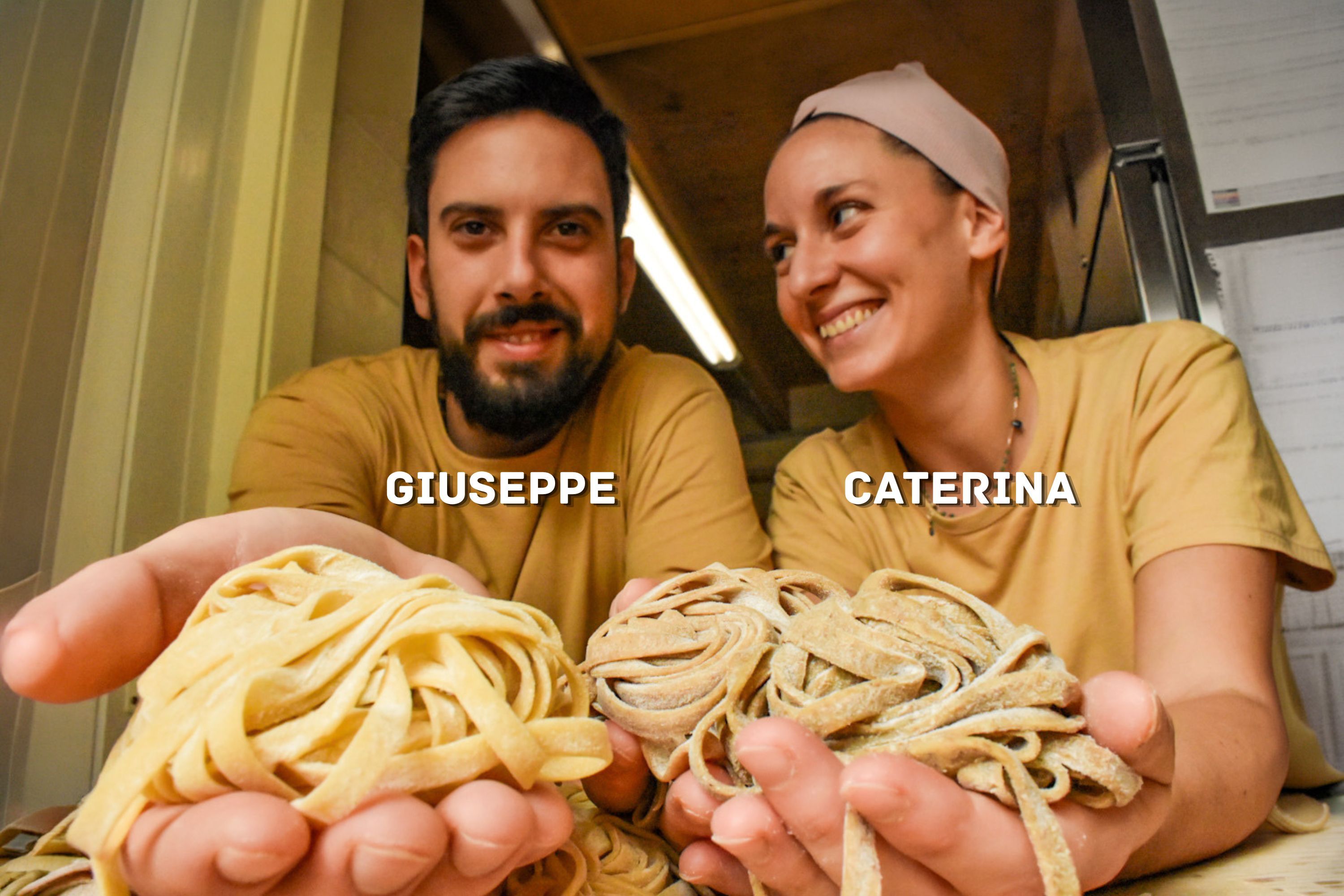
Today, guiding Pasta Fresca U Fratin are Luca Garesio and Giorgia Calzia, inheritors of a history initiated long before their time.
It was the year 1954 when the enterprise opened its doors in Oneglia. In its genesis, it was not yet a pastificio in the contemporary sense of the word: it was above all a boutique of "commestibili" and vegetables, where fresh pasta occupied but a modest portion of the production.
Then, a metamorphosis occurred. Over the years, pasta progressively claimed its dominion, demand flourished, and what was once merely a component of the shop ultimately became its very essence. Groceries and greens faded away; fresh pasta remained supreme.
For a long epoch, the people of Oneglia knew the shop as Pasta Paola, bound to Giovanni Calzia and his sister Paola. In 2014, upon Paola's retirement, Luca and Giorgia began to gradually gather the threads of her legacy, until they directly assumed the stewardship of the atelier.
Yet, the renaming of the shop did not arise from a desire to sever ties with the past. On the contrary, it reclaimed the fil rouge of an even more ancient memory.
For U Fratin was the moniker bestowed upon Giovanni’s father. Its origin, according to family lore, was a wide-hooded cloak he was accustomed to wearing, reminiscent of a friar's habit. Upon his passing, the nickname descended to Giovanni, and many years later, Luca and Giorgia chose to elevate it as the name of the pastificio.
A domestic term of endearment transformed into a historic signpost: as though, in changing its name, the shop had chosen to journey even further à rebours into its own history.
alchemy
Among the creations that carry the longest memory within them are the classic tortellini, rich with prosciutto and mortadella. Even to this day, patrons step into the shop who recall purchasing them as children, hand in hand with their grandparents. Before they are ever a culinary specialty, they are a tender measure of time's passage.
Yet, the most defining signature of U Fratin is expressed, above all, through the artistry of the ravioli.
There are those of borage, singled out by Luca as one of the house's signature triumphs, and there are the ravioli all’onegliese, prepared here with chard and sausage: a robust, sustaining filling bound to the culinary heritage of the land, while still honoring the vibrant essence of the garden.
Around them revolves the daily repertoire of the bottega: fresh pasta, both filled and simple, tagliatelle, trofie, gnocchi. Familiar, recognizable shapes, crafted to grace the family table rather than to be merely paraded.
And at U Fratin, the pasta never journeys entirely alone.
Alongside the workshop, a small yet significant soul of gastronomy endures: lasagne, gnocchi alla romana, insalata russa. Offerings that expand the counter without altering the spirit of the place, keeping it true to the memory of the ancient shop, where one entered not merely to buy a product, but to carry home a piece of the afternoon feast.
Then, there are the sauces.
Here too, there is no pursuit of the eccentric: ragù, tomato, walnut sauce, pesto, sausage sauce. Condiments belonging to a domestic grammar, naturally completing the syntax of fresh pasta. The pesto and walnuts instantly evoke Liguria; ragù and sausage speak that more universal language of home cooking, destined to generously embrace gnocchi and tagliatelle.
The magic of U Fratin lies perhaps precisely here. Not in a secret recipe or in some ostentatious virtuosity, but in the continuity of gestures and flavors: in the tortellino that someone remembers with profound emotion from the days of their grandparents, in the borage cradled inside a raviolo, in the trofie to be taken home with pesto, in the lasagna resting ready on the counter alongside other newly fashioned creations.
A shop where, since 1954, pasta, sauces, and gastronomy continue to be chapters of the very same narrative that "il fraticello" – the little friar – officiates in the name of his legend.
provenance


genesis
An emblem born of a family moniker, a boutique open since 1954, and fresh pasta that continues to speak the everyday vernacular of Imperia. U Fratin safeguards a legacy woven of ravioli, tortellini, sauces, and affective geography.
Within the intimate atelier of Piazza San Giovanni, pasta is still fashioned before the very eyes of the passerby. Sfoglia, ravioli, trofie, and gnocchi compose a repertoire belonging not only to the shop, but to the collective memory of those who have frequented it for generations.
Today, guiding Pasta Fresca U Fratin are Luca Garesio and Giorgia Calzia, inheritors of a history initiated long before their time.
It was the year 1954 when the enterprise opened its doors in Oneglia. In its genesis, it was not yet a pastificio in the contemporary sense of the word: it was above all a boutique of "commestibili" and vegetables, where fresh pasta occupied but a modest portion of the production.
Then, a metamorphosis occurred. Over the years, pasta progressively claimed its dominion, demand flourished, and what was once merely a component of the shop ultimately became its very essence. Groceries and greens faded away; fresh pasta remained supreme.
For a long epoch, the people of Oneglia knew the shop as Pasta Paola, bound to Giovanni Calzia and his sister Paola. In 2014, upon Paola's retirement, Luca and Giorgia began to gradually gather the threads of her legacy, until they directly assumed the stewardship of the atelier.
Yet, the renaming of the shop did not arise from a desire to sever ties with the past. On the contrary, it reclaimed the fil rouge of an even more ancient memory.
For U Fratin was the moniker bestowed upon Giovanni’s father. Its origin, according to family lore, was a wide-hooded cloak he was accustomed to wearing, reminiscent of a friar's habit. Upon his passing, the nickname descended to Giovanni, and many years later, Luca and Giorgia chose to elevate it as the name of the pastificio.
A domestic term of endearment transformed into a historic signpost: as though, in changing its name, the shop had chosen to journey even further à rebours into its own history.
alchemy
Among the creations that carry the longest memory within them are the classic tortellini, rich with prosciutto and mortadella. Even to this day, patrons step into the shop who recall purchasing them as children, hand in hand with their grandparents. Before they are ever a culinary specialty, they are a tender measure of time's passage.
Yet, the most defining signature of U Fratin is expressed, above all, through the artistry of the ravioli.
There are those of borage, singled out by Luca as one of the house's signature triumphs, and there are the ravioli all’onegliese, prepared here with chard and sausage: a robust, sustaining filling bound to the culinary heritage of the land, while still honoring the vibrant essence of the garden.
Around them revolves the daily repertoire of the bottega: fresh pasta, both filled and simple, tagliatelle, trofie, gnocchi. Familiar, recognizable shapes, crafted to grace the family table rather than to be merely paraded.
And at U Fratin, the pasta never journeys entirely alone.
Alongside the workshop, a small yet significant soul of gastronomy endures: lasagne, gnocchi alla romana, insalata russa. Offerings that expand the counter without altering the spirit of the place, keeping it true to the memory of the ancient shop, where one entered not merely to buy a product, but to carry home a piece of the afternoon feast.
Then, there are the sauces.
Here too, there is no pursuit of the eccentric: ragù, tomato, walnut sauce, pesto, sausage sauce. Condiments belonging to a domestic grammar, naturally completing the syntax of fresh pasta. The pesto and walnuts instantly evoke Liguria; ragù and sausage speak that more universal language of home cooking, destined to generously embrace gnocchi and tagliatelle.
The magic of U Fratin lies perhaps precisely here. Not in a secret recipe or in some ostentatious virtuosity, but in the continuity of gestures and flavors: in the tortellino that someone remembers with profound emotion from the days of their grandparents, in the borage cradled inside a raviolo, in the trofie to be taken home with pesto, in the lasagna resting ready on the counter alongside other newly fashioned creations.
A shop where, since 1954, pasta, sauces, and gastronomy continue to be chapters of the very same narrative that "il fraticello" – the little friar – officiates in the name of his legend.
provenance
final heritages
genesis
An emblem born of a family moniker, a boutique open since 1954, and fresh pasta that continues to speak the everyday vernacular of Imperia. U Fratin safeguards a legacy woven of ravioli, tortellini, sauces, and affective geography.
Within the intimate atelier of Piazza San Giovanni, pasta is still fashioned before the very eyes of the passerby. Sfoglia, ravioli, trofie, and gnocchi compose a repertoire belonging not only to the shop, but to the collective memory of those who have frequented it for generations.
Today, guiding Pasta Fresca U Fratin are Luca Garesio and Giorgia Calzia, inheritors of a history initiated long before their time.
It was the year 1954 when the enterprise opened its doors in Oneglia. In its genesis, it was not yet a pastificio in the contemporary sense of the word: it was above all a boutique of "commestibili" and vegetables, where fresh pasta occupied but a modest portion of the production.
Then, a metamorphosis occurred. Over the years, pasta progressively claimed its dominion, demand flourished, and what was once merely a component of the shop ultimately became its very essence. Groceries and greens faded away; fresh pasta remained supreme.
For a long epoch, the people of Oneglia knew the shop as Pasta Paola, bound to Giovanni Calzia and his sister Paola. In 2014, upon Paola's retirement, Luca and Giorgia began to gradually gather the threads of her legacy, until they directly assumed the stewardship of the atelier.
Yet, the renaming of the shop did not arise from a desire to sever ties with the past. On the contrary, it reclaimed the fil rouge of an even more ancient memory.
For U Fratin was the moniker bestowed upon Giovanni’s father. Its origin, according to family lore, was a wide-hooded cloak he was accustomed to wearing, reminiscent of a friar's habit. Upon his passing, the nickname descended to Giovanni, and many years later, Luca and Giorgia chose to elevate it as the name of the pastificio.
A domestic term of endearment transformed into a historic signpost: as though, in changing its name, the shop had chosen to journey even further à rebours into its own history.
alchemy
Among the creations that carry the longest memory within them are the classic tortellini, rich with prosciutto and mortadella. Even to this day, patrons step into the shop who recall purchasing them as children, hand in hand with their grandparents. Before they are ever a culinary specialty, they are a tender measure of time's passage.
Yet, the most defining signature of U Fratin is expressed, above all, through the artistry of the ravioli.
There are those of borage, singled out by Luca as one of the house's signature triumphs, and there are the ravioli all’onegliese, prepared here with chard and sausage: a robust, sustaining filling bound to the culinary heritage of the land, while still honoring the vibrant essence of the garden.
Around them revolves the daily repertoire of the bottega: fresh pasta, both filled and simple, tagliatelle, trofie, gnocchi. Familiar, recognizable shapes, crafted to grace the family table rather than to be merely paraded.
And at U Fratin, the pasta never journeys entirely alone.
Alongside the workshop, a small yet significant soul of gastronomy endures: lasagne, gnocchi alla romana, insalata russa. Offerings that expand the counter without altering the spirit of the place, keeping it true to the memory of the ancient shop, where one entered not merely to buy a product, but to carry home a piece of the afternoon feast.
Then, there are the sauces.
Here too, there is no pursuit of the eccentric: ragù, tomato, walnut sauce, pesto, sausage sauce. Condiments belonging to a domestic grammar, naturally completing the syntax of fresh pasta. The pesto and walnuts instantly evoke Liguria; ragù and sausage speak that more universal language of home cooking, destined to generously embrace gnocchi and tagliatelle.
The magic of U Fratin lies perhaps precisely here. Not in a secret recipe or in some ostentatious virtuosity, but in the continuity of gestures and flavors: in the tortellino that someone remembers with profound emotion from the days of their grandparents, in the borage cradled inside a raviolo, in the trofie to be taken home with pesto, in the lasagna resting ready on the counter alongside other newly fashioned creations.
A shop where, since 1954, pasta, sauces, and gastronomy continue to be chapters of the very same narrative that "il fraticello" – the little friar – officiates in the name of his legend.