A QUESTION OF FORM
petite architectures of the everyday
5/4/26
A QUESTION OF FORM
petite architectures of the everyday
5/4/26
A QUESTION OF FORM
petite architectures of the everyday
5/4/26
Italian pasta flourishes across the globe, yet remains ever faithful to its domestic geometries.
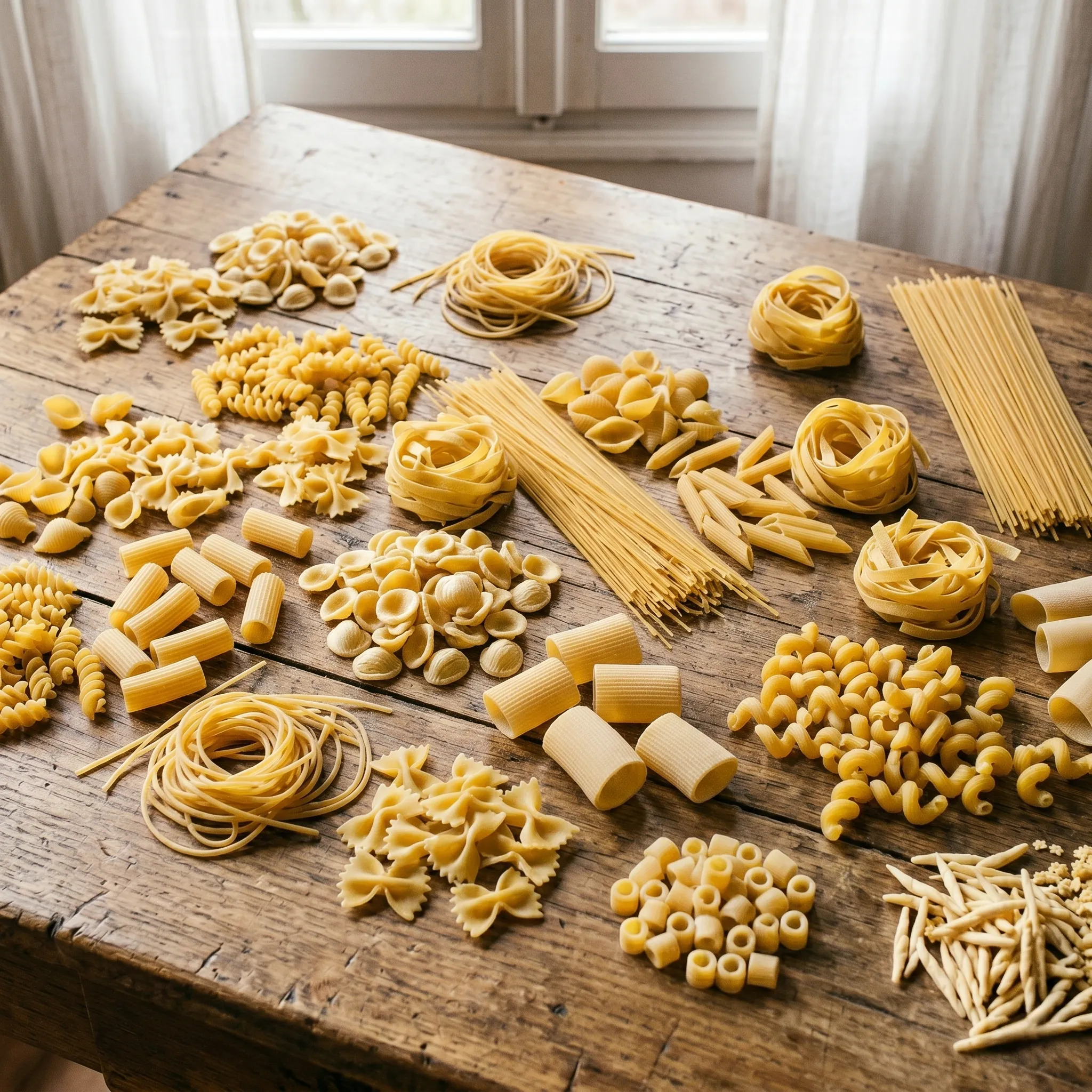
Even as Italian pasta continues to elevate its global supremacy, a more intimate truth—less economic, more sentimental—narrates our communion with this nourishment: before hundreds of possible configurations, we perpetually return to the selfsame shapes. Spaghetti. Penne. Fusilli. Rigatoni.
This is neither indolence nor a paucity of imagination. It is fidelity intertwined with a quest for certainty. It is the same devotion that leads one, after many years, back to a specific piazza, to a particular café, to words uttered always in the exact same cadence.
Recent figures bear witness to the sacred centrality of this sustenance. In 2025, Italian exports of pasta achieved 2.456 million tons, commanding a value nearing 4 billion euros, reaffirming pasta's legacy as one of the symbolic masterpieces of 'Made in Italy' gastronomy. Italy also remains the foremost sanctuary of its consumption on earth: over 23 kilograms of pasta per capita annually, a bounty that suggests something far grander than mere dietary routine.
The latest observations on consumption validate a truth now manifest: even amidst an extraordinary wealth of shapes, the daily choice remains focused upon a few familiar forms. Penne rigate—in the realm of short pasta—remain among the most adored for their affinity to embrace the sauce; fusilli cradle within their spirals denser, more tactile nectars; rigatoni preserve a generous, almost architectural vocation. And spaghetti, in their deceptive, slender simplicity, continue to embody the long form par excellence, demanding a condiment capable of enveloping them without ever overwhelming.
To choose a shape, after all, is already to begin the culinary rite: to decree the soul of the dish even before the water ascends to a boil.
Pasta, prior to being flavor, is functional design.
For this reason, upon our tables, allegiance to spaghetti can harmoniously coexist with the choosing of paccheri, the deployment of penne rigate with a return to orecchiette. Those who truly revere pasta do not eternally choose for the sake of novelty, but rather for correspondence. They seek the most fitting profile, that which unites hunger and heritage, sauce and gesture, custom and desire.
In a world, even culinary, in perpetual mutation, pasta invites us to contemplate deeply how modernity does not erase ancient forms, but rather restores them to the sacred cycle, renewing them and sending them forth into the world.


Italian pasta flourishes across the globe, yet remains ever faithful to its domestic geometries.
Even as Italian pasta continues to elevate its global supremacy, a more intimate truth—less economic, more sentimental—narrates our communion with this nourishment: before hundreds of possible configurations, we perpetually return to the selfsame shapes. Spaghetti. Penne. Fusilli. Rigatoni.
This is neither indolence nor a paucity of imagination. It is fidelity intertwined with a quest for certainty. It is the same devotion that leads one, after many years, back to a specific piazza, to a particular café, to words uttered always in the exact same cadence.
Recent figures bear witness to the sacred centrality of this sustenance. In 2025, Italian exports of pasta achieved 2.456 million tons, commanding a value nearing 4 billion euros, reaffirming pasta's legacy as one of the symbolic masterpieces of 'Made in Italy' gastronomy. Italy also remains the foremost sanctuary of its consumption on earth: over 23 kilograms of pasta per capita annually, a bounty that suggests something far grander than mere dietary routine.
The latest observations on consumption validate a truth now manifest: even amidst an extraordinary wealth of shapes, the daily choice remains focused upon a few familiar forms. Penne rigate—in the realm of short pasta—remain among the most adored for their affinity to embrace the sauce; fusilli cradle within their spirals denser, more tactile nectars; rigatoni preserve a generous, almost architectural vocation. And spaghetti, in their deceptive, slender simplicity, continue to embody the long form par excellence, demanding a condiment capable of enveloping them without ever overwhelming.
To choose a shape, after all, is already to begin the culinary rite: to decree the soul of the dish even before the water ascends to a boil.
Pasta, prior to being flavor, is functional design.
For this reason, upon our tables, allegiance to spaghetti can harmoniously coexist with the choosing of paccheri, the deployment of penne rigate with a return to orecchiette. Those who truly revere pasta do not eternally choose for the sake of novelty, but rather for correspondence. They seek the most fitting profile, that which unites hunger and heritage, sauce and gesture, custom and desire.
In a world, even culinary, in perpetual mutation, pasta invites us to contemplate deeply how modernity does not erase ancient forms, but rather restores them to the sacred cycle, renewing them and sending them forth into the world.
Italian pasta flourishes across the globe, yet remains ever faithful to its domestic geometries.
Even as Italian pasta continues to elevate its global supremacy, a more intimate truth—less economic, more sentimental—narrates our communion with this nourishment: before hundreds of possible configurations, we perpetually return to the selfsame shapes. Spaghetti. Penne. Fusilli. Rigatoni.
This is neither indolence nor a paucity of imagination. It is fidelity intertwined with a quest for certainty. It is the same devotion that leads one, after many years, back to a specific piazza, to a particular café, to words uttered always in the exact same cadence.
Recent figures bear witness to the sacred centrality of this sustenance. In 2025, Italian exports of pasta achieved 2.456 million tons, commanding a value nearing 4 billion euros, reaffirming pasta's legacy as one of the symbolic masterpieces of 'Made in Italy' gastronomy. Italy also remains the foremost sanctuary of its consumption on earth: over 23 kilograms of pasta per capita annually, a bounty that suggests something far grander than mere dietary routine.
The latest observations on consumption validate a truth now manifest: even amidst an extraordinary wealth of shapes, the daily choice remains focused upon a few familiar forms. Penne rigate—in the realm of short pasta—remain among the most adored for their affinity to embrace the sauce; fusilli cradle within their spirals denser, more tactile nectars; rigatoni preserve a generous, almost architectural vocation. And spaghetti, in their deceptive, slender simplicity, continue to embody the long form par excellence, demanding a condiment capable of enveloping them without ever overwhelming.
To choose a shape, after all, is already to begin the culinary rite: to decree the soul of the dish even before the water ascends to a boil.
Pasta, prior to being flavor, is functional design.
For this reason, upon our tables, allegiance to spaghetti can harmoniously coexist with the choosing of paccheri, the deployment of penne rigate with a return to orecchiette. Those who truly revere pasta do not eternally choose for the sake of novelty, but rather for correspondence. They seek the most fitting profile, that which unites hunger and heritage, sauce and gesture, custom and desire.
In a world, even culinary, in perpetual mutation, pasta invites us to contemplate deeply how modernity does not erase ancient forms, but rather restores them to the sacred cycle, renewing them and sending them forth into the world.