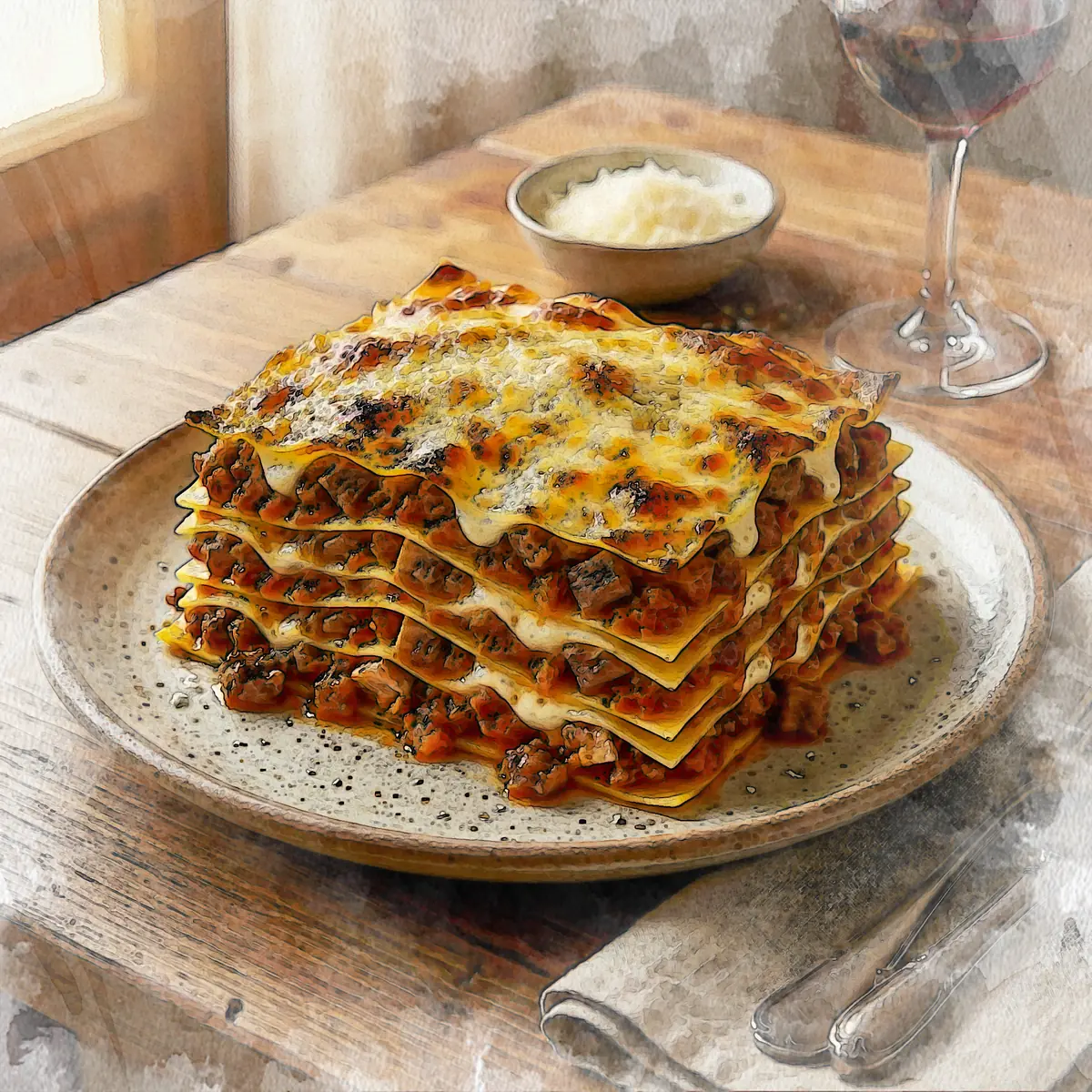
VINCISGRASSI IN THE STYLE OF MACERATA
Flour, Eggs, Beef, Pork, Chicken giblets, Tomatoes, Milk, Butter, Parmigiano Reggiano
A demanding pursuit
The Marches
240 minutes
950 Kcal
VINCISGRASSI IN THE STYLE OF MACERATA
Flour, Eggs, Beef, Pork, Chicken giblets, Tomatoes, Milk, Butter, Parmigiano Reggiano
A demanding pursuit
The Marches
240 minutes
950 Kcal
VINCISGRASSI IN THE STYLE OF MACERATA
Flour, Eggs, Beef, Pork, Chicken giblets, Tomatoes, Milk, Butter, Parmigiano Reggiano
A demanding pursuit
The Marches
240 minutes
950 Kcal
GENESIS
Vincisgrassi alla maceratese stands as the sovereign dish of Marche gastronomy, a culinary emblem originating specifically from the lands of Macerata. Popular lore attributes its nomenclature and origin to the Austrian General Alfred von Windisch-Graetz, who, stationed in the Marche region during the Napoleonic Wars in 1799, was so deeply enamoured by this baked pasta that he bestowed upon it his own name. Yet, rigorous historical research unveils more ancient origins. Within the pages of the illustrious 1781 culinary treatise "Il Cuoco Maceratese" by Antonio Nebbia, there appears a recipe anointed "princisgras." In that eighteenth-century iteration, the dish was distinct from the present: adorned with a velvet white sauce of cream, truffles, and prosciutto, untouched by the tomato. The recipe’s evolution toward today's scarlet triumph—codified by tradition and fiercely guarded by the Association of Macerata Chefs—demands a highly particular ragù. This sauce is defined by meats hand-cut into rustic pieces, never finely ground, and, above all, by the essential presence of chicken giblets, which impart a robust, profound soul to the dish. Vincisgrassi is distinguished from the Bolognese lasagna by the firmer, more resilient texture of its pasta, and by the spiced, aromatic complexity of its gravy. Today, this masterwork is revered and officially recognized as a traditional Italian agricultural and food heritage product.
PORTIONS (FOR 4 PERSONS)
FOR THE PASTA
Flour '00'
Durum wheat semolina
Medium eggs
Extra virgin olive oil
400 g
100 g
5
1 tablespoon
FOR THE EMBELLISHMENT
Finely minced beef
Lean pork tenderloin
Chicken giblets
(livers, hearts, gizzards)
Cured fatback or pancetta
Golden onion
Carrot
Stalk of celery
Dry white wine
Puru00e9ed tomatoes
Tomato paste
Rich meat broth
Extra virgin olive oil
Salt
Pepper
300 g
200 g
200 g
50 g
1
1
1
200 ml
500 g
1 tablespoon
to taste
to taste
to taste
to taste
FOR THE VELVET BECHAMEL
Fresh whole milk
Butter
Flour 00
Nutmeg
Salt
500 ml
50 g
50 g
to taste
to taste
FOR THE FINAL TOUCH
Parmigiano Reggiano
150 g
CURATION
For the seasoning:
Begin with the preparation of the ragù, as it demands a slow, patient simmering. Finely mince the lard (or pancetta) on the cutting board alongside the onion, carrot, and celery. In a spacious casserole, ideally of terracotta or cast iron, warm a thread of extra virgin olive oil and gently sauté this aromatic battuto of lard and vegetables over a whisper of heat until the onion turns translucent. Meanwhile, hand-cut the beef and pork into very small cubes (do not resort to minced meat). Carefully clean the chicken giblets and dice them into tiny morsels. Introduce the beef and pork to the soffritto, searing them over a lively flame to seal in their juices. Once the meat has changed color, add the chicken giblets and let them marry with the flavors for a few minutes. Deglaze with white wine and allow the alcohol to evaporate completely. Dissolve the tomato paste in a small amount of warm water or broth and stir it into the meat. Finally, pour in the tomato passata (or fresh tomatoes, parboiled and sieved). Season with salt and pepper. Lower the heat to its absolute minimum, cover with a lid left slightly ajar, and let it simmer gently for at least three hours. Should the sauce dry too much, ladle in a little hot broth at a time. The final reward must be a dense, velvety, and full-bodied ragù.For the fresh pasta:
While the ragù is slowly simmering, dedicate yourself to the art of the dough. Mound the flour and semolina on a wooden pastry board. Create a hollow in the center and break the eggs into it, adding a pinch of salt and a drizzle of extra virgin olive oil. With a fork, gently beat the eggs, gradually drawing in the flour from the inner walls. Once the dough begins to find its form, knead it vigorously by hand for about ten minutes, until it becomes smooth, supple, and elastic. Wrap the dough in cling film and let it rest at room temperature for 30 minutes, allowing the gluten to relax. Afterward, roll the dough with a rolling pin or a pasta machine into a thin, yet substantial, sheet. Cut the pasta into rectangles to fit your baking dish. Bring a pot of salted water to a boil with a spoonful of oil (to prevent the sheets from sticking). Blanch the pasta rectangles a few at a time for one minute, drain them, and immediately plunge them into cold water to halt the cooking. Lay them pristine on a clean cotton tea towel to dry.For the béchamel:
In a small saucepan, gently melt the butter over low heat. Remove from the flame and whisk in the sifted flour, stirring vigorously to prevent any lumps, creating a golden roux. Return to the heat and toast the mixture for a minute until it turns pale gold. Pour in the warm milk in a slow, steady stream, whisking continuously. Bring to a boil and let the sauce thicken for a few minutes until it achieves a velvety, enveloping consistency, fluid yet noble. Season with salt and a generous grating of fresh nutmeg.The Assemblage:
Secure a rectangular baking dish and spread a few spoonfuls of ragù and a veil of béchamel over the bottom. Lay the first sheet of fresh pasta to completely cover the base. Dress with an abundant layer of ragù, beautifully distributing the morsels of meat, a few spoonfuls of béchamel placed here and there, and a snow of Parmigiano Reggiano. Continue to layer—pasta, ragù, béchamel, cheese—until all components are harmoniously spent. The final crowning layer must be enveloped in ragù and a generous dusting of Parmigiano Reggiano. Preheat the oven to 180°C and bake for approximately 40 minutes, until a golden, crackling, and irresistible crust forms on the surface.
aspiration
Allow the Vincisgrassi to rest after its journey from the oven for at least 15-20 minutes before serving; this interlude permits the rich notes to harmonize and ensures the portion is carved with grace.
Certain historical reinterpretations suggest a spoonful of noble boiled wine, folded into the pasta dough or the ragù, to infuse the dish with the ancestral aroma of the Marche region.
For those who seek a more profound canvas of flavors, one may introduce cockscombs—previously boiled and peeled—into the ragù, paying homage to the most ancient culinary traditions.


GENESIS
Vincisgrassi alla maceratese stands as the sovereign dish of Marche gastronomy, a culinary emblem originating specifically from the lands of Macerata. Popular lore attributes its nomenclature and origin to the Austrian General Alfred von Windisch-Graetz, who, stationed in the Marche region during the Napoleonic Wars in 1799, was so deeply enamoured by this baked pasta that he bestowed upon it his own name. Yet, rigorous historical research unveils more ancient origins. Within the pages of the illustrious 1781 culinary treatise "Il Cuoco Maceratese" by Antonio Nebbia, there appears a recipe anointed "princisgras." In that eighteenth-century iteration, the dish was distinct from the present: adorned with a velvet white sauce of cream, truffles, and prosciutto, untouched by the tomato. The recipe’s evolution toward today's scarlet triumph—codified by tradition and fiercely guarded by the Association of Macerata Chefs—demands a highly particular ragù. This sauce is defined by meats hand-cut into rustic pieces, never finely ground, and, above all, by the essential presence of chicken giblets, which impart a robust, profound soul to the dish. Vincisgrassi is distinguished from the Bolognese lasagna by the firmer, more resilient texture of its pasta, and by the spiced, aromatic complexity of its gravy. Today, this masterwork is revered and officially recognized as a traditional Italian agricultural and food heritage product.
PORTIONS (FOR 4 PERSONS)
FOR THE PASTA
Flour '00'
Durum wheat semolina
Medium eggs
Extra virgin olive oil
400 g
100 g
5
1 tablespoon
FOR THE EMBELLISHMENT
Finely minced beef
Lean pork tenderloin
Chicken giblets
(livers, hearts, gizzards)
Cured fatback or pancetta
Golden onion
Carrot
Stalk of celery
Dry white wine
Puru00e9ed tomatoes
Tomato paste
Rich meat broth
Extra virgin olive oil
Salt
Pepper
300 g
200 g
200 g
50 g
1
1
1
200 ml
500 g
1 tablespoon
to taste
to taste
to taste
to taste
FOR THE VELVET BECHAMEL
Fresh whole milk
Butter
Flour 00
Nutmeg
Salt
500 ml
50 g
50 g
to taste
to taste
FOR THE FINAL TOUCH
Parmigiano Reggiano
150 g
CURATION
For the seasoning:
Begin with the preparation of the ragù, as it demands a slow, patient simmering. Finely mince the lard (or pancetta) on the cutting board alongside the onion, carrot, and celery. In a spacious casserole, ideally of terracotta or cast iron, warm a thread of extra virgin olive oil and gently sauté this aromatic battuto of lard and vegetables over a whisper of heat until the onion turns translucent. Meanwhile, hand-cut the beef and pork into very small cubes (do not resort to minced meat). Carefully clean the chicken giblets and dice them into tiny morsels. Introduce the beef and pork to the soffritto, searing them over a lively flame to seal in their juices. Once the meat has changed color, add the chicken giblets and let them marry with the flavors for a few minutes. Deglaze with white wine and allow the alcohol to evaporate completely. Dissolve the tomato paste in a small amount of warm water or broth and stir it into the meat. Finally, pour in the tomato passata (or fresh tomatoes, parboiled and sieved). Season with salt and pepper. Lower the heat to its absolute minimum, cover with a lid left slightly ajar, and let it simmer gently for at least three hours. Should the sauce dry too much, ladle in a little hot broth at a time. The final reward must be a dense, velvety, and full-bodied ragù.For the fresh pasta:
While the ragù is slowly simmering, dedicate yourself to the art of the dough. Mound the flour and semolina on a wooden pastry board. Create a hollow in the center and break the eggs into it, adding a pinch of salt and a drizzle of extra virgin olive oil. With a fork, gently beat the eggs, gradually drawing in the flour from the inner walls. Once the dough begins to find its form, knead it vigorously by hand for about ten minutes, until it becomes smooth, supple, and elastic. Wrap the dough in cling film and let it rest at room temperature for 30 minutes, allowing the gluten to relax. Afterward, roll the dough with a rolling pin or a pasta machine into a thin, yet substantial, sheet. Cut the pasta into rectangles to fit your baking dish. Bring a pot of salted water to a boil with a spoonful of oil (to prevent the sheets from sticking). Blanch the pasta rectangles a few at a time for one minute, drain them, and immediately plunge them into cold water to halt the cooking. Lay them pristine on a clean cotton tea towel to dry.For the béchamel:
In a small saucepan, gently melt the butter over low heat. Remove from the flame and whisk in the sifted flour, stirring vigorously to prevent any lumps, creating a golden roux. Return to the heat and toast the mixture for a minute until it turns pale gold. Pour in the warm milk in a slow, steady stream, whisking continuously. Bring to a boil and let the sauce thicken for a few minutes until it achieves a velvety, enveloping consistency, fluid yet noble. Season with salt and a generous grating of fresh nutmeg.The Assemblage:
Secure a rectangular baking dish and spread a few spoonfuls of ragù and a veil of béchamel over the bottom. Lay the first sheet of fresh pasta to completely cover the base. Dress with an abundant layer of ragù, beautifully distributing the morsels of meat, a few spoonfuls of béchamel placed here and there, and a snow of Parmigiano Reggiano. Continue to layer—pasta, ragù, béchamel, cheese—until all components are harmoniously spent. The final crowning layer must be enveloped in ragù and a generous dusting of Parmigiano Reggiano. Preheat the oven to 180°C and bake for approximately 40 minutes, until a golden, crackling, and irresistible crust forms on the surface.
aspiration
Allow the Vincisgrassi to rest after its journey from the oven for at least 15-20 minutes before serving; this interlude permits the rich notes to harmonize and ensures the portion is carved with grace.
Certain historical reinterpretations suggest a spoonful of noble boiled wine, folded into the pasta dough or the ragù, to infuse the dish with the ancestral aroma of the Marche region.
For those who seek a more profound canvas of flavors, one may introduce cockscombs—previously boiled and peeled—into the ragù, paying homage to the most ancient culinary traditions.
latest culinary creations
GENESIS
Vincisgrassi alla maceratese stands as the sovereign dish of Marche gastronomy, a culinary emblem originating specifically from the lands of Macerata. Popular lore attributes its nomenclature and origin to the Austrian General Alfred von Windisch-Graetz, who, stationed in the Marche region during the Napoleonic Wars in 1799, was so deeply enamoured by this baked pasta that he bestowed upon it his own name. Yet, rigorous historical research unveils more ancient origins. Within the pages of the illustrious 1781 culinary treatise "Il Cuoco Maceratese" by Antonio Nebbia, there appears a recipe anointed "princisgras." In that eighteenth-century iteration, the dish was distinct from the present: adorned with a velvet white sauce of cream, truffles, and prosciutto, untouched by the tomato. The recipe’s evolution toward today's scarlet triumph—codified by tradition and fiercely guarded by the Association of Macerata Chefs—demands a highly particular ragù. This sauce is defined by meats hand-cut into rustic pieces, never finely ground, and, above all, by the essential presence of chicken giblets, which impart a robust, profound soul to the dish. Vincisgrassi is distinguished from the Bolognese lasagna by the firmer, more resilient texture of its pasta, and by the spiced, aromatic complexity of its gravy. Today, this masterwork is revered and officially recognized as a traditional Italian agricultural and food heritage product.
PORTIONS (FOR 4 PERSONS)
FOR THE PASTA
Flour '00'
Durum wheat semolina
Medium eggs
Extra virgin olive oil
400 g
100 g
5
1 tablespoon
FOR THE EMBELLISHMENT
Finely minced beef
Lean pork tenderloin
Chicken giblets
(livers, hearts, gizzards)
Cured fatback or pancetta
Golden onion
Carrot
Stalk of celery
Dry white wine
Puru00e9ed tomatoes
Tomato paste
Rich meat broth
Extra virgin olive oil
Salt
Pepper
300 g
200 g
200 g
50 g
1
1
1
200 ml
500 g
1 tablespoon
to taste
to taste
to taste
to taste
FOR THE VELVET BECHAMEL
Fresh whole milk
Butter
Flour 00
Nutmeg
Salt
500 ml
50 g
50 g
to taste
to taste
FOR THE FINAL TOUCH
Parmigiano Reggiano
150 g
CURATION
For the seasoning:
Begin with the preparation of the ragù, as it demands a slow, patient simmering. Finely mince the lard (or pancetta) on the cutting board alongside the onion, carrot, and celery. In a spacious casserole, ideally of terracotta or cast iron, warm a thread of extra virgin olive oil and gently sauté this aromatic battuto of lard and vegetables over a whisper of heat until the onion turns translucent. Meanwhile, hand-cut the beef and pork into very small cubes (do not resort to minced meat). Carefully clean the chicken giblets and dice them into tiny morsels. Introduce the beef and pork to the soffritto, searing them over a lively flame to seal in their juices. Once the meat has changed color, add the chicken giblets and let them marry with the flavors for a few minutes. Deglaze with white wine and allow the alcohol to evaporate completely. Dissolve the tomato paste in a small amount of warm water or broth and stir it into the meat. Finally, pour in the tomato passata (or fresh tomatoes, parboiled and sieved). Season with salt and pepper. Lower the heat to its absolute minimum, cover with a lid left slightly ajar, and let it simmer gently for at least three hours. Should the sauce dry too much, ladle in a little hot broth at a time. The final reward must be a dense, velvety, and full-bodied ragù.For the fresh pasta:
While the ragù is slowly simmering, dedicate yourself to the art of the dough. Mound the flour and semolina on a wooden pastry board. Create a hollow in the center and break the eggs into it, adding a pinch of salt and a drizzle of extra virgin olive oil. With a fork, gently beat the eggs, gradually drawing in the flour from the inner walls. Once the dough begins to find its form, knead it vigorously by hand for about ten minutes, until it becomes smooth, supple, and elastic. Wrap the dough in cling film and let it rest at room temperature for 30 minutes, allowing the gluten to relax. Afterward, roll the dough with a rolling pin or a pasta machine into a thin, yet substantial, sheet. Cut the pasta into rectangles to fit your baking dish. Bring a pot of salted water to a boil with a spoonful of oil (to prevent the sheets from sticking). Blanch the pasta rectangles a few at a time for one minute, drain them, and immediately plunge them into cold water to halt the cooking. Lay them pristine on a clean cotton tea towel to dry.For the béchamel:
In a small saucepan, gently melt the butter over low heat. Remove from the flame and whisk in the sifted flour, stirring vigorously to prevent any lumps, creating a golden roux. Return to the heat and toast the mixture for a minute until it turns pale gold. Pour in the warm milk in a slow, steady stream, whisking continuously. Bring to a boil and let the sauce thicken for a few minutes until it achieves a velvety, enveloping consistency, fluid yet noble. Season with salt and a generous grating of fresh nutmeg.The Assemblage:
Secure a rectangular baking dish and spread a few spoonfuls of ragù and a veil of béchamel over the bottom. Lay the first sheet of fresh pasta to completely cover the base. Dress with an abundant layer of ragù, beautifully distributing the morsels of meat, a few spoonfuls of béchamel placed here and there, and a snow of Parmigiano Reggiano. Continue to layer—pasta, ragù, béchamel, cheese—until all components are harmoniously spent. The final crowning layer must be enveloped in ragù and a generous dusting of Parmigiano Reggiano. Preheat the oven to 180°C and bake for approximately 40 minutes, until a golden, crackling, and irresistible crust forms on the surface.
aspiration
Allow the Vincisgrassi to rest after its journey from the oven for at least 15-20 minutes before serving; this interlude permits the rich notes to harmonize and ensures the portion is carved with grace.
Certain historical reinterpretations suggest a spoonful of noble boiled wine, folded into the pasta dough or the ragù, to infuse the dish with the ancestral aroma of the Marche region.
For those who seek a more profound canvas of flavors, one may introduce cockscombs—previously boiled and peeled—into the ragù, paying homage to the most ancient culinary traditions.