READINGS OF PASTA: A LITERARY CHRONICLE
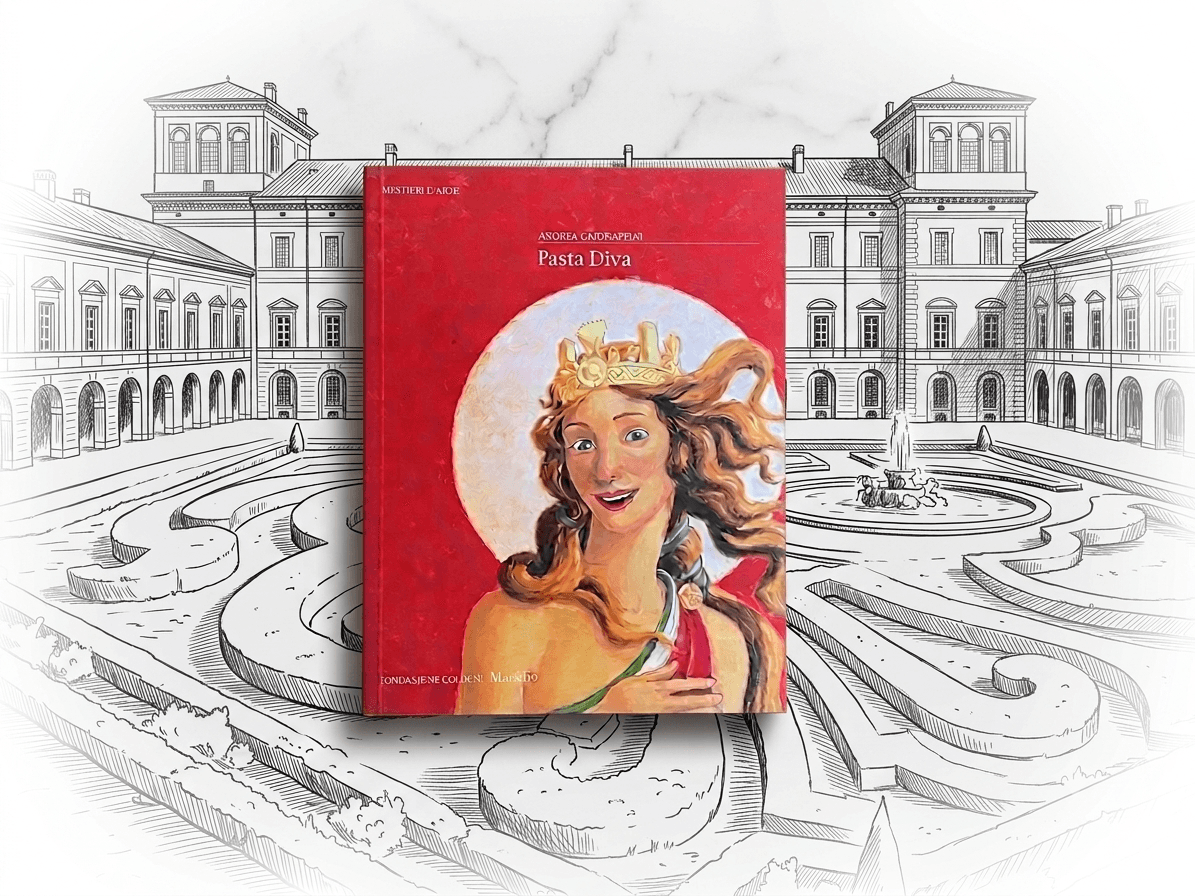
“PASTA DIVA” (Andrea Grignaffini, Marsilio Editore, 224 pp.)
Jun 11, 2026
READINGS OF PASTA: A LITERARY CHRONICLE
“PASTA DIVA” (Andrea Grignaffini, Marsilio Editore, 224 pp.)
Jun 11, 2026
READINGS OF PASTA: A LITERARY CHRONICLE
“PASTA DIVA” (Andrea Grignaffini, Marsilio Editore, 224 pp.)
Jun 11, 2026
There are books that merely explain an ingredient. And then there are books that, without confining it within a definition, restore its stage, its body, its voice. “Pasta Diva” by Andrea Grignaffini belongs to this second family: it does not treat pasta as a simple gastronomic object, but as a grand protagonist of Italian culture, capable of dwelling simultaneously within the domestic kitchen and the realm of haute cuisine, familial memory and technical thought, tradition and its necessary evolution.
The title is already a declaration. Pasta is a “diva” not because she distances herself from the daily table, but because for centuries she has always returned to it as the protagonist. She can be humble and theatrical, poor and sumptuous, elementary and highly sophisticated. She is made of wheat, water, eggs, hands, bronze dies, cooking times, but also of geographies, rituals, customs, feasts, sauces, condiments, and anticipation. Within her, Italy has deposited an essential part of its own material vocabulary.
The volume, published by Marsilio in the “Mestieri d’Arte” series of the Fondazione Cologni, is structured as a journey across thirty-three chapters dedicated to the secrets of pasta: from shapes to cooking methods and times, from sauces to condiments, from daily habits to festive occasions. The journey culminates in a compendium of thirty-three signature recipes penned by great Italian chefs.
On one side lies pasta as ancient, daily, popular knowledge: a grammar of gestures repeated, handed down, and refined by time. On the other lies pasta as a field of contemporary research, observed by chefs in its structure, its capacity to hold sauce, its resistance to the bite, and the tension between shape and condiment, memory and invention.
Grignaffini does not crystallize pasta in nostalgia. He observes her in her mutations. And this is perhaps the most compelling point: tradition, here, is not a showcase, but a fermenting matter. Every shape carries an origin, but also a possibility. Every recipe guards a past, yet remains open to be reinterpreted, reread, and ushered into a new era of taste.
The illustrations by Paolo Rui further bestow upon the volume an ethereal, visionary, almost theatrical dimension. Pasta is imagined. She steps off the plate and becomes a figure, a mask, a scene, an apparition. This, too, contributes to making her a diva: not a static foodstuff, but a leading character of our material culture.
For MILLEUNAPASTA, “Pasta Diva” is a precious work because it confirms a foundational conviction: pasta is not a minor subject. It is social history, artisanal technique, the economy of wheat, the geography of taste, familial ritual, and a contemporary laboratory. It is the place where Italy continues to narrate itself without the need for rhetoric, simply through a shape that arrives at the table and only needs to appear. A plate, a fork, the aroma of a sauce, a textured surface, a filling that reveals itself. From there, every time, the story begins anew.


There are books that merely explain an ingredient. And then there are books that, without confining it within a definition, restore its stage, its body, its voice. “Pasta Diva” by Andrea Grignaffini belongs to this second family: it does not treat pasta as a simple gastronomic object, but as a grand protagonist of Italian culture, capable of dwelling simultaneously within the domestic kitchen and the realm of haute cuisine, familial memory and technical thought, tradition and its necessary evolution.
The title is already a declaration. Pasta is a “diva” not because she distances herself from the daily table, but because for centuries she has always returned to it as the protagonist. She can be humble and theatrical, poor and sumptuous, elementary and highly sophisticated. She is made of wheat, water, eggs, hands, bronze dies, cooking times, but also of geographies, rituals, customs, feasts, sauces, condiments, and anticipation. Within her, Italy has deposited an essential part of its own material vocabulary.
The volume, published by Marsilio in the “Mestieri d’Arte” series of the Fondazione Cologni, is structured as a journey across thirty-three chapters dedicated to the secrets of pasta: from shapes to cooking methods and times, from sauces to condiments, from daily habits to festive occasions. The journey culminates in a compendium of thirty-three signature recipes penned by great Italian chefs.
On one side lies pasta as ancient, daily, popular knowledge: a grammar of gestures repeated, handed down, and refined by time. On the other lies pasta as a field of contemporary research, observed by chefs in its structure, its capacity to hold sauce, its resistance to the bite, and the tension between shape and condiment, memory and invention.
Grignaffini does not crystallize pasta in nostalgia. He observes her in her mutations. And this is perhaps the most compelling point: tradition, here, is not a showcase, but a fermenting matter. Every shape carries an origin, but also a possibility. Every recipe guards a past, yet remains open to be reinterpreted, reread, and ushered into a new era of taste.
The illustrations by Paolo Rui further bestow upon the volume an ethereal, visionary, almost theatrical dimension. Pasta is imagined. She steps off the plate and becomes a figure, a mask, a scene, an apparition. This, too, contributes to making her a diva: not a static foodstuff, but a leading character of our material culture.
For MILLEUNAPASTA, “Pasta Diva” is a precious work because it confirms a foundational conviction: pasta is not a minor subject. It is social history, artisanal technique, the economy of wheat, the geography of taste, familial ritual, and a contemporary laboratory. It is the place where Italy continues to narrate itself without the need for rhetoric, simply through a shape that arrives at the table and only needs to appear. A plate, a fork, the aroma of a sauce, a textured surface, a filling that reveals itself. From there, every time, the story begins anew.
There are books that merely explain an ingredient. And then there are books that, without confining it within a definition, restore its stage, its body, its voice. “Pasta Diva” by Andrea Grignaffini belongs to this second family: it does not treat pasta as a simple gastronomic object, but as a grand protagonist of Italian culture, capable of dwelling simultaneously within the domestic kitchen and the realm of haute cuisine, familial memory and technical thought, tradition and its necessary evolution.
The title is already a declaration. Pasta is a “diva” not because she distances herself from the daily table, but because for centuries she has always returned to it as the protagonist. She can be humble and theatrical, poor and sumptuous, elementary and highly sophisticated. She is made of wheat, water, eggs, hands, bronze dies, cooking times, but also of geographies, rituals, customs, feasts, sauces, condiments, and anticipation. Within her, Italy has deposited an essential part of its own material vocabulary.
The volume, published by Marsilio in the “Mestieri d’Arte” series of the Fondazione Cologni, is structured as a journey across thirty-three chapters dedicated to the secrets of pasta: from shapes to cooking methods and times, from sauces to condiments, from daily habits to festive occasions. The journey culminates in a compendium of thirty-three signature recipes penned by great Italian chefs.
On one side lies pasta as ancient, daily, popular knowledge: a grammar of gestures repeated, handed down, and refined by time. On the other lies pasta as a field of contemporary research, observed by chefs in its structure, its capacity to hold sauce, its resistance to the bite, and the tension between shape and condiment, memory and invention.
Grignaffini does not crystallize pasta in nostalgia. He observes her in her mutations. And this is perhaps the most compelling point: tradition, here, is not a showcase, but a fermenting matter. Every shape carries an origin, but also a possibility. Every recipe guards a past, yet remains open to be reinterpreted, reread, and ushered into a new era of taste.
The illustrations by Paolo Rui further bestow upon the volume an ethereal, visionary, almost theatrical dimension. Pasta is imagined. She steps off the plate and becomes a figure, a mask, a scene, an apparition. This, too, contributes to making her a diva: not a static foodstuff, but a leading character of our material culture.
For MILLEUNAPASTA, “Pasta Diva” is a precious work because it confirms a foundational conviction: pasta is not a minor subject. It is social history, artisanal technique, the economy of wheat, the geography of taste, familial ritual, and a contemporary laboratory. It is the place where Italy continues to narrate itself without the need for rhetoric, simply through a shape that arrives at the table and only needs to appear. A plate, a fork, the aroma of a sauce, a textured surface, a filling that reveals itself. From there, every time, the story begins anew.