Elixir of Meat Broth
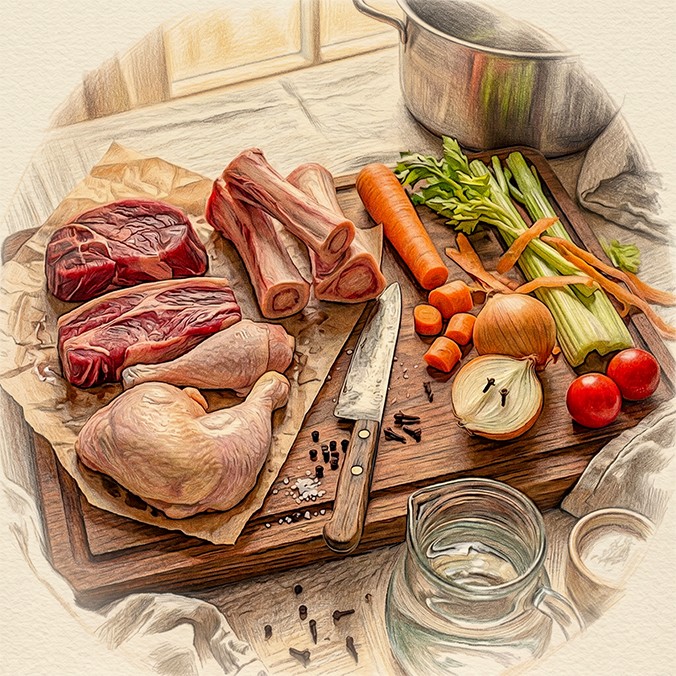
Beef, hen, marrow bones, carrot, celery, and onion
Effortless
Italy
190 minutes
45 Calories
Elixir of Meat Broth
Beef, hen, marrow bones, carrot, celery, and onion
Effortless
Italy
190 minutes
45 Calories
Elixir of Meat Broth
Beef, hen, marrow bones, carrot, celery, and onion
Effortless
Italy
190 minutes
45 Calories
GENESIS
Meat broth stands as one of the fundamental pillars of traditional Italian gastronomy, serving as an indispensable foundation for countless culinary creations, from rich risottos and delicate soups to the slow poaching of filled pasta, such as the storied Emilian tortellini. Its origins are lost in the mists of time, born of the necessity to elevate humbler cuts of meat and bones through a patient, prolonged simmer in water. Pellegrino Artusi, in his celebrated 1891 treatise "Science in the Kitchen and the Art of Eating Well," devotes elegant prose to the flawless execution of broth, drawing a distinction between that destined to be savored as a comforting soup and that intended as a base to enrich grander sauces. Historically, broth was the sacred dish of Sundays and solemn feasts, a symbol of conviviality and domestic harmony. Gastronomic technique dictates that the meat be immersed in cold water to coax out the very essence of its juices and nutrients, unlike the classic boiled meat, where the flesh is plunged into boiling water to seal in its internal flavors. Regional variations abound, often introducing capon during the festive Christmas season, or the inclusion of aged Parmigiano Reggiano rinds to bestow a profound, savory depth upon the liquid. Beyond its magnificent culinary value, broth has long been revered in folklore as an elixir of restorative power. A pristine clarity and a luminous golden hue are the supreme hallmarks of a broth crafted to perfection. The delicate ritual of skimming—the removal of impurities that rise to the surface during the boiling process—is paramount to achieving a crystalline brilliance. The selection of aromatic herbs and vegetables, such as celery, carrot, and onion, completes the bouquet, whilst the addition of a single tomato or the gentle charring of the onion on the hearth can impart a deeper, amber nuance to the liquid gold.
PORTIONS (FOR 4 PERSONS)
THE RECIPE
Beef shank
Beef short ribs
Hen
Soup bones
Carrots
Celery ribs
Golden onion
Cherry tomatoes
Salt
Cold water
500 gr
300 gr
1/4
2
2
2
1
2
q.b.
3 l
CURATION
For the preparation of the ingredients:
Begin by reverently washing the carrots and celery under running water. Peel the carrots and divest the celery of its toughest fibers. Take the onion, strip it of its outer papery skin, and slice it in twain. Should you desire a broth of a deeper, amber hue, you may place the onion cut-side down upon a searing pan for a brief moment, until it is gently kissed by the fire. Rinse the cuts of meat (the beef muscle, short ribs, and hen) alongside the marrow bones, cleansing them of any lingering impurities.For the simmering of the elixir:
Select a vessel of grand proportions, vast enough to cradle the three liters of water and the remaining treasures of the earth and pasture. Place within it the beef, the hen, and the bones. Accompany them with the carrots, the celery, the onion, and the cherry tomatoes. Pour the cold water until everything is abundantly submerged. Set the vessel over the flame, heating it gently until it reaches a rolling boil. As the water awakens, a greyish froth will rise to the surface; use a skimmer to remove this impurity entirely. This ritual is essential to achieve a broth of pristine clarity. Once the surface is purified, reduce the heat to its gentlest whisper, add a pinch of salt to taste, and partially cover with a lid. Allow it to simmer undisturbed for at least 3 hours, keeping only the faintest quiver on the surface.For the final refinement:
Upon completing this slow alchemy, extinguish the flame. Gently retrieve the meats and vegetables from the pot using tongs or a skimmer. Filter the liquid gold through a fine-mesh sieve, preferably lined with a clean cotton cloth, to banish any remaining sediment. If you prefer a broth of ethereal lightness, allow it to cool and place it within the refrigerator; once chilled, the fat will solidify upon the surface, allowing you to lift it away with ease.
aspiration
Should you desire a more profound resonance of flavor, you may introduce a few peppercorns of black pepper or a single clove pressed into the heart of the onion.
Do not discard the simmered meats and vegetables: they may be savored as a noble second course, graced by a vibrant salsa verde or a traditional mostarda.
Should the broth reduce too fervently during the simmer, gently add a measure of hot water, so as not to interrupt the gentle rhythm of its boiling.



GENESIS
Meat broth stands as one of the fundamental pillars of traditional Italian gastronomy, serving as an indispensable foundation for countless culinary creations, from rich risottos and delicate soups to the slow poaching of filled pasta, such as the storied Emilian tortellini. Its origins are lost in the mists of time, born of the necessity to elevate humbler cuts of meat and bones through a patient, prolonged simmer in water. Pellegrino Artusi, in his celebrated 1891 treatise "Science in the Kitchen and the Art of Eating Well," devotes elegant prose to the flawless execution of broth, drawing a distinction between that destined to be savored as a comforting soup and that intended as a base to enrich grander sauces. Historically, broth was the sacred dish of Sundays and solemn feasts, a symbol of conviviality and domestic harmony. Gastronomic technique dictates that the meat be immersed in cold water to coax out the very essence of its juices and nutrients, unlike the classic boiled meat, where the flesh is plunged into boiling water to seal in its internal flavors. Regional variations abound, often introducing capon during the festive Christmas season, or the inclusion of aged Parmigiano Reggiano rinds to bestow a profound, savory depth upon the liquid. Beyond its magnificent culinary value, broth has long been revered in folklore as an elixir of restorative power. A pristine clarity and a luminous golden hue are the supreme hallmarks of a broth crafted to perfection. The delicate ritual of skimming—the removal of impurities that rise to the surface during the boiling process—is paramount to achieving a crystalline brilliance. The selection of aromatic herbs and vegetables, such as celery, carrot, and onion, completes the bouquet, whilst the addition of a single tomato or the gentle charring of the onion on the hearth can impart a deeper, amber nuance to the liquid gold.
PORTIONS (FOR 4 PERSONS)
THE RECIPE
Beef shank
Beef short ribs
Hen
Soup bones
Carrots
Celery ribs
Golden onion
Cherry tomatoes
Salt
Cold water
500 gr
300 gr
1/4
2
2
2
1
2
q.b.
3 l
CURATION
For the preparation of the ingredients:
Begin by reverently washing the carrots and celery under running water. Peel the carrots and divest the celery of its toughest fibers. Take the onion, strip it of its outer papery skin, and slice it in twain. Should you desire a broth of a deeper, amber hue, you may place the onion cut-side down upon a searing pan for a brief moment, until it is gently kissed by the fire. Rinse the cuts of meat (the beef muscle, short ribs, and hen) alongside the marrow bones, cleansing them of any lingering impurities.For the simmering of the elixir:
Select a vessel of grand proportions, vast enough to cradle the three liters of water and the remaining treasures of the earth and pasture. Place within it the beef, the hen, and the bones. Accompany them with the carrots, the celery, the onion, and the cherry tomatoes. Pour the cold water until everything is abundantly submerged. Set the vessel over the flame, heating it gently until it reaches a rolling boil. As the water awakens, a greyish froth will rise to the surface; use a skimmer to remove this impurity entirely. This ritual is essential to achieve a broth of pristine clarity. Once the surface is purified, reduce the heat to its gentlest whisper, add a pinch of salt to taste, and partially cover with a lid. Allow it to simmer undisturbed for at least 3 hours, keeping only the faintest quiver on the surface.For the final refinement:
Upon completing this slow alchemy, extinguish the flame. Gently retrieve the meats and vegetables from the pot using tongs or a skimmer. Filter the liquid gold through a fine-mesh sieve, preferably lined with a clean cotton cloth, to banish any remaining sediment. If you prefer a broth of ethereal lightness, allow it to cool and place it within the refrigerator; once chilled, the fat will solidify upon the surface, allowing you to lift it away with ease.
aspiration
Should you desire a more profound resonance of flavor, you may introduce a few peppercorns of black pepper or a single clove pressed into the heart of the onion.
Do not discard the simmered meats and vegetables: they may be savored as a noble second course, graced by a vibrant salsa verde or a traditional mostarda.
Should the broth reduce too fervently during the simmer, gently add a measure of hot water, so as not to interrupt the gentle rhythm of its boiling.
ultimate alchemies
GENESIS
Meat broth stands as one of the fundamental pillars of traditional Italian gastronomy, serving as an indispensable foundation for countless culinary creations, from rich risottos and delicate soups to the slow poaching of filled pasta, such as the storied Emilian tortellini. Its origins are lost in the mists of time, born of the necessity to elevate humbler cuts of meat and bones through a patient, prolonged simmer in water. Pellegrino Artusi, in his celebrated 1891 treatise "Science in the Kitchen and the Art of Eating Well," devotes elegant prose to the flawless execution of broth, drawing a distinction between that destined to be savored as a comforting soup and that intended as a base to enrich grander sauces. Historically, broth was the sacred dish of Sundays and solemn feasts, a symbol of conviviality and domestic harmony. Gastronomic technique dictates that the meat be immersed in cold water to coax out the very essence of its juices and nutrients, unlike the classic boiled meat, where the flesh is plunged into boiling water to seal in its internal flavors. Regional variations abound, often introducing capon during the festive Christmas season, or the inclusion of aged Parmigiano Reggiano rinds to bestow a profound, savory depth upon the liquid. Beyond its magnificent culinary value, broth has long been revered in folklore as an elixir of restorative power. A pristine clarity and a luminous golden hue are the supreme hallmarks of a broth crafted to perfection. The delicate ritual of skimming—the removal of impurities that rise to the surface during the boiling process—is paramount to achieving a crystalline brilliance. The selection of aromatic herbs and vegetables, such as celery, carrot, and onion, completes the bouquet, whilst the addition of a single tomato or the gentle charring of the onion on the hearth can impart a deeper, amber nuance to the liquid gold.
PORTIONS (FOR 4 PERSONS)
THE RECIPE
Beef shank
Beef short ribs
Hen
Soup bones
Carrots
Celery ribs
Golden onion
Cherry tomatoes
Salt
Cold water
500 gr
300 gr
1/4
2
2
2
1
2
q.b.
3 l
CURATION
For the preparation of the ingredients:
Begin by reverently washing the carrots and celery under running water. Peel the carrots and divest the celery of its toughest fibers. Take the onion, strip it of its outer papery skin, and slice it in twain. Should you desire a broth of a deeper, amber hue, you may place the onion cut-side down upon a searing pan for a brief moment, until it is gently kissed by the fire. Rinse the cuts of meat (the beef muscle, short ribs, and hen) alongside the marrow bones, cleansing them of any lingering impurities.For the simmering of the elixir:
Select a vessel of grand proportions, vast enough to cradle the three liters of water and the remaining treasures of the earth and pasture. Place within it the beef, the hen, and the bones. Accompany them with the carrots, the celery, the onion, and the cherry tomatoes. Pour the cold water until everything is abundantly submerged. Set the vessel over the flame, heating it gently until it reaches a rolling boil. As the water awakens, a greyish froth will rise to the surface; use a skimmer to remove this impurity entirely. This ritual is essential to achieve a broth of pristine clarity. Once the surface is purified, reduce the heat to its gentlest whisper, add a pinch of salt to taste, and partially cover with a lid. Allow it to simmer undisturbed for at least 3 hours, keeping only the faintest quiver on the surface.For the final refinement:
Upon completing this slow alchemy, extinguish the flame. Gently retrieve the meats and vegetables from the pot using tongs or a skimmer. Filter the liquid gold through a fine-mesh sieve, preferably lined with a clean cotton cloth, to banish any remaining sediment. If you prefer a broth of ethereal lightness, allow it to cool and place it within the refrigerator; once chilled, the fat will solidify upon the surface, allowing you to lift it away with ease.
aspiration
Should you desire a more profound resonance of flavor, you may introduce a few peppercorns of black pepper or a single clove pressed into the heart of the onion.
Do not discard the simmered meats and vegetables: they may be savored as a noble second course, graced by a vibrant salsa verde or a traditional mostarda.
Should the broth reduce too fervently during the simmer, gently add a measure of hot water, so as not to interrupt the gentle rhythm of its boiling.