
A Symphony of Gorgonzola and Radicchio
Crimson Radicchio, sweet Gorgonzola, Walnuts, and Shallot
Effortless
Lombardy
25 min
280 Kcal
A Symphony of Gorgonzola and Radicchio
Crimson Radicchio, sweet Gorgonzola, Walnuts, and Shallot
Effortless
Lombardy
25 min
280 Kcal
A Symphony of Gorgonzola and Radicchio
Crimson Radicchio, sweet Gorgonzola, Walnuts, and Shallot
Effortless
Lombardy
25 min
280 Kcal
GENESIS
The union between gorgonzola and radicchio represents one of the most celebrated alliances in the gastronomic heritage of Northern Italy, seamlessly marrying the excellence of two neighboring territories: Lombardy and Veneto. Gorgonzola is a raw-paste blue cheese of ancient lineage, whose origins, by tradition, are said to trace back to the year 879 in the namesake town on the outskirts of Milan. Today safeguarded by the PDO designation, its creation requires the introduction of Penicillium spores into cow's milk, giving rise to those signature blue-green veins and that unmistakable flavor profile which oscillates between sweet and piquant, according to its maturation.
Radicchio, most notably the red variety from Treviso, possesses an equally spellbinding history. While chicories have been savored since antiquity, the refined technique of bleaching—which bestows upon the radicchio its characteristic crispness and intense ruby-red hue striped with snow-white—was perfected in the second half of the nineteenth century by the Belgian agronomist Francesco Van Den Borre. This vegetable is distinguished by a noble bitter note that marries harmoniously with the richness and velvety creaminess of the cheese.
From an organoleptic and chemical perspective, this preparation plays gracefully upon the contrast between the sweet undertones of the gorgonzola and the subtle bitterness of the radicchio. The addition of walnuts is not merely a tribute to rustic tradition, but serves to introduce a protein-rich component and a crisp texture that balances the sublime softness of the sauce. Historically, this pairing emerged as a dressing for winter pasta dishes or as a sumptuous topping for crostini, reflecting the ancient necessity of utilizing nourishing ingredients readily available during the bleak winter months of the Po and Venetian plains. The elegance of its simplicity exalts the sheer quality of the raw ingredients, which must be of pristine freshness to truly elevate the dish.
PORTIONS (FOR 4 PERSONS)
THE RECIPE
Treviso Red Radicchio
Sweet Gorgonzola
Walnut Kernels
Shallot
Extra Virgin Olive Oil
Salt
Black pepper
300 gr
150 gr
40 gr
1
to taste
to taste
to taste
CURATION
For the Condiment:
Begin your preparation by meticulously cleansing the chicory. Remove the base of the stalk, which proves too fibrous, and separate the leaves. Wash the leaves under cold, running water, pat them dry with a pristine cloth or a salad spinner, and ribbon them into generous strips.
Take the shallot, peel it, and mince it finely. In a spacious skillet, pour a thread of extra virgin olive oil and warm it over a gentle flame. Add the minced shallot and allow it to sweat slowly, taking care that it does not take on too dark a color. If necessary, add a spoonful of water to gently coax its cooking.
When the shallot has rendered translucent, unite the chicory in the pan. Raise the flame slightly and sauté for about five or six minutes. The chicory must soften, yet retain a delicate whisper of its crispness. Season with salt and black pepper, keeping in mind that the cheese will soon bestow its own savory richness.
While the chicory cooks, take the sweet Gorgonzola and dice it into cubes after removing its rind. Once the chicory is ready, lower the flame to a whisper and add the cubes of cheese. Stir with a wooden spoon until the cheese has completely dissolved, creating an enveloping cream that harmoniously binds with the vegetable.
Shell the walnuts and break the kernels coarsely with your hands or a knife. Add them to the condiment only at the final moment, just before extinguishing the fire, so that they preserve their crisp texture and their flavors do not merge excessively during cooking. Medley one last time to distribute the walnuts evenly and serve while still warm.
aspiration
Should you desire a texture of even greater fluidity, you may introduce a spoonful of milk or fresh cream as the Gorgonzola surrenders to the flame.
For a further aromatic cadence, bestow a few delicate leaves of fresh thyme upon the dish at the climax of its creation.
Perchance you prefer a more assertive character; you may replace half the measure of sweet Gorgonzola with its intensely piquant counterpart.


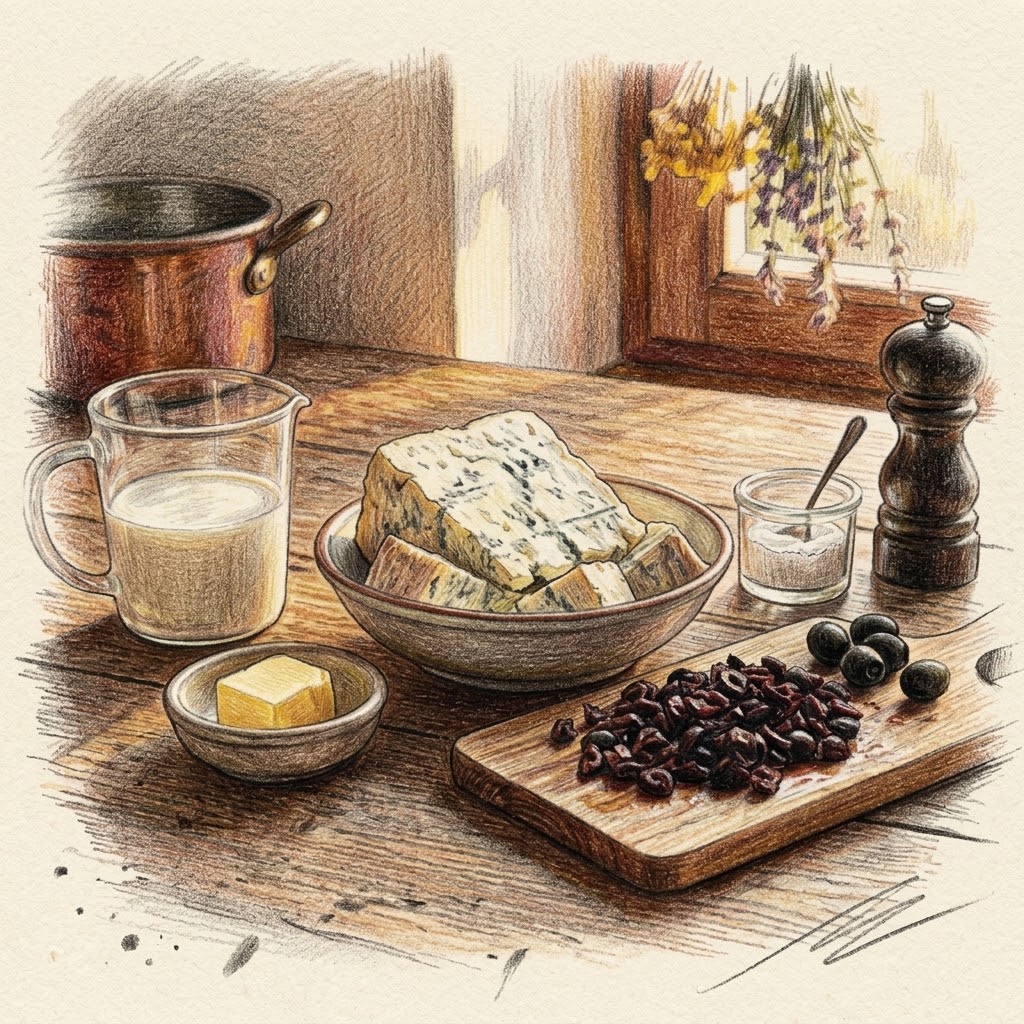

GENESIS
The union between gorgonzola and radicchio represents one of the most celebrated alliances in the gastronomic heritage of Northern Italy, seamlessly marrying the excellence of two neighboring territories: Lombardy and Veneto. Gorgonzola is a raw-paste blue cheese of ancient lineage, whose origins, by tradition, are said to trace back to the year 879 in the namesake town on the outskirts of Milan. Today safeguarded by the PDO designation, its creation requires the introduction of Penicillium spores into cow's milk, giving rise to those signature blue-green veins and that unmistakable flavor profile which oscillates between sweet and piquant, according to its maturation.
Radicchio, most notably the red variety from Treviso, possesses an equally spellbinding history. While chicories have been savored since antiquity, the refined technique of bleaching—which bestows upon the radicchio its characteristic crispness and intense ruby-red hue striped with snow-white—was perfected in the second half of the nineteenth century by the Belgian agronomist Francesco Van Den Borre. This vegetable is distinguished by a noble bitter note that marries harmoniously with the richness and velvety creaminess of the cheese.
From an organoleptic and chemical perspective, this preparation plays gracefully upon the contrast between the sweet undertones of the gorgonzola and the subtle bitterness of the radicchio. The addition of walnuts is not merely a tribute to rustic tradition, but serves to introduce a protein-rich component and a crisp texture that balances the sublime softness of the sauce. Historically, this pairing emerged as a dressing for winter pasta dishes or as a sumptuous topping for crostini, reflecting the ancient necessity of utilizing nourishing ingredients readily available during the bleak winter months of the Po and Venetian plains. The elegance of its simplicity exalts the sheer quality of the raw ingredients, which must be of pristine freshness to truly elevate the dish.
PORTIONS (FOR 4 PERSONS)
THE RECIPE
Treviso Red Radicchio
Sweet Gorgonzola
Walnut Kernels
Shallot
Extra Virgin Olive Oil
Salt
Black pepper
300 gr
150 gr
40 gr
1
to taste
to taste
to taste
CURATION
For the Condiment:
Begin your preparation by meticulously cleansing the chicory. Remove the base of the stalk, which proves too fibrous, and separate the leaves. Wash the leaves under cold, running water, pat them dry with a pristine cloth or a salad spinner, and ribbon them into generous strips.
Take the shallot, peel it, and mince it finely. In a spacious skillet, pour a thread of extra virgin olive oil and warm it over a gentle flame. Add the minced shallot and allow it to sweat slowly, taking care that it does not take on too dark a color. If necessary, add a spoonful of water to gently coax its cooking.
When the shallot has rendered translucent, unite the chicory in the pan. Raise the flame slightly and sauté for about five or six minutes. The chicory must soften, yet retain a delicate whisper of its crispness. Season with salt and black pepper, keeping in mind that the cheese will soon bestow its own savory richness.
While the chicory cooks, take the sweet Gorgonzola and dice it into cubes after removing its rind. Once the chicory is ready, lower the flame to a whisper and add the cubes of cheese. Stir with a wooden spoon until the cheese has completely dissolved, creating an enveloping cream that harmoniously binds with the vegetable.
Shell the walnuts and break the kernels coarsely with your hands or a knife. Add them to the condiment only at the final moment, just before extinguishing the fire, so that they preserve their crisp texture and their flavors do not merge excessively during cooking. Medley one last time to distribute the walnuts evenly and serve while still warm.
aspiration
Should you desire a texture of even greater fluidity, you may introduce a spoonful of milk or fresh cream as the Gorgonzola surrenders to the flame.
For a further aromatic cadence, bestow a few delicate leaves of fresh thyme upon the dish at the climax of its creation.
Perchance you prefer a more assertive character; you may replace half the measure of sweet Gorgonzola with its intensely piquant counterpart.
ultimate alchemies
GENESIS
The union between gorgonzola and radicchio represents one of the most celebrated alliances in the gastronomic heritage of Northern Italy, seamlessly marrying the excellence of two neighboring territories: Lombardy and Veneto. Gorgonzola is a raw-paste blue cheese of ancient lineage, whose origins, by tradition, are said to trace back to the year 879 in the namesake town on the outskirts of Milan. Today safeguarded by the PDO designation, its creation requires the introduction of Penicillium spores into cow's milk, giving rise to those signature blue-green veins and that unmistakable flavor profile which oscillates between sweet and piquant, according to its maturation.
Radicchio, most notably the red variety from Treviso, possesses an equally spellbinding history. While chicories have been savored since antiquity, the refined technique of bleaching—which bestows upon the radicchio its characteristic crispness and intense ruby-red hue striped with snow-white—was perfected in the second half of the nineteenth century by the Belgian agronomist Francesco Van Den Borre. This vegetable is distinguished by a noble bitter note that marries harmoniously with the richness and velvety creaminess of the cheese.
From an organoleptic and chemical perspective, this preparation plays gracefully upon the contrast between the sweet undertones of the gorgonzola and the subtle bitterness of the radicchio. The addition of walnuts is not merely a tribute to rustic tradition, but serves to introduce a protein-rich component and a crisp texture that balances the sublime softness of the sauce. Historically, this pairing emerged as a dressing for winter pasta dishes or as a sumptuous topping for crostini, reflecting the ancient necessity of utilizing nourishing ingredients readily available during the bleak winter months of the Po and Venetian plains. The elegance of its simplicity exalts the sheer quality of the raw ingredients, which must be of pristine freshness to truly elevate the dish.
PORTIONS (FOR 4 PERSONS)
THE RECIPE
Treviso Red Radicchio
Sweet Gorgonzola
Walnut Kernels
Shallot
Extra Virgin Olive Oil
Salt
Black pepper
300 gr
150 gr
40 gr
1
to taste
to taste
to taste
CURATION
For the Condiment:
Begin your preparation by meticulously cleansing the chicory. Remove the base of the stalk, which proves too fibrous, and separate the leaves. Wash the leaves under cold, running water, pat them dry with a pristine cloth or a salad spinner, and ribbon them into generous strips.
Take the shallot, peel it, and mince it finely. In a spacious skillet, pour a thread of extra virgin olive oil and warm it over a gentle flame. Add the minced shallot and allow it to sweat slowly, taking care that it does not take on too dark a color. If necessary, add a spoonful of water to gently coax its cooking.
When the shallot has rendered translucent, unite the chicory in the pan. Raise the flame slightly and sauté for about five or six minutes. The chicory must soften, yet retain a delicate whisper of its crispness. Season with salt and black pepper, keeping in mind that the cheese will soon bestow its own savory richness.
While the chicory cooks, take the sweet Gorgonzola and dice it into cubes after removing its rind. Once the chicory is ready, lower the flame to a whisper and add the cubes of cheese. Stir with a wooden spoon until the cheese has completely dissolved, creating an enveloping cream that harmoniously binds with the vegetable.
Shell the walnuts and break the kernels coarsely with your hands or a knife. Add them to the condiment only at the final moment, just before extinguishing the fire, so that they preserve their crisp texture and their flavors do not merge excessively during cooking. Medley one last time to distribute the walnuts evenly and serve while still warm.
aspiration
Should you desire a texture of even greater fluidity, you may introduce a spoonful of milk or fresh cream as the Gorgonzola surrenders to the flame.
For a further aromatic cadence, bestow a few delicate leaves of fresh thyme upon the dish at the climax of its creation.
Perchance you prefer a more assertive character; you may replace half the measure of sweet Gorgonzola with its intensely piquant counterpart.