THE RAGÙ OF PELLEGRINO ARTUSI
Veal, Pancetta, Butter, Carrots, Celery, Onions
Effortless
Emilia-Romagna
110 minutes
380 Kcal
THE RAGÙ OF PELLEGRINO ARTUSI
Veal, Pancetta, Butter, Carrots, Celery, Onions
Effortless
Emilia-Romagna
110 minutes
380 Kcal
THE RAGÙ OF PELLEGRINO ARTUSI
Veal, Pancetta, Butter, Carrots, Celery, Onions
Effortless
Emilia-Romagna
110 minutes
380 Kcal
GENESIS
The recipe for ragu00f9 described by Pellegrino Artusi in his celebrated manual "Science in the Kitchen and the Art of Eating Well," first published in 1891, stands as a fundamental testament to the transition of Italian gastronomy toward modernity. In particular, we look to recipe number 87, entitled "Maccheroni alla bolognese," wherein the author illustrates the preparation of what we now regard as the ancestor of modern ragu00f9 alla bolognese. Unlike contemporary renderings, Artusi's version is a "white" ragu00f9, thus devoid of tomato, an ingredient which at the time had not yet become the absolute sovereign of pasta condiments in Northern Italy.
Artusi prescribes the use of lean veal cut into delicate cubes, rather than minced, to preserve the inherent texture and original essence of the raw ingredient. The aromatic foundation is composed of the classic finely chopped battuto of herbs (onion, carrot, and celery) gently simmered in butter and pancetta. A distinctive element of his creation is the final addition of a pinch of flour to bind the pan juices, alongside the use of meat broth for a slow, contemplative simmer. The author further whispers of the possibility of enriching the sauce with seasonal or prestigious treasures, such as dried wild mushrooms, truffles, or chicken livers, rendering the dish exquisitely versatile and adaptable to the social standing of the household. This ragu00f9 embodies the Artusian philosophy of "good taste" and wholesomeness, placing supreme emphasis upon the nobility of the ingredients and the simplicity of their culinary execution.
PORTIONS (FOR 4 PERSONS)
THE RECIPE
Veal pulp
Pork belly
Butter
Onion
Carrot
Celery
White flour
Meat broth
Salt
Pepper
Nutmeg
250 g
50 g
40 g
1/4
1/2
a small morsel
1 tablespoon
200 ml
to taste
to taste
to taste
CURATION
For the seasoning:
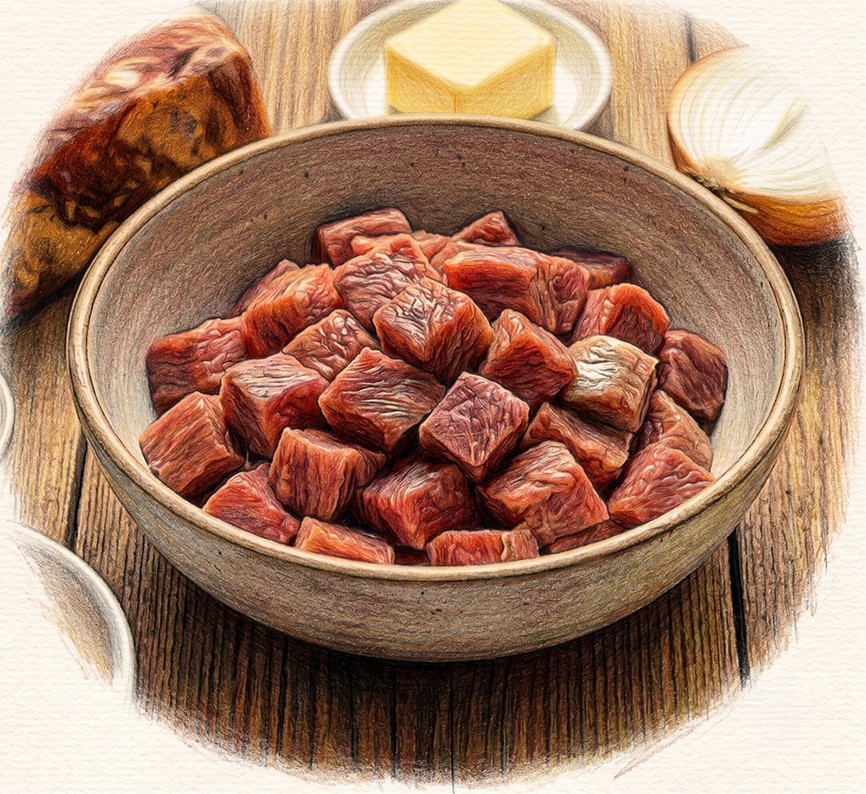
Take the loin of veal and, with a finely honed blade, dice it into minuscule cubes, transport of hand mimicking a rustic mince. Proceed in the selfsame manner with the pork belly, rendering it into tiny fragments. Finely mince the onion, carrot, and celery until you achieve a harmonious soffritto.
In a pot of earthenware or copper, gently melt the butter and introduce the pork belly. When the fat of the belly begins to turn translucent, add the minced aromatic herbs and let them soften over a sigh of fire until the onion turns golden. At this juncture, raise the flame slightly and add the veal. Sear the meat thoroughly, stirring frequently, so that it captures color upon every side.
Once the meat is beautifully browned, dust it with a spoonful of flour, stirring meticulously to prevent the formation of any clumps. Season with salt and pepper, then bestow a grating of nutmeg. Begin to pour the meat broth, ladle by ladle, barely skimming the ingredients. Lower the flame to its absolute minimum, cover the vessel, and allow it to simmer slowly for about an hour and a half. Should you observe the condiment drying excessively, enrich it with more warm broth during the cooking process. The ultimate creation must be a beautifully bound sauce, wherein the essences of the meat and the aromatics are in perfect, poetic harmony.
aspiration
To render the ragoût yet more delectable, you may introduce dried mushrooms, previously rehydrated in tepid water and finely minced.
Should you desire a more pronounced note of flavor, you may unite finely chopped chicken livers to the simmer midway through its slow cooking.
Artusi suggests, for those who cherish a creamier texture, the addition of a half-glass of fresh cream just prior to removing the ragoût from the hearth.
Ever employ a fresh meat broth to guarantee the utmost depth of flavor.



GENESIS
The recipe for ragu00f9 described by Pellegrino Artusi in his celebrated manual "Science in the Kitchen and the Art of Eating Well," first published in 1891, stands as a fundamental testament to the transition of Italian gastronomy toward modernity. In particular, we look to recipe number 87, entitled "Maccheroni alla bolognese," wherein the author illustrates the preparation of what we now regard as the ancestor of modern ragu00f9 alla bolognese. Unlike contemporary renderings, Artusi's version is a "white" ragu00f9, thus devoid of tomato, an ingredient which at the time had not yet become the absolute sovereign of pasta condiments in Northern Italy.
Artusi prescribes the use of lean veal cut into delicate cubes, rather than minced, to preserve the inherent texture and original essence of the raw ingredient. The aromatic foundation is composed of the classic finely chopped battuto of herbs (onion, carrot, and celery) gently simmered in butter and pancetta. A distinctive element of his creation is the final addition of a pinch of flour to bind the pan juices, alongside the use of meat broth for a slow, contemplative simmer. The author further whispers of the possibility of enriching the sauce with seasonal or prestigious treasures, such as dried wild mushrooms, truffles, or chicken livers, rendering the dish exquisitely versatile and adaptable to the social standing of the household. This ragu00f9 embodies the Artusian philosophy of "good taste" and wholesomeness, placing supreme emphasis upon the nobility of the ingredients and the simplicity of their culinary execution.
PORTIONS (FOR 4 PERSONS)
THE RECIPE
Veal pulp
Pork belly
Butter
Onion
Carrot
Celery
White flour
Meat broth
Salt
Pepper
Nutmeg
250 g
50 g
40 g
1/4
1/2
a small morsel
1 tablespoon
200 ml
to taste
to taste
to taste
CURATION
For the seasoning:
Take the loin of veal and, with a finely honed blade, dice it into minuscule cubes, transport of hand mimicking a rustic mince. Proceed in the selfsame manner with the pork belly, rendering it into tiny fragments. Finely mince the onion, carrot, and celery until you achieve a harmonious soffritto.
In a pot of earthenware or copper, gently melt the butter and introduce the pork belly. When the fat of the belly begins to turn translucent, add the minced aromatic herbs and let them soften over a sigh of fire until the onion turns golden. At this juncture, raise the flame slightly and add the veal. Sear the meat thoroughly, stirring frequently, so that it captures color upon every side.
Once the meat is beautifully browned, dust it with a spoonful of flour, stirring meticulously to prevent the formation of any clumps. Season with salt and pepper, then bestow a grating of nutmeg. Begin to pour the meat broth, ladle by ladle, barely skimming the ingredients. Lower the flame to its absolute minimum, cover the vessel, and allow it to simmer slowly for about an hour and a half. Should you observe the condiment drying excessively, enrich it with more warm broth during the cooking process. The ultimate creation must be a beautifully bound sauce, wherein the essences of the meat and the aromatics are in perfect, poetic harmony.
aspiration
To render the ragoût yet more delectable, you may introduce dried mushrooms, previously rehydrated in tepid water and finely minced.
Should you desire a more pronounced note of flavor, you may unite finely chopped chicken livers to the simmer midway through its slow cooking.
Artusi suggests, for those who cherish a creamier texture, the addition of a half-glass of fresh cream just prior to removing the ragoût from the hearth.
Ever employ a fresh meat broth to guarantee the utmost depth of flavor.
ultimate alchemies
GENESIS
The recipe for ragu00f9 described by Pellegrino Artusi in his celebrated manual "Science in the Kitchen and the Art of Eating Well," first published in 1891, stands as a fundamental testament to the transition of Italian gastronomy toward modernity. In particular, we look to recipe number 87, entitled "Maccheroni alla bolognese," wherein the author illustrates the preparation of what we now regard as the ancestor of modern ragu00f9 alla bolognese. Unlike contemporary renderings, Artusi's version is a "white" ragu00f9, thus devoid of tomato, an ingredient which at the time had not yet become the absolute sovereign of pasta condiments in Northern Italy.
Artusi prescribes the use of lean veal cut into delicate cubes, rather than minced, to preserve the inherent texture and original essence of the raw ingredient. The aromatic foundation is composed of the classic finely chopped battuto of herbs (onion, carrot, and celery) gently simmered in butter and pancetta. A distinctive element of his creation is the final addition of a pinch of flour to bind the pan juices, alongside the use of meat broth for a slow, contemplative simmer. The author further whispers of the possibility of enriching the sauce with seasonal or prestigious treasures, such as dried wild mushrooms, truffles, or chicken livers, rendering the dish exquisitely versatile and adaptable to the social standing of the household. This ragu00f9 embodies the Artusian philosophy of "good taste" and wholesomeness, placing supreme emphasis upon the nobility of the ingredients and the simplicity of their culinary execution.
PORTIONS (FOR 4 PERSONS)
THE RECIPE
Veal pulp
Pork belly
Butter
Onion
Carrot
Celery
White flour
Meat broth
Salt
Pepper
Nutmeg
250 g
50 g
40 g
1/4
1/2
a small morsel
1 tablespoon
200 ml
to taste
to taste
to taste
CURATION
For the seasoning:
Take the loin of veal and, with a finely honed blade, dice it into minuscule cubes, transport of hand mimicking a rustic mince. Proceed in the selfsame manner with the pork belly, rendering it into tiny fragments. Finely mince the onion, carrot, and celery until you achieve a harmonious soffritto.
In a pot of earthenware or copper, gently melt the butter and introduce the pork belly. When the fat of the belly begins to turn translucent, add the minced aromatic herbs and let them soften over a sigh of fire until the onion turns golden. At this juncture, raise the flame slightly and add the veal. Sear the meat thoroughly, stirring frequently, so that it captures color upon every side.
Once the meat is beautifully browned, dust it with a spoonful of flour, stirring meticulously to prevent the formation of any clumps. Season with salt and pepper, then bestow a grating of nutmeg. Begin to pour the meat broth, ladle by ladle, barely skimming the ingredients. Lower the flame to its absolute minimum, cover the vessel, and allow it to simmer slowly for about an hour and a half. Should you observe the condiment drying excessively, enrich it with more warm broth during the cooking process. The ultimate creation must be a beautifully bound sauce, wherein the essences of the meat and the aromatics are in perfect, poetic harmony.
aspiration
To render the ragoût yet more delectable, you may introduce dried mushrooms, previously rehydrated in tepid water and finely minced.
Should you desire a more pronounced note of flavor, you may unite finely chopped chicken livers to the simmer midway through its slow cooking.
Artusi suggests, for those who cherish a creamier texture, the addition of a half-glass of fresh cream just prior to removing the ragoût from the hearth.
Ever employ a fresh meat broth to guarantee the utmost depth of flavor.