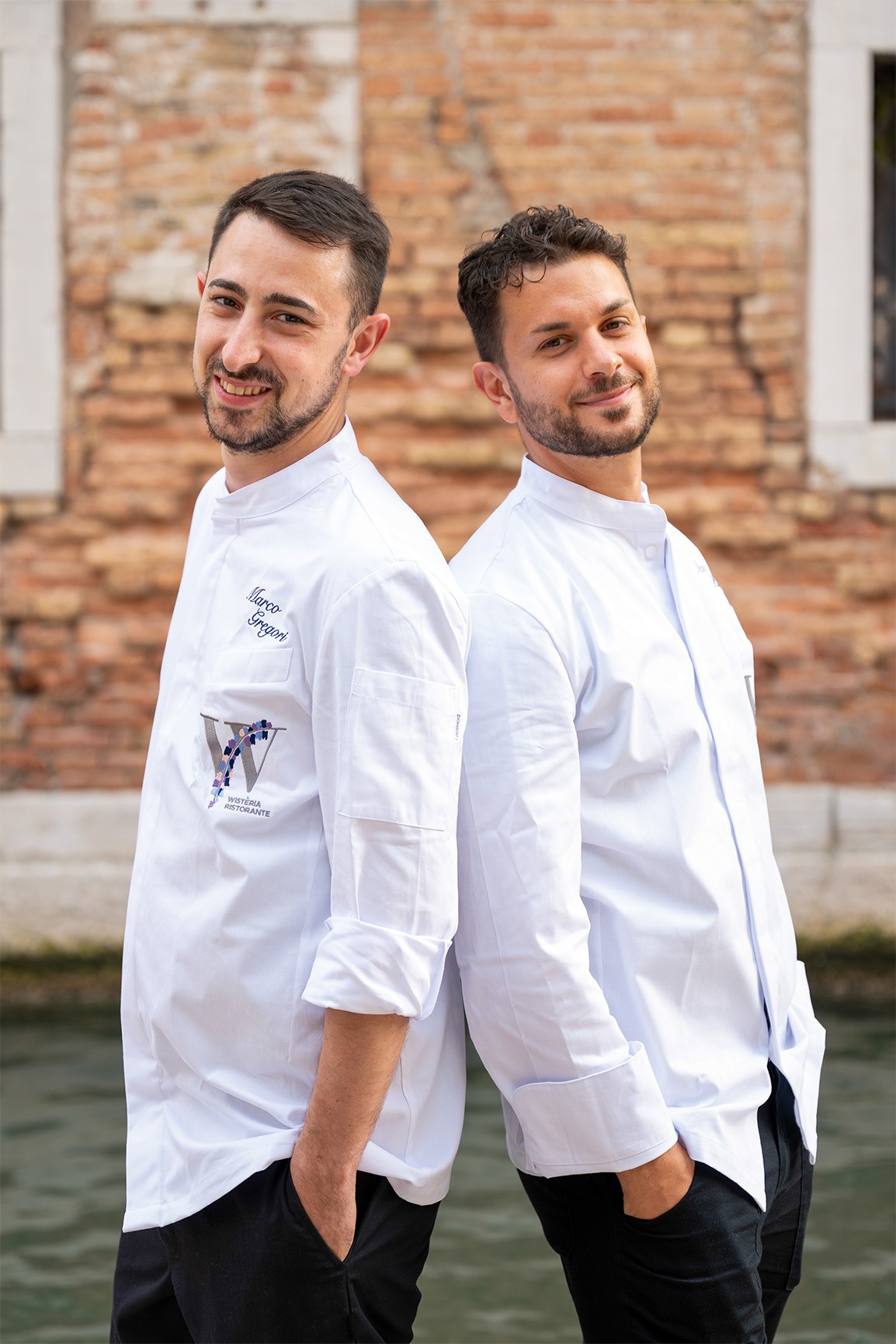
MARCO GREGORI and NICOLÒ POMETTI
two visions, one culinary art
1997
The Tower of Quartesolo - Pontremoli
Lagoonal - Contemporary
MARCO GREGORI and NICOLÒ POMETTI
two visions, one culinary art
1997
The Tower of Quartesolo - Pontremoli
Lagoonal - Contemporary
MARCO GREGORI and NICOLÒ POMETTI
two visions, one culinary art
1997
The Tower of Quartesolo - Pontremoli
Lagoonal - Contemporary
CURRICULUM VITAE
Marco Gregori is born in Torre di Quartesolo, in the heart of Veneto, twenty minutes away from one of the restaurants - La Peca - that will define his culinary destiny. Gastronomy beckons to him early and with absolute clarity: he enrols in the hotel school of Recoaro, then begins his ascent through the kitchens of the region, journeying from Corrado Fasolato in Vicenza to Il Ridotto in Venice, under the guidance of Marco Bravetti. It is here that a metamorphosis occurs: that anarchic experience, as he himself describes it, imparts a centrifugal force within him, urging him outward, toward the unknown.
He departs for Spain, where he remains for three years. He works at Aponiente, three Michelin stars, a frontier kitchen that beholds the sea as an unexplored repertoire of tastes. It is there that he encounters Nicolò. His native Veneto, for a brief spell, recedes — yet it is precisely through that distance that he understands where his heart wishes to return.
His homecoming takes place at La Peca, where the fellowship between the two chefs is forged and takes shape. From that convergence arises the shared decision to take the helm at Wistèria, bringing with them a culinary method built on rigour, fluid movement, and the profound awareness of those who have gazed afar to better comprehend their origins.
Nicolò Pometti is born in Pontremoli, in Lunigiana, into a family of restaurateurs. Yet gastronomy, for him, is long an unwelcome realm: the chaos of service, the crowded larders, and the dense, lingering aromas feel alien. He chooses a linguistic high school, and subsequently begins working in the family enterprise, specialized in the trade and distribution of traditional products of Lunigiana. This is tangible work, rooted deeply in the raw material.
It is the growing cultural renaissance surrounding the figure of the chef that awakens something within him, whispering that, through gastronomy, he too might express his innermost self. He enrols at Alma, and from there his path unfolds with poetic coherence: an apprenticeship at La Peca in Vicenza, then a passage under Niko Romito, culminating in the Iberian adventure at Aponiente, three Michelin stars, whose kitchen interrogates the ocean even in its most unusual depths.
It is there that Marco and Nicolò meet. Two distinct trajectories — one rooted in Veneto, the other germinated in Tuscany — which cross paths in Andalusia, finding the true purpose of their shared journey. Their return to La Peca seals their alliance, and the decision to jointly direct the kitchen at Wistèria becomes the natural progression: not a mere coincidence, but a destined and shared course.
dialogues
At Wistèria, gastronomy is born from two gazes collaborating in unison, transcending traditional hierarchy. When composing a pasta dish, how do your dual sensibilities harmonize?
Our sensibilities perpetually intertwine through a daily communion, which in measured steps continuously conceives new ideas, culinary creations, and horizons. We oft divine equilibrium by blending our diverse influences, which allow us to fashion something ever unexpected, yet profoundly rooted in our shared identity.
Venice is a city of water, of commerce, of spices, of safe harbors. In what manner does this Levantine geography permeate your philosophy of pasta?
In our vision of pasta, the city's vibrant dynamics enter through an enduring relationship with companions and purveyors who bridges Venice with the wider world. Among the most emblematic examples are the citrus fruits sourced from the Todoli Citrus Foundaciò in Valencia.
Your cuisine appears to seek a poise between technical precision and culinary wonder. Pasta, by its very nature, is a highly codified medium: how do you introduce the unexpected without compromising its clarity?
We have sought to unveil the unexpected while preserving legibility by thinking beyond conventional paradigms — a gift of our sojourns abroad, most notably at Aponiente in Cádiz — and by interpreting recipes with a strictly personal signature. We strive to diminish fats to allow the pristine, recognizable herbaceous notes to emerge, imparting fresh, acidic, or balsamic accents according to the rhythm of the seasons.
You both depart from an illustrious path at La Peca. In the construction of a first course, what heritage do you carry forward from that school of rigor, purity, and depth of flavor?
From that formative epoch, we retain the harmony and balance of the raw ingredients we employ, elevating the pasta of small-scale artisans without obscuring its unique character. In every creation, all elements must coexist and remain beautifully distinct.
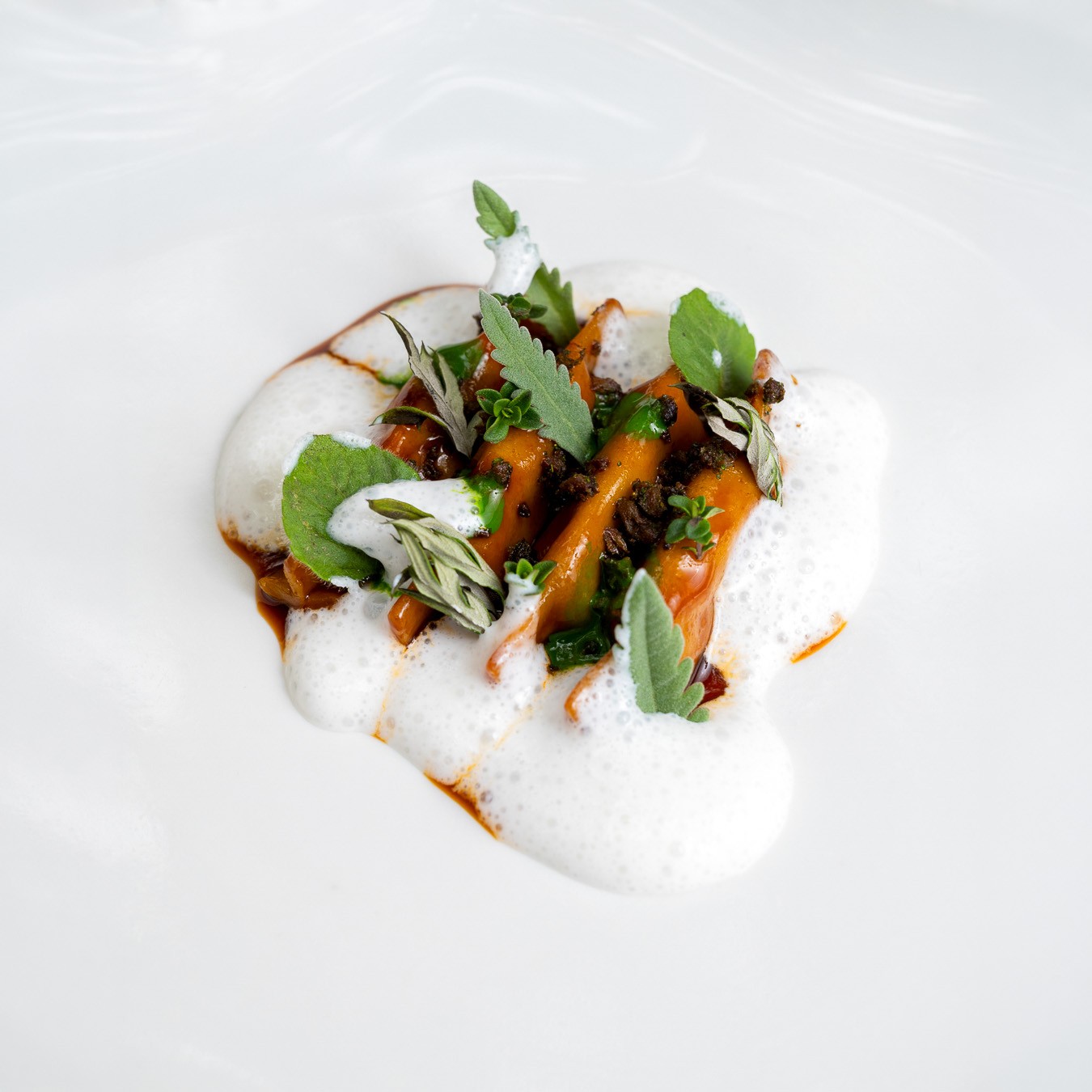
The menu features the Lamb 'Caramelle' with goat's milk yogurt and bitter herbs. What role, in your eyes, does stuffed pasta assume: a relic of domestic memory, a technical exercise, or a miniature architecture of taste?
We believe that stuffed pasta, within the culinary laboratory of Wistèria, simultaneously embodies domestic memory, technical mastery, and the architecture of taste. The former is found in the ancestral gestures of handmade pasta; technical execution lies in adapting these gestures to a dining experience removed from the ordinary; the architecture of taste manifests in our desire to bestow upon our preparations a personal and distinctive imprint, built upon our collective heritage.
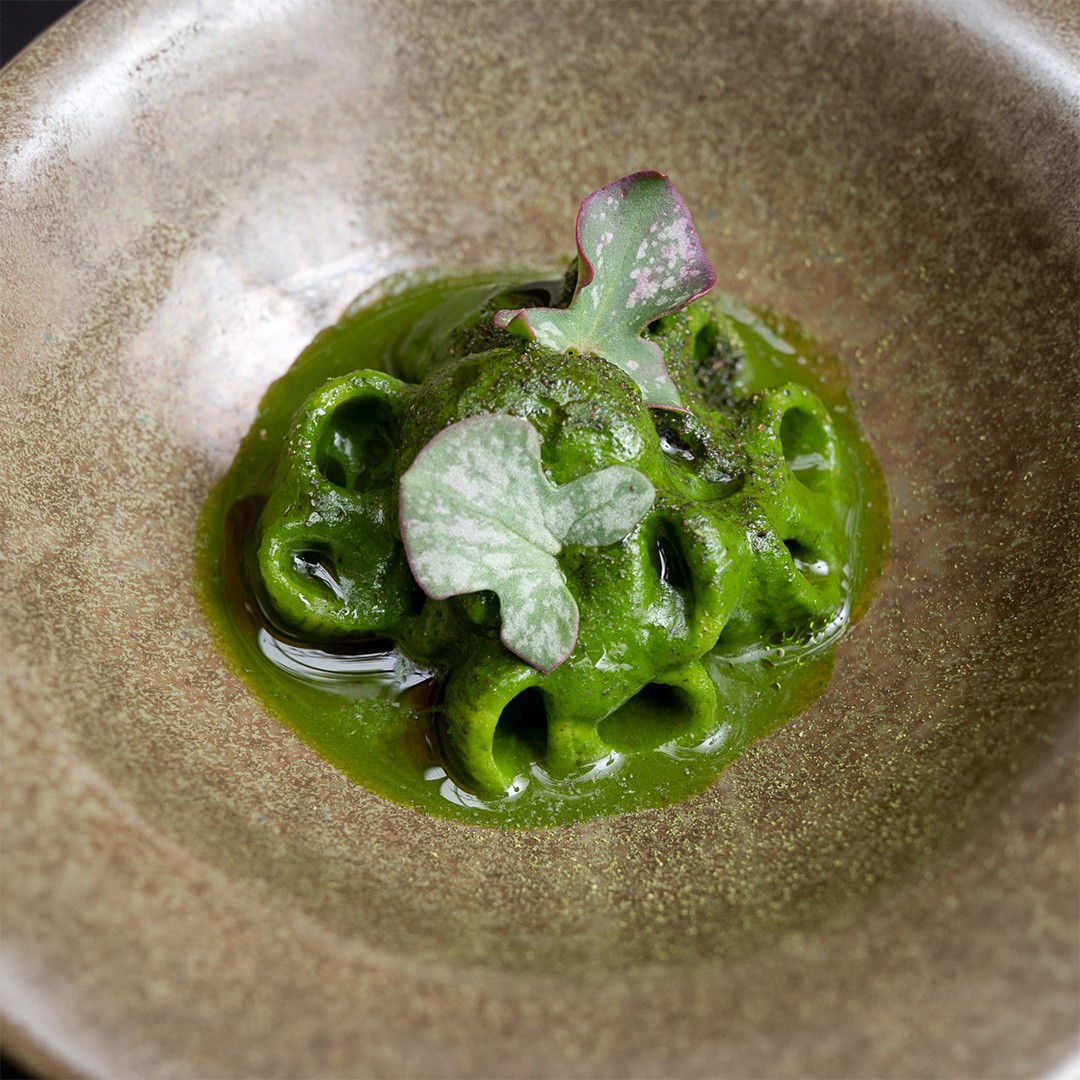
The Pipe pasta with chickweed and snails seems to celebrate humble, almost terrestrial elements, yet with a distinctly contemporary 'quid'. How is a pasta dish born from such silent ingredients?
A dish composed of silent ingredients is born from the capacity to decelerate and perceive the quiet vibrations of nature within an increasingly frenetic epoch. We hold the seasonality of our ingredients in high reverence, striving to mirror it faithfully in our recipes. In this course, we employ chickweed—a wild herb common to our local soil—to bestow a vibrant green, vegetal component that elevates the sweetness and earthy resonance of the snails, which awaken at this time with the turning of the season. We crown the dish with an essence of wild campion and wood sorrel.
In a pasta course, the decisive element is often not the most visible: it may be a reduction, a whisper of bitterness, an acidic note, or a subtle texture. What, for you, is the precise moment when a pasta dish achieves completion?
Our gastronomy is the orchestration of all these gustatory components; we deem a first course complete when the bite achieves perfect poise, inviting the palate effortlessly to the next. Italian pasta always carries an innate sense of comfort, even when elevated to the realms of haute cuisine.
How does one prevent it from fading into a shadow of nostalgia, transforming it instead into a contemporary gastronomic language?
Our method of converting a pasta dish into a contemporary culinary vernacular lies in distilling our memories of traditional pairings, accentuating their flavor profiles to render them as vivid and luminous as possible upon the palate.
Wistèria explores deeply the concept of 'serendipity': the unexpected that unfolds while seeking something else entirely. Has a pasta dish ever truly risen from a mistake, a detour, or a lateral discovery?
Most assuredly, for such is the nature of any creative quest and research. Often, one does not know precisely what is sought until, perhaps by a stroke of fortune, one encounters that very revelation.
Looking to the destiny of Italian gastronomy, what can pasta yet articulate: will it remain the guardian of identity, a crucible for research, or perhaps both in unison?
Pasta will inexorably remain at the heart of every Italian chef's contemplation, preserving the sacred identity of our cuisine; yet, the tenets by which we seek to transform it into a contemporary culinary language will continuously evolve.
CURRICULUM VITAE
Marco Gregori is born in Torre di Quartesolo, in the heart of Veneto, twenty minutes away from one of the restaurants - La Peca - that will define his culinary destiny. Gastronomy beckons to him early and with absolute clarity: he enrols in the hotel school of Recoaro, then begins his ascent through the kitchens of the region, journeying from Corrado Fasolato in Vicenza to Il Ridotto in Venice, under the guidance of Marco Bravetti. It is here that a metamorphosis occurs: that anarchic experience, as he himself describes it, imparts a centrifugal force within him, urging him outward, toward the unknown.
He departs for Spain, where he remains for three years. He works at Aponiente, three Michelin stars, a frontier kitchen that beholds the sea as an unexplored repertoire of tastes. It is there that he encounters Nicolò. His native Veneto, for a brief spell, recedes — yet it is precisely through that distance that he understands where his heart wishes to return.
His homecoming takes place at La Peca, where the fellowship between the two chefs is forged and takes shape. From that convergence arises the shared decision to take the helm at Wistèria, bringing with them a culinary method built on rigour, fluid movement, and the profound awareness of those who have gazed afar to better comprehend their origins.
Nicolò Pometti is born in Pontremoli, in Lunigiana, into a family of restaurateurs. Yet gastronomy, for him, is long an unwelcome realm: the chaos of service, the crowded larders, and the dense, lingering aromas feel alien. He chooses a linguistic high school, and subsequently begins working in the family enterprise, specialized in the trade and distribution of traditional products of Lunigiana. This is tangible work, rooted deeply in the raw material.
It is the growing cultural renaissance surrounding the figure of the chef that awakens something within him, whispering that, through gastronomy, he too might express his innermost self. He enrols at Alma, and from there his path unfolds with poetic coherence: an apprenticeship at La Peca in Vicenza, then a passage under Niko Romito, culminating in the Iberian adventure at Aponiente, three Michelin stars, whose kitchen interrogates the ocean even in its most unusual depths.
It is there that Marco and Nicolò meet. Two distinct trajectories — one rooted in Veneto, the other germinated in Tuscany — which cross paths in Andalusia, finding the true purpose of their shared journey. Their return to La Peca seals their alliance, and the decision to jointly direct the kitchen at Wistèria becomes the natural progression: not a mere coincidence, but a destined and shared course.
dialogues
At Wistèria, gastronomy is born from two gazes collaborating in unison, transcending traditional hierarchy. When composing a pasta dish, how do your dual sensibilities harmonize?
Our sensibilities perpetually intertwine through a daily communion, which in measured steps continuously conceives new ideas, culinary creations, and horizons. We oft divine equilibrium by blending our diverse influences, which allow us to fashion something ever unexpected, yet profoundly rooted in our shared identity.
Venice is a city of water, of commerce, of spices, of safe harbors. In what manner does this Levantine geography permeate your philosophy of pasta?
In our vision of pasta, the city's vibrant dynamics enter through an enduring relationship with companions and purveyors who bridges Venice with the wider world. Among the most emblematic examples are the citrus fruits sourced from the Todoli Citrus Foundaciò in Valencia.
Your cuisine appears to seek a poise between technical precision and culinary wonder. Pasta, by its very nature, is a highly codified medium: how do you introduce the unexpected without compromising its clarity?
We have sought to unveil the unexpected while preserving legibility by thinking beyond conventional paradigms — a gift of our sojourns abroad, most notably at Aponiente in Cádiz — and by interpreting recipes with a strictly personal signature. We strive to diminish fats to allow the pristine, recognizable herbaceous notes to emerge, imparting fresh, acidic, or balsamic accents according to the rhythm of the seasons.
You both depart from an illustrious path at La Peca. In the construction of a first course, what heritage do you carry forward from that school of rigor, purity, and depth of flavor?
From that formative epoch, we retain the harmony and balance of the raw ingredients we employ, elevating the pasta of small-scale artisans without obscuring its unique character. In every creation, all elements must coexist and remain beautifully distinct.
The menu features the Lamb 'Caramelle' with goat's milk yogurt and bitter herbs. What role, in your eyes, does stuffed pasta assume: a relic of domestic memory, a technical exercise, or a miniature architecture of taste?
We believe that stuffed pasta, within the culinary laboratory of Wistèria, simultaneously embodies domestic memory, technical mastery, and the architecture of taste. The former is found in the ancestral gestures of handmade pasta; technical execution lies in adapting these gestures to a dining experience removed from the ordinary; the architecture of taste manifests in our desire to bestow upon our preparations a personal and distinctive imprint, built upon our collective heritage.
The Pipe pasta with chickweed and snails seems to celebrate humble, almost terrestrial elements, yet with a distinctly contemporary 'quid'. How is a pasta dish born from such silent ingredients?
A dish composed of silent ingredients is born from the capacity to decelerate and perceive the quiet vibrations of nature within an increasingly frenetic epoch. We hold the seasonality of our ingredients in high reverence, striving to mirror it faithfully in our recipes. In this course, we employ chickweed—a wild herb common to our local soil—to bestow a vibrant green, vegetal component that elevates the sweetness and earthy resonance of the snails, which awaken at this time with the turning of the season. We crown the dish with an essence of wild campion and wood sorrel.
In a pasta course, the decisive element is often not the most visible: it may be a reduction, a whisper of bitterness, an acidic note, or a subtle texture. What, for you, is the precise moment when a pasta dish achieves completion?
Our gastronomy is the orchestration of all these gustatory components; we deem a first course complete when the bite achieves perfect poise, inviting the palate effortlessly to the next. Italian pasta always carries an innate sense of comfort, even when elevated to the realms of haute cuisine.
How does one prevent it from fading into a shadow of nostalgia, transforming it instead into a contemporary gastronomic language?
Our method of converting a pasta dish into a contemporary culinary vernacular lies in distilling our memories of traditional pairings, accentuating their flavor profiles to render them as vivid and luminous as possible upon the palate.
Wistèria explores deeply the concept of 'serendipity': the unexpected that unfolds while seeking something else entirely. Has a pasta dish ever truly risen from a mistake, a detour, or a lateral discovery?
Most assuredly, for such is the nature of any creative quest and research. Often, one does not know precisely what is sought until, perhaps by a stroke of fortune, one encounters that very revelation.
Looking to the destiny of Italian gastronomy, what can pasta yet articulate: will it remain the guardian of identity, a crucible for research, or perhaps both in unison?
Pasta will inexorably remain at the heart of every Italian chef's contemplation, preserving the sacred identity of our cuisine; yet, the tenets by which we seek to transform it into a contemporary culinary language will continuously evolve.
CURRICULUM VITAE
Marco Gregori is born in Torre di Quartesolo, in the heart of Veneto, twenty minutes away from one of the restaurants - La Peca - that will define his culinary destiny. Gastronomy beckons to him early and with absolute clarity: he enrols in the hotel school of Recoaro, then begins his ascent through the kitchens of the region, journeying from Corrado Fasolato in Vicenza to Il Ridotto in Venice, under the guidance of Marco Bravetti. It is here that a metamorphosis occurs: that anarchic experience, as he himself describes it, imparts a centrifugal force within him, urging him outward, toward the unknown.
He departs for Spain, where he remains for three years. He works at Aponiente, three Michelin stars, a frontier kitchen that beholds the sea as an unexplored repertoire of tastes. It is there that he encounters Nicolò. His native Veneto, for a brief spell, recedes — yet it is precisely through that distance that he understands where his heart wishes to return.
His homecoming takes place at La Peca, where the fellowship between the two chefs is forged and takes shape. From that convergence arises the shared decision to take the helm at Wistèria, bringing with them a culinary method built on rigour, fluid movement, and the profound awareness of those who have gazed afar to better comprehend their origins.
Nicolò Pometti is born in Pontremoli, in Lunigiana, into a family of restaurateurs. Yet gastronomy, for him, is long an unwelcome realm: the chaos of service, the crowded larders, and the dense, lingering aromas feel alien. He chooses a linguistic high school, and subsequently begins working in the family enterprise, specialized in the trade and distribution of traditional products of Lunigiana. This is tangible work, rooted deeply in the raw material.
It is the growing cultural renaissance surrounding the figure of the chef that awakens something within him, whispering that, through gastronomy, he too might express his innermost self. He enrols at Alma, and from there his path unfolds with poetic coherence: an apprenticeship at La Peca in Vicenza, then a passage under Niko Romito, culminating in the Iberian adventure at Aponiente, three Michelin stars, whose kitchen interrogates the ocean even in its most unusual depths.
It is there that Marco and Nicolò meet. Two distinct trajectories — one rooted in Veneto, the other germinated in Tuscany — which cross paths in Andalusia, finding the true purpose of their shared journey. Their return to La Peca seals their alliance, and the decision to jointly direct the kitchen at Wistèria becomes the natural progression: not a mere coincidence, but a destined and shared course.
dialogues
At Wistèria, gastronomy is born from two gazes collaborating in unison, transcending traditional hierarchy. When composing a pasta dish, how do your dual sensibilities harmonize?
Our sensibilities perpetually intertwine through a daily communion, which in measured steps continuously conceives new ideas, culinary creations, and horizons. We oft divine equilibrium by blending our diverse influences, which allow us to fashion something ever unexpected, yet profoundly rooted in our shared identity.
Venice is a city of water, of commerce, of spices, of safe harbors. In what manner does this Levantine geography permeate your philosophy of pasta?
In our vision of pasta, the city's vibrant dynamics enter through an enduring relationship with companions and purveyors who bridges Venice with the wider world. Among the most emblematic examples are the citrus fruits sourced from the Todoli Citrus Foundaciò in Valencia.
Your cuisine appears to seek a poise between technical precision and culinary wonder. Pasta, by its very nature, is a highly codified medium: how do you introduce the unexpected without compromising its clarity?
We have sought to unveil the unexpected while preserving legibility by thinking beyond conventional paradigms — a gift of our sojourns abroad, most notably at Aponiente in Cádiz — and by interpreting recipes with a strictly personal signature. We strive to diminish fats to allow the pristine, recognizable herbaceous notes to emerge, imparting fresh, acidic, or balsamic accents according to the rhythm of the seasons.
You both depart from an illustrious path at La Peca. In the construction of a first course, what heritage do you carry forward from that school of rigor, purity, and depth of flavor?
From that formative epoch, we retain the harmony and balance of the raw ingredients we employ, elevating the pasta of small-scale artisans without obscuring its unique character. In every creation, all elements must coexist and remain beautifully distinct.
The menu features the Lamb 'Caramelle' with goat's milk yogurt and bitter herbs. What role, in your eyes, does stuffed pasta assume: a relic of domestic memory, a technical exercise, or a miniature architecture of taste?
We believe that stuffed pasta, within the culinary laboratory of Wistèria, simultaneously embodies domestic memory, technical mastery, and the architecture of taste. The former is found in the ancestral gestures of handmade pasta; technical execution lies in adapting these gestures to a dining experience removed from the ordinary; the architecture of taste manifests in our desire to bestow upon our preparations a personal and distinctive imprint, built upon our collective heritage.
The Pipe pasta with chickweed and snails seems to celebrate humble, almost terrestrial elements, yet with a distinctly contemporary 'quid'. How is a pasta dish born from such silent ingredients?
A dish composed of silent ingredients is born from the capacity to decelerate and perceive the quiet vibrations of nature within an increasingly frenetic epoch. We hold the seasonality of our ingredients in high reverence, striving to mirror it faithfully in our recipes. In this course, we employ chickweed—a wild herb common to our local soil—to bestow a vibrant green, vegetal component that elevates the sweetness and earthy resonance of the snails, which awaken at this time with the turning of the season. We crown the dish with an essence of wild campion and wood sorrel.
In a pasta course, the decisive element is often not the most visible: it may be a reduction, a whisper of bitterness, an acidic note, or a subtle texture. What, for you, is the precise moment when a pasta dish achieves completion?
Our gastronomy is the orchestration of all these gustatory components; we deem a first course complete when the bite achieves perfect poise, inviting the palate effortlessly to the next. Italian pasta always carries an innate sense of comfort, even when elevated to the realms of haute cuisine.
How does one prevent it from fading into a shadow of nostalgia, transforming it instead into a contemporary gastronomic language?
Our method of converting a pasta dish into a contemporary culinary vernacular lies in distilling our memories of traditional pairings, accentuating their flavor profiles to render them as vivid and luminous as possible upon the palate.
Wistèria explores deeply the concept of 'serendipity': the unexpected that unfolds while seeking something else entirely. Has a pasta dish ever truly risen from a mistake, a detour, or a lateral discovery?
Most assuredly, for such is the nature of any creative quest and research. Often, one does not know precisely what is sought until, perhaps by a stroke of fortune, one encounters that very revelation.
Looking to the destiny of Italian gastronomy, what can pasta yet articulate: will it remain the guardian of identity, a crucible for research, or perhaps both in unison?
Pasta will inexorably remain at the heart of every Italian chef's contemplation, preserving the sacred identity of our cuisine; yet, the tenets by which we seek to transform it into a contemporary culinary language will continuously evolve.