INSPIRATION
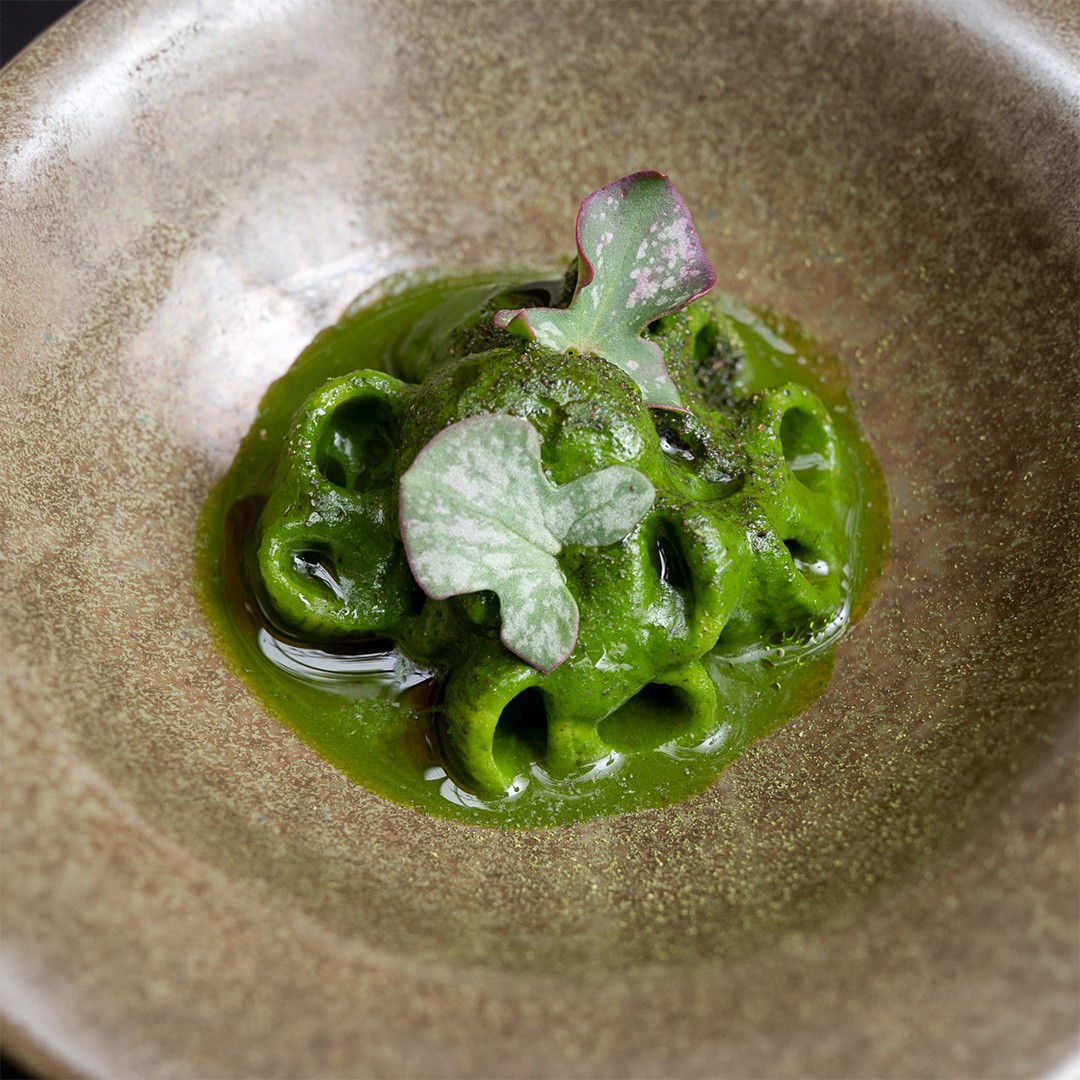
This dish is born from the desire to narrate spring through an original lens: to capture the very moment when snails awaken from their winter torpor, returning to populate the verdant sanctuaries of our trusted farm, cradled in Favaro near the outskirts of Venice.
To pay homage to this awakening, we cream the pipe pasta with a sauce of chickweed — a common, wild herb for which snails possess a voracious fondness — whilst at the base lies a slow-stewed preparation of the mollusks, a traditional element designed to evoke a sensory memory.
Completing the dish: a dusting of nettle powder, wild garlic oil, and an extract of bladder campion and wood sorrel, which guests pour directly onto the plate from the snail's shell — a simple gesture that invites their participation, transforming the meal into a moment of shared conviviality.
PORTIONS (FOR 4 PERSONS)
THE RECIPE
Noble reduction (1.5 L +
1 kg essential stock of guinea fowl)
Live snails
Onion
Meticulously prepared snail livers
Smooth puru00e9e of bladder campion
Smooth puru00e9e of chickweed
Red wine
Butter (lactose-free)
Parmigiano
Cold emulsion, bound with 8% starch
Guanciale
Carrot
Veloutu00e9 of chard
Essence of bladder campion
Celery
Essence of wood sorrel
Smooth puru00e9e of wild ramps
Water
Gelespessa
Laurel leaves
Shield sorrel leaves
Olive oil
White wine
Coarse mineral salt
Vinegar
Celery, carrot, onion
and laurel (for poaching)
Sage, thyme, rosemary,
laurel (aromatic bouquet)
Wild ramps / seed oil
(in ratio of 1 to 3)
Powdered wild ramps
Powdered nettle
Rainbow chard
Artisanal snail pasta (Pastificio Mancini)
Sorrel or shield rumex
Salted water
Salty and acidic accents
1.020 kg
1 kg
650 g
300 g
280 g
170 g
150 g
100 g
100 g
95 g
60 g
60 g
50 g
45 g
40 g
30 g
11 g
11 g
1 g
2
12
To taste
To taste
To taste
To taste
To taste
To taste
To taste
To taste
To taste
To taste
To taste
To taste
To taste
To taste
INGREDIENTS BY COMPOSITION
FOR THE PREPARATION OF
LIVE SNAILS
Snails yet vibrant with life
Lukewarm water
Coarse sea salt
Vinegar
Celery
Carrot
Onion
Bay leaf
Flowing water
FOR THE BRAISING OF
THE SNAILS
Blanched and meticulously cleaned snails
Butter (lactose-free)
Olive oil
Guanciale
Onion
Carrot
Celery
White wine
Guinea fowl stock essence
Sage
Thyme
Rosemary
Bay leaves
Pâté of snail livers
Lukewarm water
FOR THE SNAIL LIVER PÂTÉ
Brunoise of onion
Prepared snail livers
Red wine
White wine
Master stock essence
Bay leaves
Olive oil
FOR THE PIPA SAUCE
Smooth purée of bladder campion
(pacotized with 10% oil and 1% salt)
Smooth purée of chickweed
Smooth purée of wild garlic
Cream of Swiss chard (gently sautéed
with oil and a whisper of salt,
then puréed in the Bimby)
Water emulsified with 8% cold cream
FOR THE PARMIGIANO ESSENCE
Parmigiano
Olive oil
Water
FOR THE WILD GARLIC OIL
Wild garlic
Seed oil (in a ratio of
1 to 3 with the wild garlic)
FOR THE WILD GARLIC
DUST
Powdered wild garlic
Powdered stinging nettle
FOR THE ELIXIR OF BLADDER
CAMPION AND WOOD SORREL
Extract of bladder campion
Extract of wood sorrel
Gelespessa
FOR THE CONCENTRATED
SWISS CHARD CREAM
Rainbow Swiss chard
Olive oil
Salt
Water
FOR THE COMPOSITION OF THE DISH
Snail-shell pasta (from Pastificio Mancini)
Salted water
Salt and acidity
Wood sorrel leaves
To taste
To taste
To taste
To taste
To taste
To taste
To taste
To taste
To taste
700 g
100 g
50 g
60 g
150 g
60 g
40 g
350 g
1 kg
10 g
10 g
10 g
2
200 g
To taste
500 g
300 g
150 g
80 g
1.5 L
2
To taste
280 g
170 g
11 g
50 g
95 g
100 g
50 g
11 g
To taste
To taste
50%
50%
45 g
30 g
1 g
To taste
To taste
To taste
To taste
To taste
To taste
To taste
12
To taste
CURATION
For the purification of live snails:
Purge the living snails within a grand basin filled with tepid water, coarse salt, and vinegar. Repeat this ritual, renewing the salted and vinegared water every 30 minutes, for no fewer than four cycles. Once this essential purification is complete, rinse them meticulously under running water to banish all trace of the mucilage they have spun. Simmer them subsequently in a court-bouillon infused with celery, carrot, onion, and bay leaf for at least 45 minutes. Extract the snails from their shells with the aid of a delicate skewer, then gently separate their anatomy, discarding both mouth and intestine.For the braised snails in sauce:
Warm the butter and oil, allowing the rich fat of the guanciale to melt into them, then introduce the vegetables cut into a fine brunoise, gently coaxing them to tenderness without allowing them to take on color. Introduce the snails—freed of their veil of mucilage in warm water—and let them surrender their natural juices; once these have been absorbed back, bathe them in white wine. Once the spirit of the wine has vanished into air, gently place the bouquet garni within and cover the snails just to their crown with the rich stock. Cover with moistened parchment paper and foil, then let them simmer with profound patience. This slow braising knows no fixed hour, for it belongs to the nature of the snails chosen; after the first two hours have elapsed, inspect the preparation every hour, arresting the fire if they have reached perfection or letting them dream further on the hearth. Satisfied with the yield of the mollusk's bite, drain the snails upon a perforated tray nested over another, and pass the captured nectar through a fine sieve to banish any stray vegetable fibers. Reduce this liquid to your heart's desire, then emulsify it with the luxurious pâté of snail livers. Reunite the elements, binding them into a cohesive, velvety, and deeply concentrated sauce.For the pâté of snail livers:
Confect the onion in olive oil, allowing it to caramelize deeply and with great patience; indeed, such harmonious caramelization demands nearly an hour of gentle heat. Drain any excess oil once this golden alchemy is achieved, then deglaze first with white wine, and subsequently with red. Once the spirit of the wines has wept away, add the snail livers, letting them steep in the rich infusion for 8 to 10 minutes; during this embrace, introduce the bay leaves, then moisten with the stock little by little, letting it simmer until the liquids are beautifully bound. Blend the whole to a sublime purée in the Bimby, then pass it through a fine sieve until it becomes a slick, satin-smooth paste.For the pipa sauce:
Emulsify the ingredients within the Bimby (the paste of bladder campion, the chickweed paste, the wild garlic paste, the rich chard cream, and the starch-bound water prepared half an hour prior), until you achieve a sauce of perfect, velvety cling, free of any granulate or stray fiber.For the Parmigiano base:
Blend the ingredients in the Bimby at 80°C for 10 minutes, then filter the preparation through a fine mesh.For the wild garlic oil:
Infuse the wild garlic with the seed oil in the Bimby at 70°C, then allow it to decant and store the liquid gold.For the wild garlic powder:
Artfully blend the powdered wild garlic and powdered nettle in the prescribed proportions.For the extract of bladder campion and wood sorrel:
Combine the essence of bladder campion, the essence of wood sorrel, and the gelespessa to fashion a rich, syrup-like liqueur.For the concentrated chard cream:
Sauté the colorful chard with olive oil and a mere whisper of salt in a rondeau, allowing it to catch slightly at the bottom, then deglaze with drops of water to capture the elusive Maillard flavors. Once reduced almost to a paste and beautifully dried, blend in the Bimby to realize a smooth, deeply concentrated essence.For the plating:
Cook the snail-shaped pasta in salted water for 8 minutes, toss it in the pan with the Parmigiano base, and finally bind it with the herbaceous sauce. Adjust with salt and a touch of acidity. Arrange five snails bound with the toasted chard cream at the base of the dish, cradle the dressed pipe pasta upon them, and dust with the wild garlic powder and wild garlic oil. Complete the composition with twelve leaves of fresh wood sorrel. Aside, serve the essence of bladder campion and wood sorrel within a pristine snail shell, to be poured over the dish to bestow a final, vibrant note of acidity.
INSPIRATION
This dish is born from the desire to narrate spring through an original lens: to capture the very moment when snails awaken from their winter torpor, returning to populate the verdant sanctuaries of our trusted farm, cradled in Favaro near the outskirts of Venice.
To pay homage to this awakening, we cream the pipe pasta with a sauce of chickweed — a common, wild herb for which snails possess a voracious fondness — whilst at the base lies a slow-stewed preparation of the mollusks, a traditional element designed to evoke a sensory memory.
Completing the dish: a dusting of nettle powder, wild garlic oil, and an extract of bladder campion and wood sorrel, which guests pour directly onto the plate from the snail's shell — a simple gesture that invites their participation, transforming the meal into a moment of shared conviviality.
PORTIONS (FOR 4 PERSONS)
THE RECIPE
Noble reduction (1.5 L +
1 kg essential stock of guinea fowl)
Live snails
Onion
Meticulously prepared snail livers
Smooth puru00e9e of bladder campion
Smooth puru00e9e of chickweed
Red wine
Butter (lactose-free)
Parmigiano
Cold emulsion, bound with 8% starch
Guanciale
Carrot
Veloutu00e9 of chard
Essence of bladder campion
Celery
Essence of wood sorrel
Smooth puru00e9e of wild ramps
Water
Gelespessa
Laurel leaves
Shield sorrel leaves
Olive oil
White wine
Coarse mineral salt
Vinegar
Celery, carrot, onion
and laurel (for poaching)
Sage, thyme, rosemary,
laurel (aromatic bouquet)
Wild ramps / seed oil
(in ratio of 1 to 3)
Powdered wild ramps
Powdered nettle
Rainbow chard
Artisanal snail pasta (Pastificio Mancini)
Sorrel or shield rumex
Salted water
Salty and acidic accents
1.020 kg
1 kg
650 g
300 g
280 g
170 g
150 g
100 g
100 g
95 g
60 g
60 g
50 g
45 g
40 g
30 g
11 g
11 g
1 g
2
12
To taste
To taste
To taste
To taste
To taste
To taste
To taste
To taste
To taste
To taste
To taste
To taste
To taste
To taste
INGREDIENTS BY COMPOSITION
FOR THE PREPARATION OF
LIVE SNAILS
Snails yet vibrant with life
Lukewarm water
Coarse sea salt
Vinegar
Celery
Carrot
Onion
Bay leaf
Flowing water
FOR THE BRAISING OF
THE SNAILS
Blanched and meticulously cleaned snails
Butter (lactose-free)
Olive oil
Guanciale
Onion
Carrot
Celery
White wine
Guinea fowl stock essence
Sage
Thyme
Rosemary
Bay leaves
Pâté of snail livers
Lukewarm water
FOR THE SNAIL LIVER PÂTÉ
Brunoise of onion
Prepared snail livers
Red wine
White wine
Master stock essence
Bay leaves
Olive oil
FOR THE PIPA SAUCE
Smooth purée of bladder campion
(pacotized with 10% oil and 1% salt)
Smooth purée of chickweed
Smooth purée of wild garlic
Cream of Swiss chard (gently sautéed
with oil and a whisper of salt,
then puréed in the Bimby)
Water emulsified with 8% cold cream
FOR THE PARMIGIANO ESSENCE
Parmigiano
Olive oil
Water
FOR THE WILD GARLIC OIL
Wild garlic
Seed oil (in a ratio of
1 to 3 with the wild garlic)
FOR THE WILD GARLIC
DUST
Powdered wild garlic
Powdered stinging nettle
FOR THE ELIXIR OF BLADDER
CAMPION AND WOOD SORREL
Extract of bladder campion
Extract of wood sorrel
Gelespessa
FOR THE CONCENTRATED
SWISS CHARD CREAM
Rainbow Swiss chard
Olive oil
Salt
Water
FOR THE COMPOSITION OF THE DISH
Snail-shell pasta (from Pastificio Mancini)
Salted water
Salt and acidity
Wood sorrel leaves
To taste
To taste
To taste
To taste
To taste
To taste
To taste
To taste
To taste
700 g
100 g
50 g
60 g
150 g
60 g
40 g
350 g
1 kg
10 g
10 g
10 g
2
200 g
To taste
500 g
300 g
150 g
80 g
1.5 L
2
To taste
280 g
170 g
11 g
50 g
95 g
100 g
50 g
11 g
To taste
To taste
50%
50%
45 g
30 g
1 g
To taste
To taste
To taste
To taste
To taste
To taste
To taste
12
To taste
CURATION
For the purification of live snails:
Purge the living snails within a grand basin filled with tepid water, coarse salt, and vinegar. Repeat this ritual, renewing the salted and vinegared water every 30 minutes, for no fewer than four cycles. Once this essential purification is complete, rinse them meticulously under running water to banish all trace of the mucilage they have spun. Simmer them subsequently in a court-bouillon infused with celery, carrot, onion, and bay leaf for at least 45 minutes. Extract the snails from their shells with the aid of a delicate skewer, then gently separate their anatomy, discarding both mouth and intestine.For the braised snails in sauce:
Warm the butter and oil, allowing the rich fat of the guanciale to melt into them, then introduce the vegetables cut into a fine brunoise, gently coaxing them to tenderness without allowing them to take on color. Introduce the snails—freed of their veil of mucilage in warm water—and let them surrender their natural juices; once these have been absorbed back, bathe them in white wine. Once the spirit of the wine has vanished into air, gently place the bouquet garni within and cover the snails just to their crown with the rich stock. Cover with moistened parchment paper and foil, then let them simmer with profound patience. This slow braising knows no fixed hour, for it belongs to the nature of the snails chosen; after the first two hours have elapsed, inspect the preparation every hour, arresting the fire if they have reached perfection or letting them dream further on the hearth. Satisfied with the yield of the mollusk's bite, drain the snails upon a perforated tray nested over another, and pass the captured nectar through a fine sieve to banish any stray vegetable fibers. Reduce this liquid to your heart's desire, then emulsify it with the luxurious pâté of snail livers. Reunite the elements, binding them into a cohesive, velvety, and deeply concentrated sauce.For the pâté of snail livers:
Confect the onion in olive oil, allowing it to caramelize deeply and with great patience; indeed, such harmonious caramelization demands nearly an hour of gentle heat. Drain any excess oil once this golden alchemy is achieved, then deglaze first with white wine, and subsequently with red. Once the spirit of the wines has wept away, add the snail livers, letting them steep in the rich infusion for 8 to 10 minutes; during this embrace, introduce the bay leaves, then moisten with the stock little by little, letting it simmer until the liquids are beautifully bound. Blend the whole to a sublime purée in the Bimby, then pass it through a fine sieve until it becomes a slick, satin-smooth paste.For the pipa sauce:
Emulsify the ingredients within the Bimby (the paste of bladder campion, the chickweed paste, the wild garlic paste, the rich chard cream, and the starch-bound water prepared half an hour prior), until you achieve a sauce of perfect, velvety cling, free of any granulate or stray fiber.For the Parmigiano base:
Blend the ingredients in the Bimby at 80°C for 10 minutes, then filter the preparation through a fine mesh.For the wild garlic oil:
Infuse the wild garlic with the seed oil in the Bimby at 70°C, then allow it to decant and store the liquid gold.For the wild garlic powder:
Artfully blend the powdered wild garlic and powdered nettle in the prescribed proportions.For the extract of bladder campion and wood sorrel:
Combine the essence of bladder campion, the essence of wood sorrel, and the gelespessa to fashion a rich, syrup-like liqueur.For the concentrated chard cream:
Sauté the colorful chard with olive oil and a mere whisper of salt in a rondeau, allowing it to catch slightly at the bottom, then deglaze with drops of water to capture the elusive Maillard flavors. Once reduced almost to a paste and beautifully dried, blend in the Bimby to realize a smooth, deeply concentrated essence.For the plating:
Cook the snail-shaped pasta in salted water for 8 minutes, toss it in the pan with the Parmigiano base, and finally bind it with the herbaceous sauce. Adjust with salt and a touch of acidity. Arrange five snails bound with the toasted chard cream at the base of the dish, cradle the dressed pipe pasta upon them, and dust with the wild garlic powder and wild garlic oil. Complete the composition with twelve leaves of fresh wood sorrel. Aside, serve the essence of bladder campion and wood sorrel within a pristine snail shell, to be poured over the dish to bestow a final, vibrant note of acidity.
INSPIRATION
This dish is born from the desire to narrate spring through an original lens: to capture the very moment when snails awaken from their winter torpor, returning to populate the verdant sanctuaries of our trusted farm, cradled in Favaro near the outskirts of Venice.
To pay homage to this awakening, we cream the pipe pasta with a sauce of chickweed — a common, wild herb for which snails possess a voracious fondness — whilst at the base lies a slow-stewed preparation of the mollusks, a traditional element designed to evoke a sensory memory.
Completing the dish: a dusting of nettle powder, wild garlic oil, and an extract of bladder campion and wood sorrel, which guests pour directly onto the plate from the snail's shell — a simple gesture that invites their participation, transforming the meal into a moment of shared conviviality.
PORTIONS (FOR 4 PERSONS)
THE RECIPE
Noble reduction (1.5 L +
1 kg essential stock of guinea fowl)
Live snails
Onion
Meticulously prepared snail livers
Smooth puru00e9e of bladder campion
Smooth puru00e9e of chickweed
Red wine
Butter (lactose-free)
Parmigiano
Cold emulsion, bound with 8% starch
Guanciale
Carrot
Veloutu00e9 of chard
Essence of bladder campion
Celery
Essence of wood sorrel
Smooth puru00e9e of wild ramps
Water
Gelespessa
Laurel leaves
Shield sorrel leaves
Olive oil
White wine
Coarse mineral salt
Vinegar
Celery, carrot, onion
and laurel (for poaching)
Sage, thyme, rosemary,
laurel (aromatic bouquet)
Wild ramps / seed oil
(in ratio of 1 to 3)
Powdered wild ramps
Powdered nettle
Rainbow chard
Artisanal snail pasta (Pastificio Mancini)
Sorrel or shield rumex
Salted water
Salty and acidic accents
1.020 kg
1 kg
650 g
300 g
280 g
170 g
150 g
100 g
100 g
95 g
60 g
60 g
50 g
45 g
40 g
30 g
11 g
11 g
1 g
2
12
To taste
To taste
To taste
To taste
To taste
To taste
To taste
To taste
To taste
To taste
To taste
To taste
To taste
To taste
INGREDIENTS BY COMPOSITION
FOR THE PREPARATION OF
LIVE SNAILS
Snails yet vibrant with life
Lukewarm water
Coarse sea salt
Vinegar
Celery
Carrot
Onion
Bay leaf
Flowing water
FOR THE BRAISING OF
THE SNAILS
Blanched and meticulously cleaned snails
Butter (lactose-free)
Olive oil
Guanciale
Onion
Carrot
Celery
White wine
Guinea fowl stock essence
Sage
Thyme
Rosemary
Bay leaves
Pâté of snail livers
Lukewarm water
FOR THE SNAIL LIVER PÂTÉ
Brunoise of onion
Prepared snail livers
Red wine
White wine
Master stock essence
Bay leaves
Olive oil
FOR THE PIPA SAUCE
Smooth purée of bladder campion
(pacotized with 10% oil and 1% salt)
Smooth purée of chickweed
Smooth purée of wild garlic
Cream of Swiss chard (gently sautéed
with oil and a whisper of salt,
then puréed in the Bimby)
Water emulsified with 8% cold cream
FOR THE PARMIGIANO ESSENCE
Parmigiano
Olive oil
Water
FOR THE WILD GARLIC OIL
Wild garlic
Seed oil (in a ratio of
1 to 3 with the wild garlic)
FOR THE WILD GARLIC
DUST
Powdered wild garlic
Powdered stinging nettle
FOR THE ELIXIR OF BLADDER
CAMPION AND WOOD SORREL
Extract of bladder campion
Extract of wood sorrel
Gelespessa
FOR THE CONCENTRATED
SWISS CHARD CREAM
Rainbow Swiss chard
Olive oil
Salt
Water
FOR THE COMPOSITION OF THE DISH
Snail-shell pasta (from Pastificio Mancini)
Salted water
Salt and acidity
Wood sorrel leaves
To taste
To taste
To taste
To taste
To taste
To taste
To taste
To taste
To taste
700 g
100 g
50 g
60 g
150 g
60 g
40 g
350 g
1 kg
10 g
10 g
10 g
2
200 g
To taste
500 g
300 g
150 g
80 g
1.5 L
2
To taste
280 g
170 g
11 g
50 g
95 g
100 g
50 g
11 g
To taste
To taste
50%
50%
45 g
30 g
1 g
To taste
To taste
To taste
To taste
To taste
To taste
To taste
12
To taste
CURATION
For the purification of live snails:
Purge the living snails within a grand basin filled with tepid water, coarse salt, and vinegar. Repeat this ritual, renewing the salted and vinegared water every 30 minutes, for no fewer than four cycles. Once this essential purification is complete, rinse them meticulously under running water to banish all trace of the mucilage they have spun. Simmer them subsequently in a court-bouillon infused with celery, carrot, onion, and bay leaf for at least 45 minutes. Extract the snails from their shells with the aid of a delicate skewer, then gently separate their anatomy, discarding both mouth and intestine.For the braised snails in sauce:
Warm the butter and oil, allowing the rich fat of the guanciale to melt into them, then introduce the vegetables cut into a fine brunoise, gently coaxing them to tenderness without allowing them to take on color. Introduce the snails—freed of their veil of mucilage in warm water—and let them surrender their natural juices; once these have been absorbed back, bathe them in white wine. Once the spirit of the wine has vanished into air, gently place the bouquet garni within and cover the snails just to their crown with the rich stock. Cover with moistened parchment paper and foil, then let them simmer with profound patience. This slow braising knows no fixed hour, for it belongs to the nature of the snails chosen; after the first two hours have elapsed, inspect the preparation every hour, arresting the fire if they have reached perfection or letting them dream further on the hearth. Satisfied with the yield of the mollusk's bite, drain the snails upon a perforated tray nested over another, and pass the captured nectar through a fine sieve to banish any stray vegetable fibers. Reduce this liquid to your heart's desire, then emulsify it with the luxurious pâté of snail livers. Reunite the elements, binding them into a cohesive, velvety, and deeply concentrated sauce.For the pâté of snail livers:
Confect the onion in olive oil, allowing it to caramelize deeply and with great patience; indeed, such harmonious caramelization demands nearly an hour of gentle heat. Drain any excess oil once this golden alchemy is achieved, then deglaze first with white wine, and subsequently with red. Once the spirit of the wines has wept away, add the snail livers, letting them steep in the rich infusion for 8 to 10 minutes; during this embrace, introduce the bay leaves, then moisten with the stock little by little, letting it simmer until the liquids are beautifully bound. Blend the whole to a sublime purée in the Bimby, then pass it through a fine sieve until it becomes a slick, satin-smooth paste.For the pipa sauce:
Emulsify the ingredients within the Bimby (the paste of bladder campion, the chickweed paste, the wild garlic paste, the rich chard cream, and the starch-bound water prepared half an hour prior), until you achieve a sauce of perfect, velvety cling, free of any granulate or stray fiber.For the Parmigiano base:
Blend the ingredients in the Bimby at 80°C for 10 minutes, then filter the preparation through a fine mesh.For the wild garlic oil:
Infuse the wild garlic with the seed oil in the Bimby at 70°C, then allow it to decant and store the liquid gold.For the wild garlic powder:
Artfully blend the powdered wild garlic and powdered nettle in the prescribed proportions.For the extract of bladder campion and wood sorrel:
Combine the essence of bladder campion, the essence of wood sorrel, and the gelespessa to fashion a rich, syrup-like liqueur.For the concentrated chard cream:
Sauté the colorful chard with olive oil and a mere whisper of salt in a rondeau, allowing it to catch slightly at the bottom, then deglaze with drops of water to capture the elusive Maillard flavors. Once reduced almost to a paste and beautifully dried, blend in the Bimby to realize a smooth, deeply concentrated essence.For the plating:
Cook the snail-shaped pasta in salted water for 8 minutes, toss it in the pan with the Parmigiano base, and finally bind it with the herbaceous sauce. Adjust with salt and a touch of acidity. Arrange five snails bound with the toasted chard cream at the base of the dish, cradle the dressed pipe pasta upon them, and dust with the wild garlic powder and wild garlic oil. Complete the composition with twelve leaves of fresh wood sorrel. Aside, serve the essence of bladder campion and wood sorrel within a pristine snail shell, to be poured over the dish to bestow a final, vibrant note of acidity.