CURRICULUM VITAE
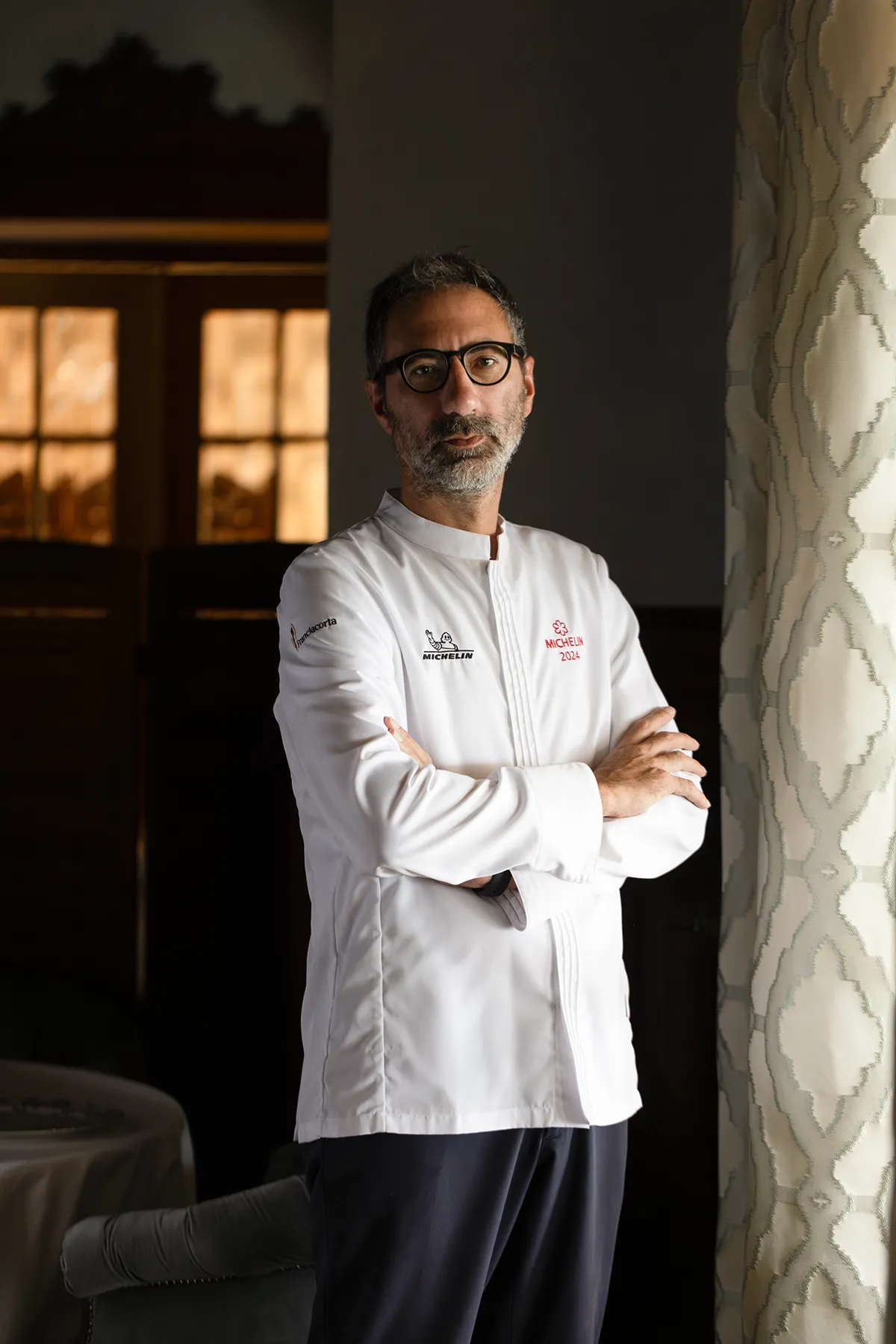
Maurizio Bufi, a Puglian-born chef of the class of 1977, stands as a seminal figure of Italian gastronomy, celebrated for weaving a culinary bridge between his native sea in Molfetta and Lake Garda, his adopted homeland. His roots run deep into the authentic flavors of his mother’s kitchen, an imprint founded upon simple, "zero-kilometer" ingredients that would become the very bedrock of his philosophy of reverence for the raw material. Born within the fertile soil of Molfetta, which gave birth to other legendary masters such as Fabio Pisani and Felice Lo Basso, Bufi soon developed an ambition that led him, at the tender age of fifteen, to leave Puglia driven by a "yearning for liberty and adventure." Thus began a formative odyssey that took him from Lake Como to cruise liners and Switzerland, building a diverse and international technical repertoire that would prove fundamental for his future career in luxury hôtellerie.
In 2008 he arrived on the shores of Lake Garda, his "second home," curating the grand opening of the prestigious Lefay Resort & Spa. The true masterstroke came in 2012, when he assumed the role of Executive Chef at Villa Giulia in Gargnano. Here, for nearly a decade, he was able to refine his "creative" and "whimsical" cuisine, a culinary language that masterfully intertwines Mediterranean flavors with the exquisite treasures of the lake. This long, meticulous devotion culminated in 2017 with the conquest of his first Michelin star, enshrining him in the pantheon of Italian dining. In October 2021, after a "heart-wrenching reflection," he departed Villa Giulia, demonstrating his relentless desire to challenge himself in constant evolution.
His philosophy is rooted in the lyric fusion between Puglia and Garda, a dialogue made harmonious by shared ingredients such as olive oil, lemons, and capers, which flourish in both terroirs. Memory plays a central role, breathing life into menus and creations born of childhood recollections. This artistic approach translates into a profound respect for the raw ingredient, utilizing non-invasive cooking techniques that preserve its raw essence, dedicated to the sacred principle: "the less you touch it, the more sublime it shall be."
At the dawn of 2022, he embraced the role of Executive Chef of Ristorante Il Fagiano at the illustrious Grand Hotel Fasano. Here, in less than two years, he achieved a true "reconquest": in November 2023, the Michelin Guide bestowed a new star upon him, honoring his mature vision and his ability to imprint an auteur's signature upon a new canvas. This triumph, heralded as a "family dream" by the proprietors and a "wondrous surprise," is the fruit of a strategic collaboration in which Bufi stands alongside another master of the craft, Pasquale Tozzi, in a triumphant model founded upon specialization. The double star confirms that his is not a cuisine bound to a single place, but rather an identity in perpetual evolution, ever projected toward a "personal quest to enrich one’s cultural and professional heritage."
dialogues
How do you reconcile reverence for the classical heritage of pasta with innovation in your restaurant’s kitchen?
It is a mesmerizing pursuit that I embrace with sensitivity and artistry. Before venturing into innovation, it is primordial to comprehend and revere the foundations: the ingredients, the techniques, the history, and the cultural resonance of classical recipes. Only by fully grasping the soul of a traditional dish can one dare to interpret it anew while honoring its heritage. The secret lies in remaining steadfast to the poetry of the dish, even as we open the gates to modern creativity and technique. Innovation, when beautifully executed, pays homage to tradition; it does not erase it.
What stylistic and technical movements do you observe in the preparation and presentation of pasta within high gastronomy, and how does your cuisine converse with them?
Within high gastronomy, pasta is experiencing a glorious renaissance, as chefs weave together technical mastery, aesthetic grace, and absolute reverence for the raw material. My culinary philosophy is anchored in the curation of a few, meticulously selected and readily identifiable ingredients. In my first courses, I strive for purity of flavor and the elevation of the primary ingredient, such as ancient grains. I offer regional shapes like plin and cannelloni alongside lesser-known or thoughtfully reimagined forms, all strictly hand-sculpted.
What future horizons do you foresee for pasta creations in fine dining? Are there elements (such as raw materials, cooking methods, or pairings) that you believe will command greater prominence?
The evolution of pasta in fine dining must be an unending journey of discovery, spanning the scholarship behind its shapes, its sauces, and the artistry of the plating. One technique destined for greater prominence is the rehydration of pasta, which tempers cooking times while preserving the structural integrity and the precious starches. Another technique is to cook the pasta "risottata": in this manner, the pasta is bathed directly in a liquid that slowly reduces, infusing the pasta shape with profound and concentrated flavor.
In what manner does the commitment to sustainability influence your selection of pasta ingredients (e.g., noble grains, organic flours) and the practices of minimizing waste in the kitchen?
In our contemporary era, pasta has transcended the paradigm of simple wheat. The biodiversity of nature’s grains grants us the privilege of employing alternative pastes crafted from burnt wheat flour, Khorasan, and Tumminia, or even legumes, ideal for a gluten-free diet. Furthermore, today one cannot curate an ingredient without envisioning how to repurpose its by-products—those elements traditionally discarded but which we can no longer afford to squander.
"Is there a particular philosophy or culinary ethos that defines the singularity of your pasta dishes? What are the signature traits often woven into them?"
Indeed, every pasta creation I compose is born from a precise philosophy, uniting memory, matter, and measure. This ethos defines my culinary identity and lends a singular voice to my offerings. For my dry pasta dishes, I consistently select bronze-extruded shapes that have undergone slow, gentle drying.
How much weight do you accord to the exploration and integration of rare ingredients or those anchored in specific terroirs (such as Slow Food Presidia) to enrich your pasta compositions?
Immense weight. My cuisine moves in harmony with the seasons, celebrating botanical and other raw ingredients at the zenith of their expression. This pursuit of beauty encompasses the use of rarer elements, such as ancient grains or lesser-known fish, which I source from small, dedicated guardians of the land and sea.
When and why do you favor dry pasta over fresh, or vice versa, for a particular composition? What criteria govern this artistic choice?
Both hold sacred roles in the harmony of selection and pairing. For instance, a pristine spaghetti with fresh tomato typically demands dry pasta, whereas in the realm of fine dining, the tomato may transfigure into a delicate filling for fresh, filled pasta.
Could you share an instance of a particularly daring experimentation or challenges encountered in working with pasta which, though they never graced the menu, offered profound lessons?
Some time ago, together with my kitchen brigade, I experimented with cooking dry pasta in a pressure cooker. We observed that all the ingredients melded in perfect harmony with the pasta, which absorbed seventy percent of the seasoning. However, we found that in certain instances, the pasta’s structure was prone to fracturing. I have temporarily set aside this endeavor, yet I fully intend to revisit it, harnessing a pasta of exceptionally high starch content.
What is your vision regarding the integration of new technologies with pasta, both in its creation (e.g., 3D printing) and its preparation or cooking?
As a chef, I generally align myself with tradition, seeking innovation primarily through novel shapes and culinary accompaniments. Recently, however, I experienced 3D pasta from an esteemed producer. I was initially skeptical of its cooking behavior, yet I was utterly captivated: it transcended all my expectations.
Beyond the sensory journey of taste, is there a particular emotion or childhood memory tied to pasta that you wish to evoke in your guests? Is there a dish that tells your own story?
To me, pasta is a vessel of memories and heritage. A plate of tagliatelle al ragù can conjure a Sunday spent with family and the aromatic whisper of the mirepoix, while orecchiette with turnip greens can summon the poignant nostalgia of one’s native earth. Preparing pasta is not merely nourishment; it is the transmission of emotion and memory, and in this sacred art, my family has always been my guiding light.
CURRICULUM VITAE
Maurizio Bufi, a Puglian-born chef of the class of 1977, stands as a seminal figure of Italian gastronomy, celebrated for weaving a culinary bridge between his native sea in Molfetta and Lake Garda, his adopted homeland. His roots run deep into the authentic flavors of his mother’s kitchen, an imprint founded upon simple, "zero-kilometer" ingredients that would become the very bedrock of his philosophy of reverence for the raw material. Born within the fertile soil of Molfetta, which gave birth to other legendary masters such as Fabio Pisani and Felice Lo Basso, Bufi soon developed an ambition that led him, at the tender age of fifteen, to leave Puglia driven by a "yearning for liberty and adventure." Thus began a formative odyssey that took him from Lake Como to cruise liners and Switzerland, building a diverse and international technical repertoire that would prove fundamental for his future career in luxury hôtellerie.
In 2008 he arrived on the shores of Lake Garda, his "second home," curating the grand opening of the prestigious Lefay Resort & Spa. The true masterstroke came in 2012, when he assumed the role of Executive Chef at Villa Giulia in Gargnano. Here, for nearly a decade, he was able to refine his "creative" and "whimsical" cuisine, a culinary language that masterfully intertwines Mediterranean flavors with the exquisite treasures of the lake. This long, meticulous devotion culminated in 2017 with the conquest of his first Michelin star, enshrining him in the pantheon of Italian dining. In October 2021, after a "heart-wrenching reflection," he departed Villa Giulia, demonstrating his relentless desire to challenge himself in constant evolution.
His philosophy is rooted in the lyric fusion between Puglia and Garda, a dialogue made harmonious by shared ingredients such as olive oil, lemons, and capers, which flourish in both terroirs. Memory plays a central role, breathing life into menus and creations born of childhood recollections. This artistic approach translates into a profound respect for the raw ingredient, utilizing non-invasive cooking techniques that preserve its raw essence, dedicated to the sacred principle: "the less you touch it, the more sublime it shall be."
At the dawn of 2022, he embraced the role of Executive Chef of Ristorante Il Fagiano at the illustrious Grand Hotel Fasano. Here, in less than two years, he achieved a true "reconquest": in November 2023, the Michelin Guide bestowed a new star upon him, honoring his mature vision and his ability to imprint an auteur's signature upon a new canvas. This triumph, heralded as a "family dream" by the proprietors and a "wondrous surprise," is the fruit of a strategic collaboration in which Bufi stands alongside another master of the craft, Pasquale Tozzi, in a triumphant model founded upon specialization. The double star confirms that his is not a cuisine bound to a single place, but rather an identity in perpetual evolution, ever projected toward a "personal quest to enrich one’s cultural and professional heritage."
dialogues
How do you reconcile reverence for the classical heritage of pasta with innovation in your restaurant’s kitchen?
It is a mesmerizing pursuit that I embrace with sensitivity and artistry. Before venturing into innovation, it is primordial to comprehend and revere the foundations: the ingredients, the techniques, the history, and the cultural resonance of classical recipes. Only by fully grasping the soul of a traditional dish can one dare to interpret it anew while honoring its heritage. The secret lies in remaining steadfast to the poetry of the dish, even as we open the gates to modern creativity and technique. Innovation, when beautifully executed, pays homage to tradition; it does not erase it.
What stylistic and technical movements do you observe in the preparation and presentation of pasta within high gastronomy, and how does your cuisine converse with them?
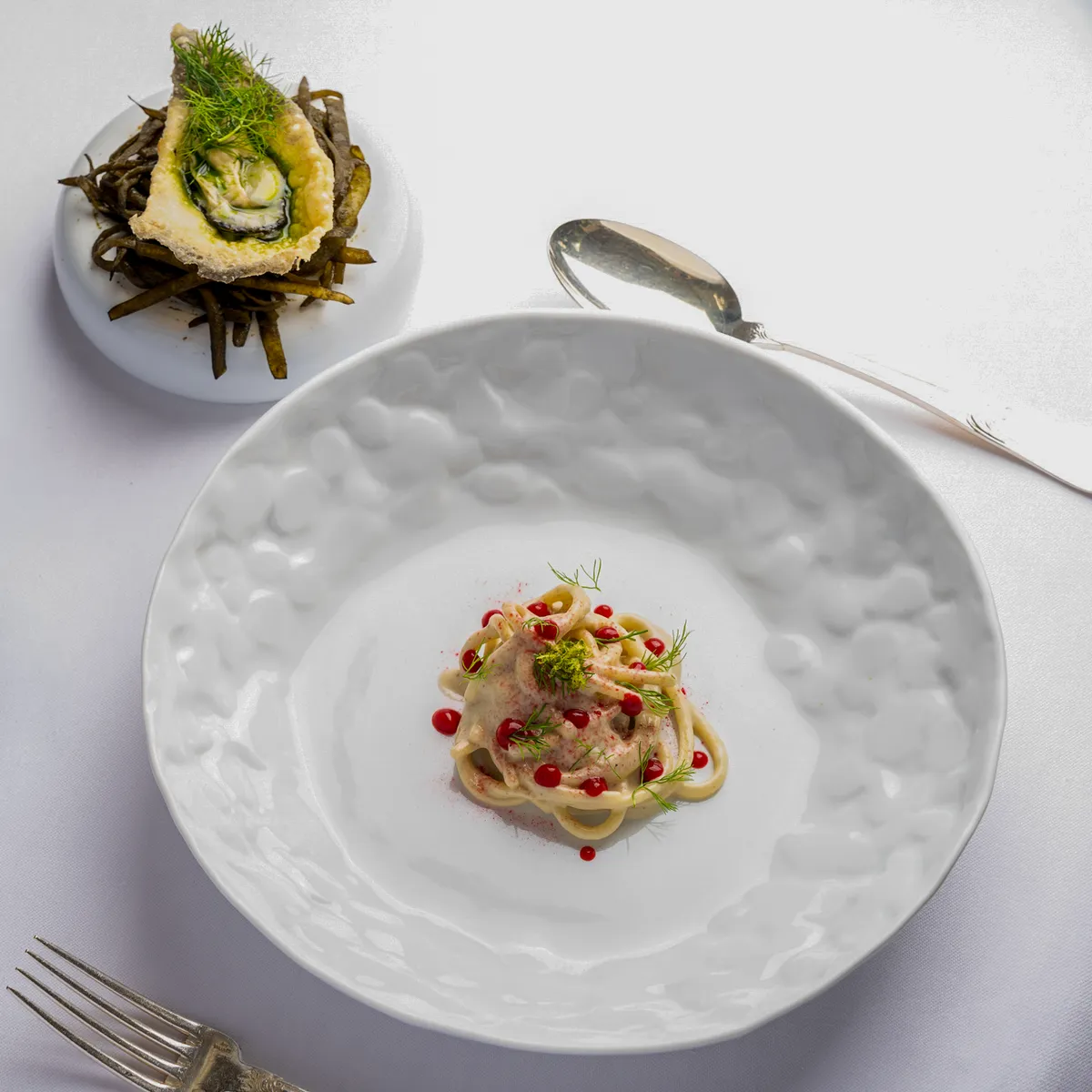
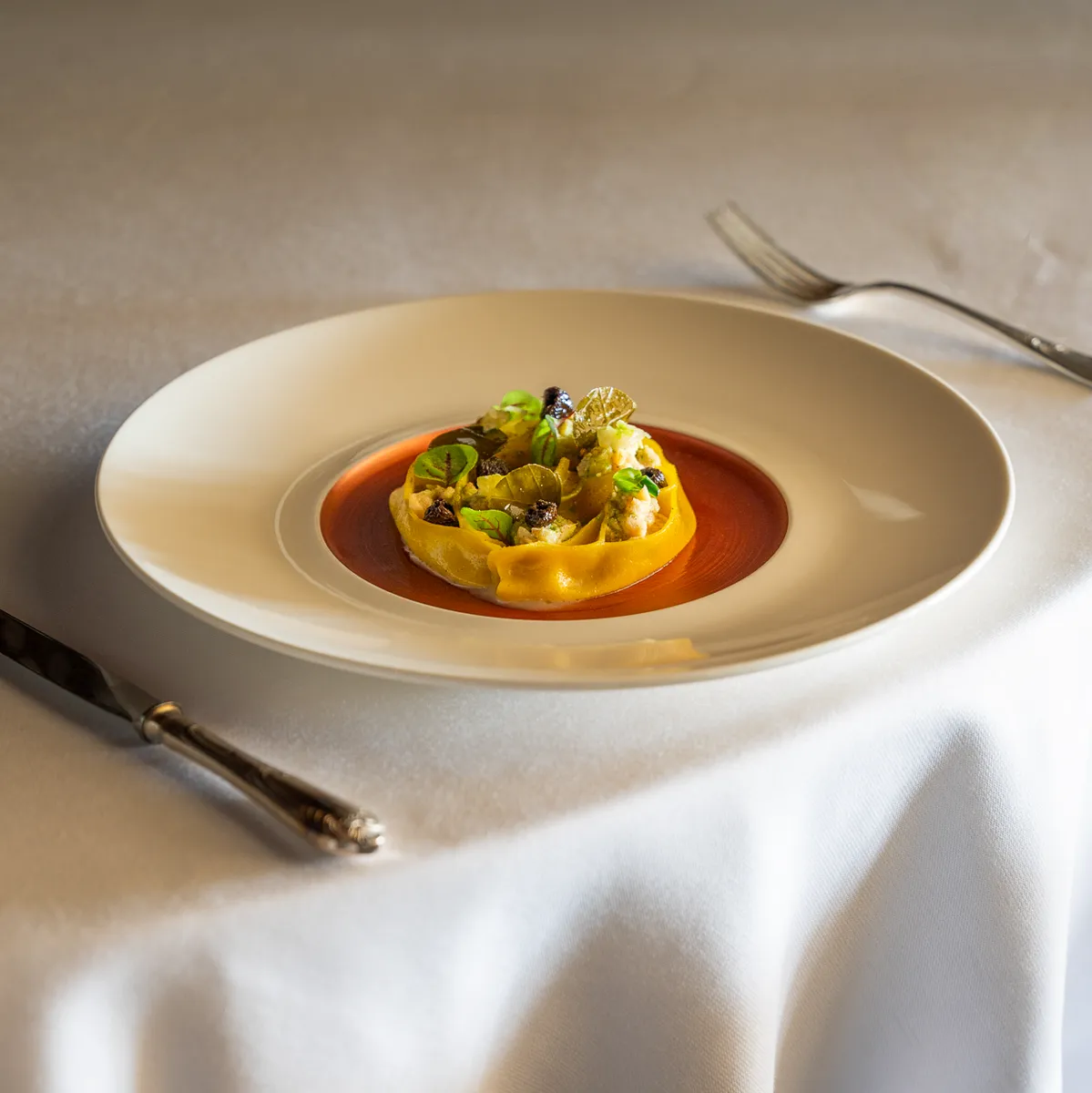
Within high gastronomy, pasta is experiencing a glorious renaissance, as chefs weave together technical mastery, aesthetic grace, and absolute reverence for the raw material. My culinary philosophy is anchored in the curation of a few, meticulously selected and readily identifiable ingredients. In my first courses, I strive for purity of flavor and the elevation of the primary ingredient, such as ancient grains. I offer regional shapes like plin and cannelloni alongside lesser-known or thoughtfully reimagined forms, all strictly hand-sculpted.
What future horizons do you foresee for pasta creations in fine dining? Are there elements (such as raw materials, cooking methods, or pairings) that you believe will command greater prominence?
The evolution of pasta in fine dining must be an unending journey of discovery, spanning the scholarship behind its shapes, its sauces, and the artistry of the plating. One technique destined for greater prominence is the rehydration of pasta, which tempers cooking times while preserving the structural integrity and the precious starches. Another technique is to cook the pasta "risottata": in this manner, the pasta is bathed directly in a liquid that slowly reduces, infusing the pasta shape with profound and concentrated flavor.
In what manner does the commitment to sustainability influence your selection of pasta ingredients (e.g., noble grains, organic flours) and the practices of minimizing waste in the kitchen?
In our contemporary era, pasta has transcended the paradigm of simple wheat. The biodiversity of nature’s grains grants us the privilege of employing alternative pastes crafted from burnt wheat flour, Khorasan, and Tumminia, or even legumes, ideal for a gluten-free diet. Furthermore, today one cannot curate an ingredient without envisioning how to repurpose its by-products—those elements traditionally discarded but which we can no longer afford to squander.
"Is there a particular philosophy or culinary ethos that defines the singularity of your pasta dishes? What are the signature traits often woven into them?"
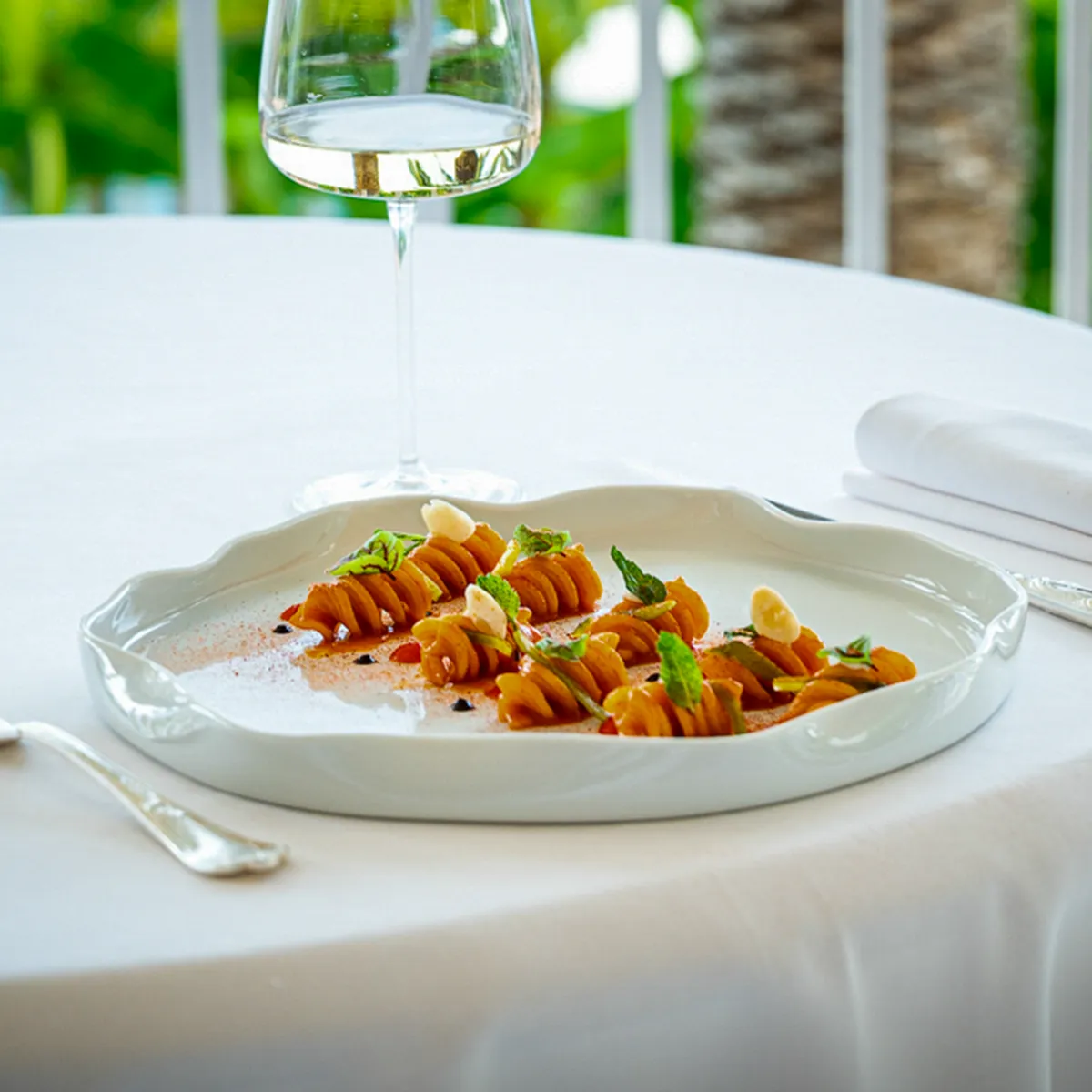
Indeed, every pasta creation I compose is born from a precise philosophy, uniting memory, matter, and measure. This ethos defines my culinary identity and lends a singular voice to my offerings. For my dry pasta dishes, I consistently select bronze-extruded shapes that have undergone slow, gentle drying.
How much weight do you accord to the exploration and integration of rare ingredients or those anchored in specific terroirs (such as Slow Food Presidia) to enrich your pasta compositions?
Immense weight. My cuisine moves in harmony with the seasons, celebrating botanical and other raw ingredients at the zenith of their expression. This pursuit of beauty encompasses the use of rarer elements, such as ancient grains or lesser-known fish, which I source from small, dedicated guardians of the land and sea.
When and why do you favor dry pasta over fresh, or vice versa, for a particular composition? What criteria govern this artistic choice?
Both hold sacred roles in the harmony of selection and pairing. For instance, a pristine spaghetti with fresh tomato typically demands dry pasta, whereas in the realm of fine dining, the tomato may transfigure into a delicate filling for fresh, filled pasta.
Could you share an instance of a particularly daring experimentation or challenges encountered in working with pasta which, though they never graced the menu, offered profound lessons?
Some time ago, together with my kitchen brigade, I experimented with cooking dry pasta in a pressure cooker. We observed that all the ingredients melded in perfect harmony with the pasta, which absorbed seventy percent of the seasoning. However, we found that in certain instances, the pasta’s structure was prone to fracturing. I have temporarily set aside this endeavor, yet I fully intend to revisit it, harnessing a pasta of exceptionally high starch content.
What is your vision regarding the integration of new technologies with pasta, both in its creation (e.g., 3D printing) and its preparation or cooking?
As a chef, I generally align myself with tradition, seeking innovation primarily through novel shapes and culinary accompaniments. Recently, however, I experienced 3D pasta from an esteemed producer. I was initially skeptical of its cooking behavior, yet I was utterly captivated: it transcended all my expectations.
Beyond the sensory journey of taste, is there a particular emotion or childhood memory tied to pasta that you wish to evoke in your guests? Is there a dish that tells your own story?
To me, pasta is a vessel of memories and heritage. A plate of tagliatelle al ragù can conjure a Sunday spent with family and the aromatic whisper of the mirepoix, while orecchiette with turnip greens can summon the poignant nostalgia of one’s native earth. Preparing pasta is not merely nourishment; it is the transmission of emotion and memory, and in this sacred art, my family has always been my guiding light.
CURRICULUM VITAE
Maurizio Bufi, a Puglian-born chef of the class of 1977, stands as a seminal figure of Italian gastronomy, celebrated for weaving a culinary bridge between his native sea in Molfetta and Lake Garda, his adopted homeland. His roots run deep into the authentic flavors of his mother’s kitchen, an imprint founded upon simple, "zero-kilometer" ingredients that would become the very bedrock of his philosophy of reverence for the raw material. Born within the fertile soil of Molfetta, which gave birth to other legendary masters such as Fabio Pisani and Felice Lo Basso, Bufi soon developed an ambition that led him, at the tender age of fifteen, to leave Puglia driven by a "yearning for liberty and adventure." Thus began a formative odyssey that took him from Lake Como to cruise liners and Switzerland, building a diverse and international technical repertoire that would prove fundamental for his future career in luxury hôtellerie.
In 2008 he arrived on the shores of Lake Garda, his "second home," curating the grand opening of the prestigious Lefay Resort & Spa. The true masterstroke came in 2012, when he assumed the role of Executive Chef at Villa Giulia in Gargnano. Here, for nearly a decade, he was able to refine his "creative" and "whimsical" cuisine, a culinary language that masterfully intertwines Mediterranean flavors with the exquisite treasures of the lake. This long, meticulous devotion culminated in 2017 with the conquest of his first Michelin star, enshrining him in the pantheon of Italian dining. In October 2021, after a "heart-wrenching reflection," he departed Villa Giulia, demonstrating his relentless desire to challenge himself in constant evolution.
His philosophy is rooted in the lyric fusion between Puglia and Garda, a dialogue made harmonious by shared ingredients such as olive oil, lemons, and capers, which flourish in both terroirs. Memory plays a central role, breathing life into menus and creations born of childhood recollections. This artistic approach translates into a profound respect for the raw ingredient, utilizing non-invasive cooking techniques that preserve its raw essence, dedicated to the sacred principle: "the less you touch it, the more sublime it shall be."
At the dawn of 2022, he embraced the role of Executive Chef of Ristorante Il Fagiano at the illustrious Grand Hotel Fasano. Here, in less than two years, he achieved a true "reconquest": in November 2023, the Michelin Guide bestowed a new star upon him, honoring his mature vision and his ability to imprint an auteur's signature upon a new canvas. This triumph, heralded as a "family dream" by the proprietors and a "wondrous surprise," is the fruit of a strategic collaboration in which Bufi stands alongside another master of the craft, Pasquale Tozzi, in a triumphant model founded upon specialization. The double star confirms that his is not a cuisine bound to a single place, but rather an identity in perpetual evolution, ever projected toward a "personal quest to enrich one’s cultural and professional heritage."
dialogues
How do you reconcile reverence for the classical heritage of pasta with innovation in your restaurant’s kitchen?
It is a mesmerizing pursuit that I embrace with sensitivity and artistry. Before venturing into innovation, it is primordial to comprehend and revere the foundations: the ingredients, the techniques, the history, and the cultural resonance of classical recipes. Only by fully grasping the soul of a traditional dish can one dare to interpret it anew while honoring its heritage. The secret lies in remaining steadfast to the poetry of the dish, even as we open the gates to modern creativity and technique. Innovation, when beautifully executed, pays homage to tradition; it does not erase it.
What stylistic and technical movements do you observe in the preparation and presentation of pasta within high gastronomy, and how does your cuisine converse with them?
Within high gastronomy, pasta is experiencing a glorious renaissance, as chefs weave together technical mastery, aesthetic grace, and absolute reverence for the raw material. My culinary philosophy is anchored in the curation of a few, meticulously selected and readily identifiable ingredients. In my first courses, I strive for purity of flavor and the elevation of the primary ingredient, such as ancient grains. I offer regional shapes like plin and cannelloni alongside lesser-known or thoughtfully reimagined forms, all strictly hand-sculpted.
What future horizons do you foresee for pasta creations in fine dining? Are there elements (such as raw materials, cooking methods, or pairings) that you believe will command greater prominence?
The evolution of pasta in fine dining must be an unending journey of discovery, spanning the scholarship behind its shapes, its sauces, and the artistry of the plating. One technique destined for greater prominence is the rehydration of pasta, which tempers cooking times while preserving the structural integrity and the precious starches. Another technique is to cook the pasta "risottata": in this manner, the pasta is bathed directly in a liquid that slowly reduces, infusing the pasta shape with profound and concentrated flavor.
In what manner does the commitment to sustainability influence your selection of pasta ingredients (e.g., noble grains, organic flours) and the practices of minimizing waste in the kitchen?
In our contemporary era, pasta has transcended the paradigm of simple wheat. The biodiversity of nature’s grains grants us the privilege of employing alternative pastes crafted from burnt wheat flour, Khorasan, and Tumminia, or even legumes, ideal for a gluten-free diet. Furthermore, today one cannot curate an ingredient without envisioning how to repurpose its by-products—those elements traditionally discarded but which we can no longer afford to squander.
"Is there a particular philosophy or culinary ethos that defines the singularity of your pasta dishes? What are the signature traits often woven into them?"
Indeed, every pasta creation I compose is born from a precise philosophy, uniting memory, matter, and measure. This ethos defines my culinary identity and lends a singular voice to my offerings. For my dry pasta dishes, I consistently select bronze-extruded shapes that have undergone slow, gentle drying.
How much weight do you accord to the exploration and integration of rare ingredients or those anchored in specific terroirs (such as Slow Food Presidia) to enrich your pasta compositions?
Immense weight. My cuisine moves in harmony with the seasons, celebrating botanical and other raw ingredients at the zenith of their expression. This pursuit of beauty encompasses the use of rarer elements, such as ancient grains or lesser-known fish, which I source from small, dedicated guardians of the land and sea.
When and why do you favor dry pasta over fresh, or vice versa, for a particular composition? What criteria govern this artistic choice?
Both hold sacred roles in the harmony of selection and pairing. For instance, a pristine spaghetti with fresh tomato typically demands dry pasta, whereas in the realm of fine dining, the tomato may transfigure into a delicate filling for fresh, filled pasta.
Could you share an instance of a particularly daring experimentation or challenges encountered in working with pasta which, though they never graced the menu, offered profound lessons?
Some time ago, together with my kitchen brigade, I experimented with cooking dry pasta in a pressure cooker. We observed that all the ingredients melded in perfect harmony with the pasta, which absorbed seventy percent of the seasoning. However, we found that in certain instances, the pasta’s structure was prone to fracturing. I have temporarily set aside this endeavor, yet I fully intend to revisit it, harnessing a pasta of exceptionally high starch content.
What is your vision regarding the integration of new technologies with pasta, both in its creation (e.g., 3D printing) and its preparation or cooking?
As a chef, I generally align myself with tradition, seeking innovation primarily through novel shapes and culinary accompaniments. Recently, however, I experienced 3D pasta from an esteemed producer. I was initially skeptical of its cooking behavior, yet I was utterly captivated: it transcended all my expectations.
Beyond the sensory journey of taste, is there a particular emotion or childhood memory tied to pasta that you wish to evoke in your guests? Is there a dish that tells your own story?
To me, pasta is a vessel of memories and heritage. A plate of tagliatelle al ragù can conjure a Sunday spent with family and the aromatic whisper of the mirepoix, while orecchiette with turnip greens can summon the poignant nostalgia of one’s native earth. Preparing pasta is not merely nourishment; it is the transmission of emotion and memory, and in this sacred art, my family has always been my guiding light.