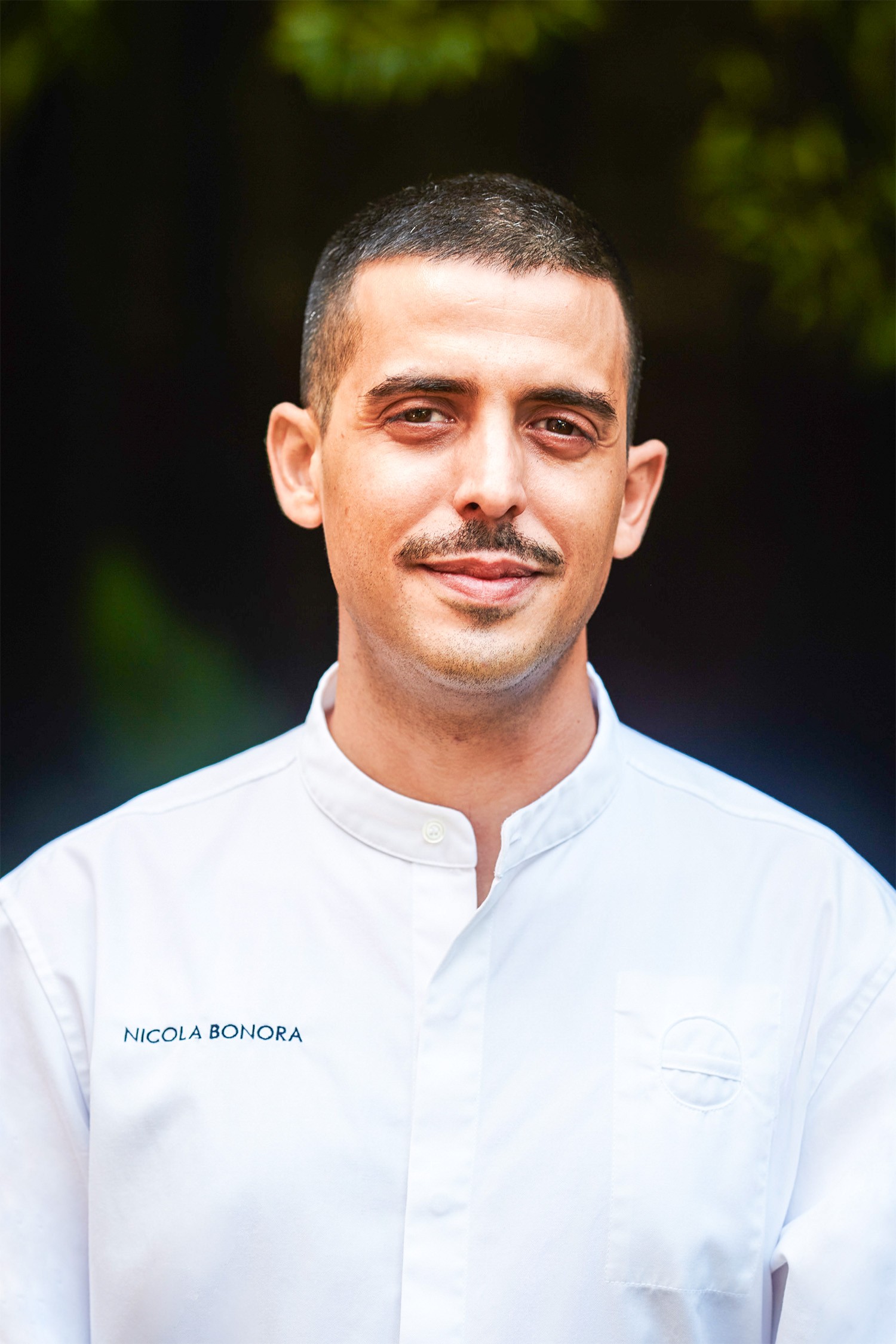
NICOLA BONORA
gastronomic avant-garde, sensory experimentation
1990
The Grand Tower
Radical - Nomadic
NICOLA BONORA
gastronomic avant-garde, sensory experimentation
1990
The Grand Tower
Radical - Nomadic
NICOLA BONORA
gastronomic avant-garde, sensory experimentation
1990
The Grand Tower
Radical - Nomadic
CURRICULUM VITAE
Nicola Bonora, born in 1990, came of age in Torre Grande, a coastal hamlet overlooking the golden lagoon of Cabras, in the province of Oristano. For him, the sea is not merely a landscape of origin, but a primary education in raw matter: his kinship with the fishermen, the rhythms of the shore, and his direct, intimate knowledge of the daily catch and its seasons have fashioned, since childhood, a watchful, concrete gaze, rooted in profound reverence for the ingredient.
His formative years soon beckoned him beyond the shores of Sardinia. Following his initial ventures between Hamburg and Madonna di Campiglio, he returned briefly to his native island, only to challenge himself within highly structured and intensely professional kitchens. Among these, his tenure within the kitchens of Gordon Ramsay at Forte Village marked a milestone in his mastery of method, rigorous discipline, and technical precision.
His journey unfolded further in Milan, within the esteemed organization of Enrico Bartolini, where Bonora dedicated himself to event management, deepening his command of technical control, kitchen organization, and the grace required to navigate a complex culinary environment.
In 2020, he was appointed Executive Chef of Serica, a Milanese dining temple conceived by Mauro Yap to foster a dialogue between Italian cuisine and Chinese culinary heritage. Bonora embraced this stewardship as a voyage of discovery: through daily communion with Yap and his family, he gradually absorbed the flavors, sauces, fermentations, and flavor profiles intrinsic to Eastern tradition.
From this harmonious encounter arose a cuisine built upon deliberate, poetic graftings, wherein the time-honored Sardinian techniques of preservation, curing, and the nose-to-tail utilization of seafood—interwoven with his personal culinary identity—converse fluently with distinct Asian expressions.
In May 2022, he assumed the culinary leadership of Motelombroso, a restaurant perched along the Naviglio Pavese, born from the restoration of a former canal-keeper\'s lodge and the creative vision of Alessandra Straccamore and Matteo Mazza. Here, his research assumed tangible form around the concept of "cucina fuori fuoco" (off-focus cuisine): a philosophy of approaching dishes of memory by shifting the perspective, altering textures, temperatures, and vessels, yet eternally preserving their recognizable soul.
Technique thus becomes a vessel to re-examine the familiar, never to erase it: a medium through which depth is restored to comforting flavors via a different lens.
The cuisine of Nicola Bonora blossoms from a dual impulse: the raw, earthy truth of Sardinian ingredients and the technical and cultural curiosity nurtured in contemporary kitchens. It is a deeply personal odyssey, still unfolding, that strives to unite terroir, memory, and avant-garde exploration, never allowing them to lapse into mere artifice.
dialogues
What is your earliest memory of pasta (domestic, familial, emotional), and what did it teach you about the physical gesture of dining, even before the appreciation of taste?
Rather than the first in chronological order, the most profoundly resonant memory for me is unquestionably tagliatella with rabbit alla cacciatora. At home, we awaited that day with breathless anticipation, so much so that anyone who could joined us at the table, whether kin or friend. That day had become a sacred rite, a grand moment of shared communion. The recipe was of an elegant simplicity: a slow-braised rabbit with pine nuts, green olives, garlic, rosemary, and Vernaccia wine. Into that rich, simmering nectar, whisper-thin, silky pappardelle were bathed, enveloping the palate and enriching the soul. The result was (and remains) sublime. Whenever I summon a precious memory of pasta, it is this that graces my mind.
At Motelombroso, as an avant-garde creator, what is your primal decision when conceiving a pasta dish — the form, the sauce, the texture, the temperature, or the guiding "idea"?
It is the idea that gives form to the culinary creation; from that spark originates a symphony of reasoning essential to the dish. Among these are feasibility, replicability, standardization, and logistics, which represent the "rational" custodians of the recipe (food cost, consistency of the creation over time, storage methods, and procurement management).
Once these structural pillars are verified, the physical architecture of the pasta acts as our guiding star: depending on the specific variety and the sensory zenith we wish to achieve, the most precise and refined cooking technique is applied.On your current menu, you present "Eliche, rustic rabbit ragout, and saffron": how was the concept of this dish born, and above all, what harmony do you seek between the architecture of the pasta, the depth of the ragout, and the aromatic "luminescence" of the saffron (in terms of roasting, extraction, and mantecatura)?
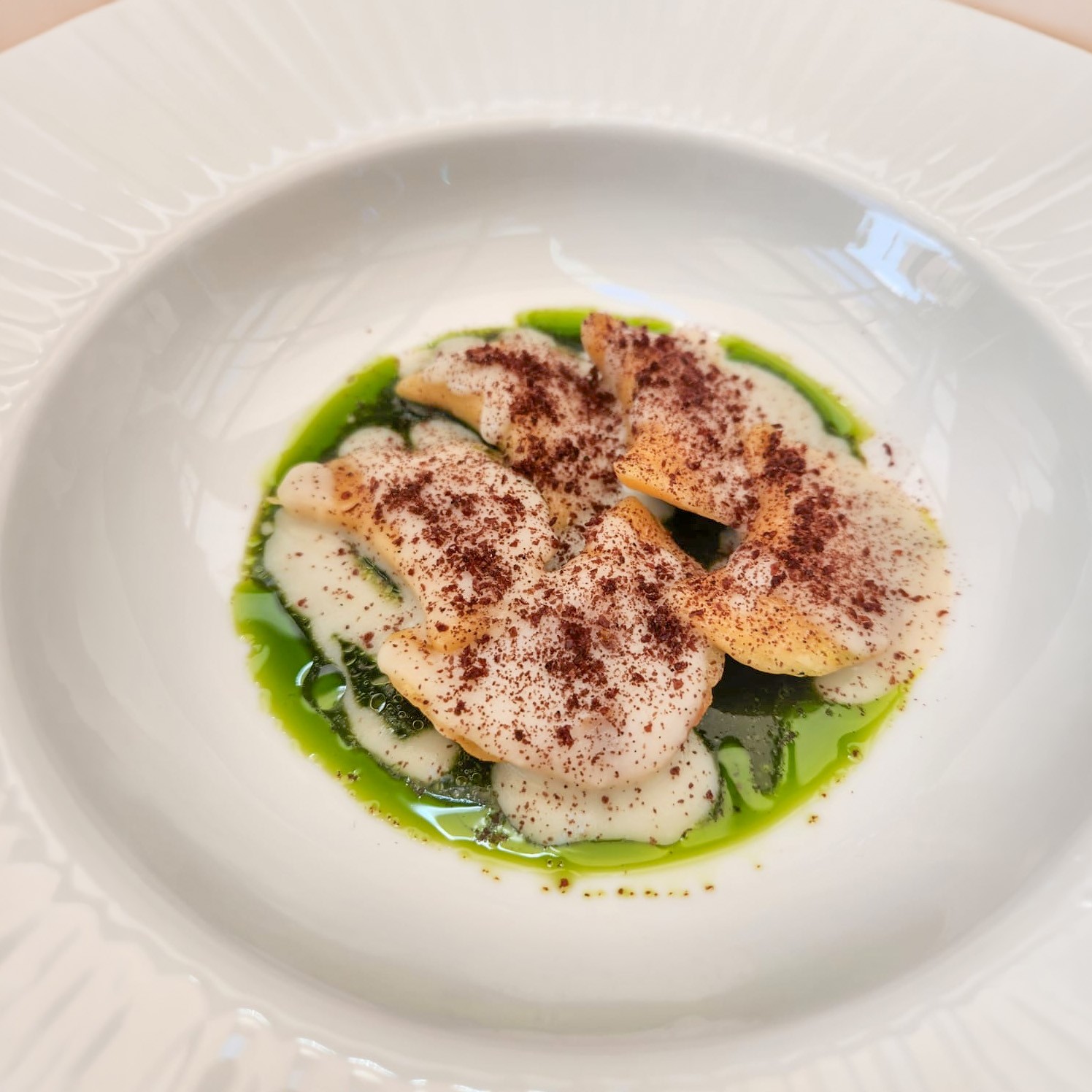
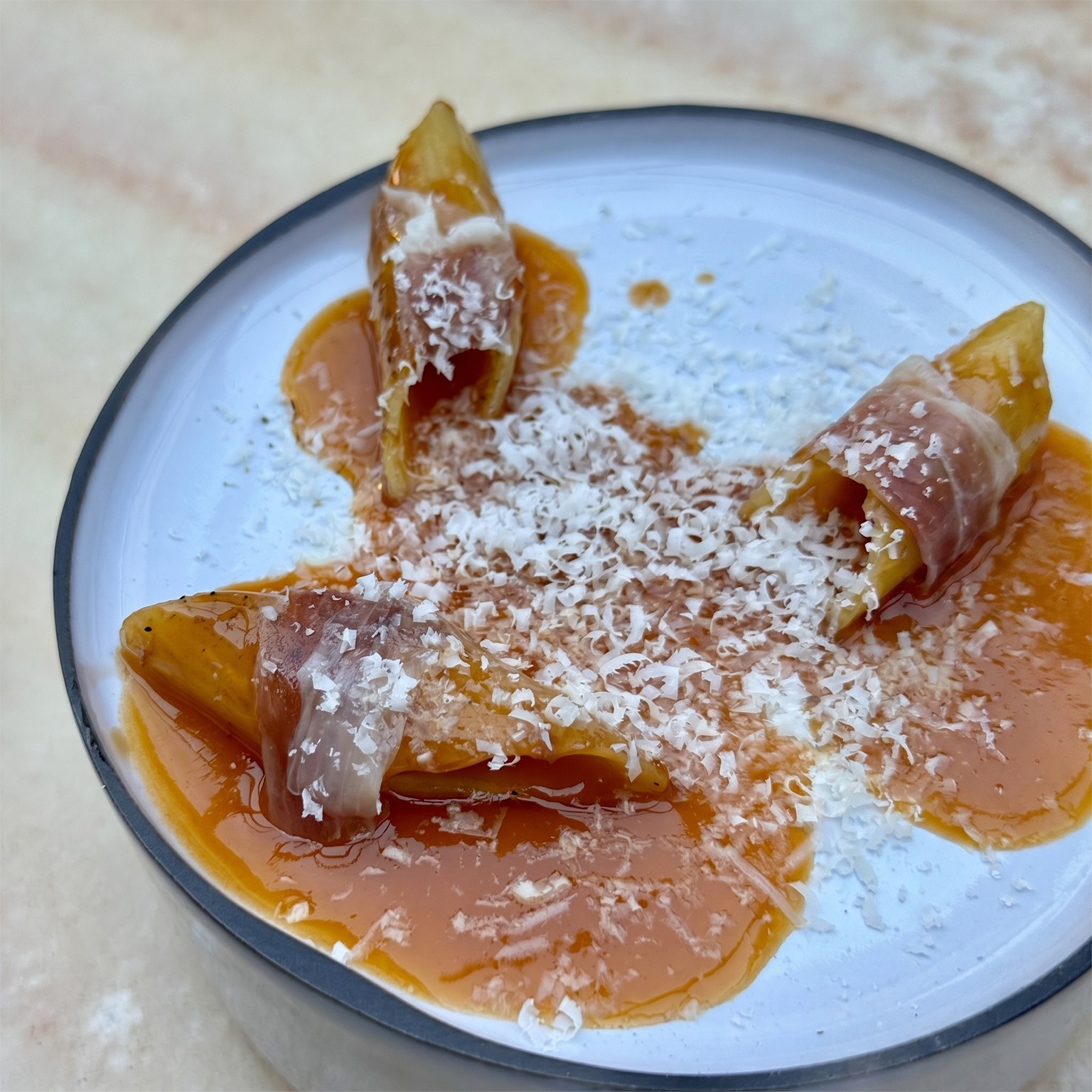
Indeed, it is a composition in perpetual evolution. We transitioned from eliche to the culinary rings of Benedetto Cavalieri's anellini, to achieve a more generous fullness and a more enveloping, seductive bite—suspended somewhere between a rich broth and a velvety risotto. It was conceived as a poetic reinterpretation of a Campidano sauce, crafted, however, with ingredients beyond Sardinian borders: the rustic Romagnolo rabbit, kissed by embers, melts into the tomato reduction to bestow deep resonance. Saffron imparts a warm, luminous grace, while the pork fat, with its delicate, almond-like whispers, allows us to eschew butter and Parmigiano. It is an identity-driven dish, reinterpreted through the eyes of a "wandering Sardinian."
If you were to define your cuisine in a single phrase, many would speak of research and precision: what is the non-negotiable technical commandment when crafting doughs, fillings, and the final sealing of the pasta?
It has been defined as radical yet unrooted. I believe, instead, that my cuisine is liberated from any form of dogma. I constantly interrogate my craft, searching above all for the "why," which leads me to tread diverse paths and experiment with new frontiers to achieve the ultimate realization of the dish.
The dough must possess structure, elasticity, and memory; the filling must be pristine and legible, never overwhelmed; the final seal, meanwhile, must be executed with flawless functionality, for it is not merely an aesthetic flourish but the guarantor of uniform cooking, integrity, and the ultimate elegance of the bite. Every phase must be replicable, without compromise.Sauce and mantecatura: in your eyes today, how do you perceive the sauce — as a "condiment," a "structure," a "mirror," or a "tapestry"? And what are the three unforgivable sins in a dish of signature pasta?
Today, I perceive the sauce not as a mere condiment, but as the very structure of the dish, for it governs the delicate alchemy between pasta, fat, water, and temperature. It must never shroud, but rather bind, becoming a tapestry and, simultaneously, a "mirror" reflecting with absolute purity the original concept. The mantecatura, in this light, is the decisive artistic moment: it is there that harmony is forged, orchestrating emulsion, density, and absorption.
The errors I cannot pardon are three. The first is separation: a sauce that fails to emulsify and splits immediately fractures the harmony of the dish. The second is the loss of mastery over the cooking of the pasta, for it compromises its architecture and bite. The third is excess—of fat, of salinity, or of extraneous elements—which muddies the creation and eclipses its clarity.You often employ contrasts and controlled, surprising sensations (crispness, embers, acidity, bitterness, cold/hot): how do you determine how far to push these boundaries without sacrificing the essential "solace" that pasta naturally carries?
I never define that boundary in isolation; it is sculpted over time through a continuous, intimate dialogue with our guests. My culinary art is in constant evolution, growing alongside those who experience it. It is they, with their responses and sensitivity, who whisper how far I may venture. I compose with contrasts and unexpected elements in a controlled manner, yet never do I lose sight of that dimension of "solace," which remains, for me, the beating heart of a pasta dish. It is a dynamic equilibrium: every step forward is born of listening and shared experience, rather than a singular, unilateral decree.
Is there a format of pasta that, more than any other, allows you to express your culinary narrative: filled, long, short, in broth, or gratin-baked? What is your "alphabet" of shapes, and what is its philosophy?
I do not possess a single shape that defines me; my "alphabet" is woven from diverse forms, each carrying a precise destiny. Filled pasta allows me to orchestrate concentration and surprise; short pasta focuses on mastication and absorption; long pasta celebrates the absolute symbiosis between the sauce and the physical gesture of dining. The choice is never merely aesthetic, but architectural: each shape is born to champion an idea and convey it in the most direct manner possible. It is a language in constant evolution, which humbles itself to the dish, and never the reverse.
As a chef of Sardinian heritage, what elements of your native island find voice (or persist) in your vision of pasta: semolina, wild herbs, the sea, whispers of smoke, or offal?
More than overt elements, I carry with me a way of contemplating the world. Sardinia whispers to my cuisine through the memory of taste: the semolina, of course, but also wild, untamed herbs, notes of woodsmoke, the salinity of the sea, and the depth of offal. These are not always explicitly displayed, but they persist as a faint trace, a profound soul. I am captivated by the art of capturing those sensations—the intensity, the essentiality, sometimes even a certain noble rustic quality—and translating them into a contemporary lexicon.
Motelombroso is also a sanctuary of atmosphere and vision: how crucial is the staging of a pasta dish—the plate, the cutlery, the rhythm of the service—in the creation of lasting memory?
The staging of a pasta dish is of paramount importance to me, yet this must not be misconstrued as superficial opulence. At Motelombroso, I champion an essential and measured aesthetic, where the plate, the cutlery, and the cadence of the service perform in silent harmony to craft a memory without encumbering the natural gesture of dining. In this way, minimalism becomes a guiding philosophy: it exalts the true substance of the dish, its balance, and the pristine quality of its ingredients, honoring the sanctuary of the space and allowing the guest to enjoy a seamless, unforgettable experience.
If you could leave the dining public with a single message in the form of a recipe: what is the "manifesto pasta" that orchestrates your culinary vision today, and what legacy would you wish to linger on the palate (and in the mind) after the final bite?
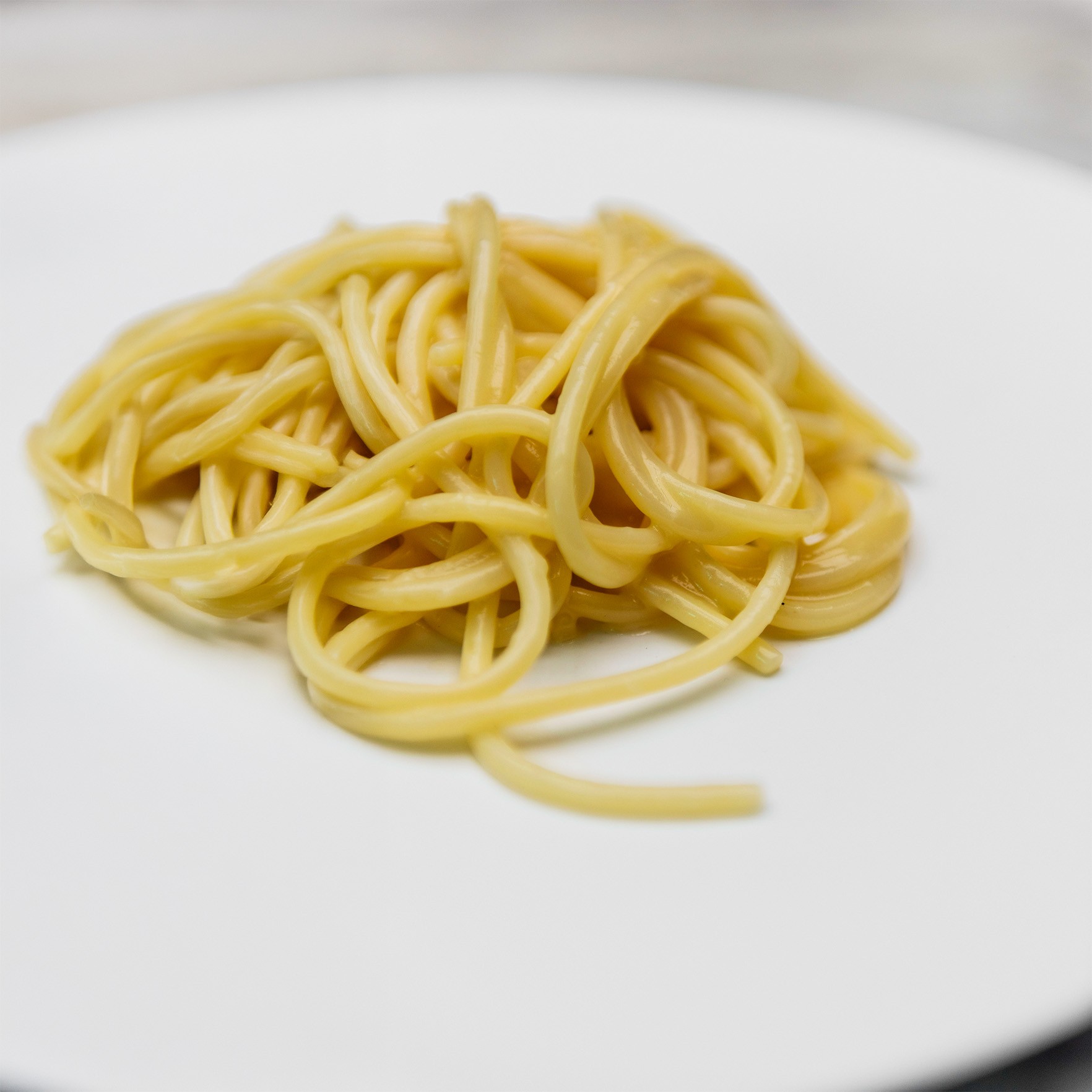
If I were to bequeath a single message, it would be enshrined in a dish of profound simplicity and completeness: Lemon and Pecorino. This pasta stands as the absolute synthesis of my cuisine: a perfect bridge between structure and aroma, depth and acidity, memory and revelation.
After the final bite, I would wish for a lingering sensation of warmth and deep fulfillment to remain—a clear recognition of pure taste, but also a lingering contemplation: that pasta can simultaneously represent solace, artistic experience, and bold invention.
CURRICULUM VITAE
Nicola Bonora, born in 1990, came of age in Torre Grande, a coastal hamlet overlooking the golden lagoon of Cabras, in the province of Oristano. For him, the sea is not merely a landscape of origin, but a primary education in raw matter: his kinship with the fishermen, the rhythms of the shore, and his direct, intimate knowledge of the daily catch and its seasons have fashioned, since childhood, a watchful, concrete gaze, rooted in profound reverence for the ingredient.
His formative years soon beckoned him beyond the shores of Sardinia. Following his initial ventures between Hamburg and Madonna di Campiglio, he returned briefly to his native island, only to challenge himself within highly structured and intensely professional kitchens. Among these, his tenure within the kitchens of Gordon Ramsay at Forte Village marked a milestone in his mastery of method, rigorous discipline, and technical precision.
His journey unfolded further in Milan, within the esteemed organization of Enrico Bartolini, where Bonora dedicated himself to event management, deepening his command of technical control, kitchen organization, and the grace required to navigate a complex culinary environment.
In 2020, he was appointed Executive Chef of Serica, a Milanese dining temple conceived by Mauro Yap to foster a dialogue between Italian cuisine and Chinese culinary heritage. Bonora embraced this stewardship as a voyage of discovery: through daily communion with Yap and his family, he gradually absorbed the flavors, sauces, fermentations, and flavor profiles intrinsic to Eastern tradition.
From this harmonious encounter arose a cuisine built upon deliberate, poetic graftings, wherein the time-honored Sardinian techniques of preservation, curing, and the nose-to-tail utilization of seafood—interwoven with his personal culinary identity—converse fluently with distinct Asian expressions.
In May 2022, he assumed the culinary leadership of Motelombroso, a restaurant perched along the Naviglio Pavese, born from the restoration of a former canal-keeper\'s lodge and the creative vision of Alessandra Straccamore and Matteo Mazza. Here, his research assumed tangible form around the concept of "cucina fuori fuoco" (off-focus cuisine): a philosophy of approaching dishes of memory by shifting the perspective, altering textures, temperatures, and vessels, yet eternally preserving their recognizable soul.
Technique thus becomes a vessel to re-examine the familiar, never to erase it: a medium through which depth is restored to comforting flavors via a different lens.
The cuisine of Nicola Bonora blossoms from a dual impulse: the raw, earthy truth of Sardinian ingredients and the technical and cultural curiosity nurtured in contemporary kitchens. It is a deeply personal odyssey, still unfolding, that strives to unite terroir, memory, and avant-garde exploration, never allowing them to lapse into mere artifice.
dialogues
What is your earliest memory of pasta (domestic, familial, emotional), and what did it teach you about the physical gesture of dining, even before the appreciation of taste?
Rather than the first in chronological order, the most profoundly resonant memory for me is unquestionably tagliatella with rabbit alla cacciatora. At home, we awaited that day with breathless anticipation, so much so that anyone who could joined us at the table, whether kin or friend. That day had become a sacred rite, a grand moment of shared communion. The recipe was of an elegant simplicity: a slow-braised rabbit with pine nuts, green olives, garlic, rosemary, and Vernaccia wine. Into that rich, simmering nectar, whisper-thin, silky pappardelle were bathed, enveloping the palate and enriching the soul. The result was (and remains) sublime. Whenever I summon a precious memory of pasta, it is this that graces my mind.
At Motelombroso, as an avant-garde creator, what is your primal decision when conceiving a pasta dish — the form, the sauce, the texture, the temperature, or the guiding "idea"?
It is the idea that gives form to the culinary creation; from that spark originates a symphony of reasoning essential to the dish. Among these are feasibility, replicability, standardization, and logistics, which represent the "rational" custodians of the recipe (food cost, consistency of the creation over time, storage methods, and procurement management).
Once these structural pillars are verified, the physical architecture of the pasta acts as our guiding star: depending on the specific variety and the sensory zenith we wish to achieve, the most precise and refined cooking technique is applied.On your current menu, you present "Eliche, rustic rabbit ragout, and saffron": how was the concept of this dish born, and above all, what harmony do you seek between the architecture of the pasta, the depth of the ragout, and the aromatic "luminescence" of the saffron (in terms of roasting, extraction, and mantecatura)?
Indeed, it is a composition in perpetual evolution. We transitioned from eliche to the culinary rings of Benedetto Cavalieri's anellini, to achieve a more generous fullness and a more enveloping, seductive bite—suspended somewhere between a rich broth and a velvety risotto. It was conceived as a poetic reinterpretation of a Campidano sauce, crafted, however, with ingredients beyond Sardinian borders: the rustic Romagnolo rabbit, kissed by embers, melts into the tomato reduction to bestow deep resonance. Saffron imparts a warm, luminous grace, while the pork fat, with its delicate, almond-like whispers, allows us to eschew butter and Parmigiano. It is an identity-driven dish, reinterpreted through the eyes of a "wandering Sardinian."
If you were to define your cuisine in a single phrase, many would speak of research and precision: what is the non-negotiable technical commandment when crafting doughs, fillings, and the final sealing of the pasta?
It has been defined as radical yet unrooted. I believe, instead, that my cuisine is liberated from any form of dogma. I constantly interrogate my craft, searching above all for the "why," which leads me to tread diverse paths and experiment with new frontiers to achieve the ultimate realization of the dish.
The dough must possess structure, elasticity, and memory; the filling must be pristine and legible, never overwhelmed; the final seal, meanwhile, must be executed with flawless functionality, for it is not merely an aesthetic flourish but the guarantor of uniform cooking, integrity, and the ultimate elegance of the bite. Every phase must be replicable, without compromise.Sauce and mantecatura: in your eyes today, how do you perceive the sauce — as a "condiment," a "structure," a "mirror," or a "tapestry"? And what are the three unforgivable sins in a dish of signature pasta?
Today, I perceive the sauce not as a mere condiment, but as the very structure of the dish, for it governs the delicate alchemy between pasta, fat, water, and temperature. It must never shroud, but rather bind, becoming a tapestry and, simultaneously, a "mirror" reflecting with absolute purity the original concept. The mantecatura, in this light, is the decisive artistic moment: it is there that harmony is forged, orchestrating emulsion, density, and absorption.
The errors I cannot pardon are three. The first is separation: a sauce that fails to emulsify and splits immediately fractures the harmony of the dish. The second is the loss of mastery over the cooking of the pasta, for it compromises its architecture and bite. The third is excess—of fat, of salinity, or of extraneous elements—which muddies the creation and eclipses its clarity.You often employ contrasts and controlled, surprising sensations (crispness, embers, acidity, bitterness, cold/hot): how do you determine how far to push these boundaries without sacrificing the essential "solace" that pasta naturally carries?
I never define that boundary in isolation; it is sculpted over time through a continuous, intimate dialogue with our guests. My culinary art is in constant evolution, growing alongside those who experience it. It is they, with their responses and sensitivity, who whisper how far I may venture. I compose with contrasts and unexpected elements in a controlled manner, yet never do I lose sight of that dimension of "solace," which remains, for me, the beating heart of a pasta dish. It is a dynamic equilibrium: every step forward is born of listening and shared experience, rather than a singular, unilateral decree.
Is there a format of pasta that, more than any other, allows you to express your culinary narrative: filled, long, short, in broth, or gratin-baked? What is your "alphabet" of shapes, and what is its philosophy?
I do not possess a single shape that defines me; my "alphabet" is woven from diverse forms, each carrying a precise destiny. Filled pasta allows me to orchestrate concentration and surprise; short pasta focuses on mastication and absorption; long pasta celebrates the absolute symbiosis between the sauce and the physical gesture of dining. The choice is never merely aesthetic, but architectural: each shape is born to champion an idea and convey it in the most direct manner possible. It is a language in constant evolution, which humbles itself to the dish, and never the reverse.
As a chef of Sardinian heritage, what elements of your native island find voice (or persist) in your vision of pasta: semolina, wild herbs, the sea, whispers of smoke, or offal?
More than overt elements, I carry with me a way of contemplating the world. Sardinia whispers to my cuisine through the memory of taste: the semolina, of course, but also wild, untamed herbs, notes of woodsmoke, the salinity of the sea, and the depth of offal. These are not always explicitly displayed, but they persist as a faint trace, a profound soul. I am captivated by the art of capturing those sensations—the intensity, the essentiality, sometimes even a certain noble rustic quality—and translating them into a contemporary lexicon.
Motelombroso is also a sanctuary of atmosphere and vision: how crucial is the staging of a pasta dish—the plate, the cutlery, the rhythm of the service—in the creation of lasting memory?
The staging of a pasta dish is of paramount importance to me, yet this must not be misconstrued as superficial opulence. At Motelombroso, I champion an essential and measured aesthetic, where the plate, the cutlery, and the cadence of the service perform in silent harmony to craft a memory without encumbering the natural gesture of dining. In this way, minimalism becomes a guiding philosophy: it exalts the true substance of the dish, its balance, and the pristine quality of its ingredients, honoring the sanctuary of the space and allowing the guest to enjoy a seamless, unforgettable experience.
If you could leave the dining public with a single message in the form of a recipe: what is the "manifesto pasta" that orchestrates your culinary vision today, and what legacy would you wish to linger on the palate (and in the mind) after the final bite?
If I were to bequeath a single message, it would be enshrined in a dish of profound simplicity and completeness: Lemon and Pecorino. This pasta stands as the absolute synthesis of my cuisine: a perfect bridge between structure and aroma, depth and acidity, memory and revelation.
After the final bite, I would wish for a lingering sensation of warmth and deep fulfillment to remain—a clear recognition of pure taste, but also a lingering contemplation: that pasta can simultaneously represent solace, artistic experience, and bold invention.
CURRICULUM VITAE
Nicola Bonora, born in 1990, came of age in Torre Grande, a coastal hamlet overlooking the golden lagoon of Cabras, in the province of Oristano. For him, the sea is not merely a landscape of origin, but a primary education in raw matter: his kinship with the fishermen, the rhythms of the shore, and his direct, intimate knowledge of the daily catch and its seasons have fashioned, since childhood, a watchful, concrete gaze, rooted in profound reverence for the ingredient.
His formative years soon beckoned him beyond the shores of Sardinia. Following his initial ventures between Hamburg and Madonna di Campiglio, he returned briefly to his native island, only to challenge himself within highly structured and intensely professional kitchens. Among these, his tenure within the kitchens of Gordon Ramsay at Forte Village marked a milestone in his mastery of method, rigorous discipline, and technical precision.
His journey unfolded further in Milan, within the esteemed organization of Enrico Bartolini, where Bonora dedicated himself to event management, deepening his command of technical control, kitchen organization, and the grace required to navigate a complex culinary environment.
In 2020, he was appointed Executive Chef of Serica, a Milanese dining temple conceived by Mauro Yap to foster a dialogue between Italian cuisine and Chinese culinary heritage. Bonora embraced this stewardship as a voyage of discovery: through daily communion with Yap and his family, he gradually absorbed the flavors, sauces, fermentations, and flavor profiles intrinsic to Eastern tradition.
From this harmonious encounter arose a cuisine built upon deliberate, poetic graftings, wherein the time-honored Sardinian techniques of preservation, curing, and the nose-to-tail utilization of seafood—interwoven with his personal culinary identity—converse fluently with distinct Asian expressions.
In May 2022, he assumed the culinary leadership of Motelombroso, a restaurant perched along the Naviglio Pavese, born from the restoration of a former canal-keeper\'s lodge and the creative vision of Alessandra Straccamore and Matteo Mazza. Here, his research assumed tangible form around the concept of "cucina fuori fuoco" (off-focus cuisine): a philosophy of approaching dishes of memory by shifting the perspective, altering textures, temperatures, and vessels, yet eternally preserving their recognizable soul.
Technique thus becomes a vessel to re-examine the familiar, never to erase it: a medium through which depth is restored to comforting flavors via a different lens.
The cuisine of Nicola Bonora blossoms from a dual impulse: the raw, earthy truth of Sardinian ingredients and the technical and cultural curiosity nurtured in contemporary kitchens. It is a deeply personal odyssey, still unfolding, that strives to unite terroir, memory, and avant-garde exploration, never allowing them to lapse into mere artifice.
dialogues
What is your earliest memory of pasta (domestic, familial, emotional), and what did it teach you about the physical gesture of dining, even before the appreciation of taste?
Rather than the first in chronological order, the most profoundly resonant memory for me is unquestionably tagliatella with rabbit alla cacciatora. At home, we awaited that day with breathless anticipation, so much so that anyone who could joined us at the table, whether kin or friend. That day had become a sacred rite, a grand moment of shared communion. The recipe was of an elegant simplicity: a slow-braised rabbit with pine nuts, green olives, garlic, rosemary, and Vernaccia wine. Into that rich, simmering nectar, whisper-thin, silky pappardelle were bathed, enveloping the palate and enriching the soul. The result was (and remains) sublime. Whenever I summon a precious memory of pasta, it is this that graces my mind.
At Motelombroso, as an avant-garde creator, what is your primal decision when conceiving a pasta dish — the form, the sauce, the texture, the temperature, or the guiding "idea"?
It is the idea that gives form to the culinary creation; from that spark originates a symphony of reasoning essential to the dish. Among these are feasibility, replicability, standardization, and logistics, which represent the "rational" custodians of the recipe (food cost, consistency of the creation over time, storage methods, and procurement management).
Once these structural pillars are verified, the physical architecture of the pasta acts as our guiding star: depending on the specific variety and the sensory zenith we wish to achieve, the most precise and refined cooking technique is applied.On your current menu, you present "Eliche, rustic rabbit ragout, and saffron": how was the concept of this dish born, and above all, what harmony do you seek between the architecture of the pasta, the depth of the ragout, and the aromatic "luminescence" of the saffron (in terms of roasting, extraction, and mantecatura)?
Indeed, it is a composition in perpetual evolution. We transitioned from eliche to the culinary rings of Benedetto Cavalieri's anellini, to achieve a more generous fullness and a more enveloping, seductive bite—suspended somewhere between a rich broth and a velvety risotto. It was conceived as a poetic reinterpretation of a Campidano sauce, crafted, however, with ingredients beyond Sardinian borders: the rustic Romagnolo rabbit, kissed by embers, melts into the tomato reduction to bestow deep resonance. Saffron imparts a warm, luminous grace, while the pork fat, with its delicate, almond-like whispers, allows us to eschew butter and Parmigiano. It is an identity-driven dish, reinterpreted through the eyes of a "wandering Sardinian."
If you were to define your cuisine in a single phrase, many would speak of research and precision: what is the non-negotiable technical commandment when crafting doughs, fillings, and the final sealing of the pasta?
It has been defined as radical yet unrooted. I believe, instead, that my cuisine is liberated from any form of dogma. I constantly interrogate my craft, searching above all for the "why," which leads me to tread diverse paths and experiment with new frontiers to achieve the ultimate realization of the dish.
The dough must possess structure, elasticity, and memory; the filling must be pristine and legible, never overwhelmed; the final seal, meanwhile, must be executed with flawless functionality, for it is not merely an aesthetic flourish but the guarantor of uniform cooking, integrity, and the ultimate elegance of the bite. Every phase must be replicable, without compromise.Sauce and mantecatura: in your eyes today, how do you perceive the sauce — as a "condiment," a "structure," a "mirror," or a "tapestry"? And what are the three unforgivable sins in a dish of signature pasta?
Today, I perceive the sauce not as a mere condiment, but as the very structure of the dish, for it governs the delicate alchemy between pasta, fat, water, and temperature. It must never shroud, but rather bind, becoming a tapestry and, simultaneously, a "mirror" reflecting with absolute purity the original concept. The mantecatura, in this light, is the decisive artistic moment: it is there that harmony is forged, orchestrating emulsion, density, and absorption.
The errors I cannot pardon are three. The first is separation: a sauce that fails to emulsify and splits immediately fractures the harmony of the dish. The second is the loss of mastery over the cooking of the pasta, for it compromises its architecture and bite. The third is excess—of fat, of salinity, or of extraneous elements—which muddies the creation and eclipses its clarity.You often employ contrasts and controlled, surprising sensations (crispness, embers, acidity, bitterness, cold/hot): how do you determine how far to push these boundaries without sacrificing the essential "solace" that pasta naturally carries?
I never define that boundary in isolation; it is sculpted over time through a continuous, intimate dialogue with our guests. My culinary art is in constant evolution, growing alongside those who experience it. It is they, with their responses and sensitivity, who whisper how far I may venture. I compose with contrasts and unexpected elements in a controlled manner, yet never do I lose sight of that dimension of "solace," which remains, for me, the beating heart of a pasta dish. It is a dynamic equilibrium: every step forward is born of listening and shared experience, rather than a singular, unilateral decree.
Is there a format of pasta that, more than any other, allows you to express your culinary narrative: filled, long, short, in broth, or gratin-baked? What is your "alphabet" of shapes, and what is its philosophy?
I do not possess a single shape that defines me; my "alphabet" is woven from diverse forms, each carrying a precise destiny. Filled pasta allows me to orchestrate concentration and surprise; short pasta focuses on mastication and absorption; long pasta celebrates the absolute symbiosis between the sauce and the physical gesture of dining. The choice is never merely aesthetic, but architectural: each shape is born to champion an idea and convey it in the most direct manner possible. It is a language in constant evolution, which humbles itself to the dish, and never the reverse.
As a chef of Sardinian heritage, what elements of your native island find voice (or persist) in your vision of pasta: semolina, wild herbs, the sea, whispers of smoke, or offal?
More than overt elements, I carry with me a way of contemplating the world. Sardinia whispers to my cuisine through the memory of taste: the semolina, of course, but also wild, untamed herbs, notes of woodsmoke, the salinity of the sea, and the depth of offal. These are not always explicitly displayed, but they persist as a faint trace, a profound soul. I am captivated by the art of capturing those sensations—the intensity, the essentiality, sometimes even a certain noble rustic quality—and translating them into a contemporary lexicon.
Motelombroso is also a sanctuary of atmosphere and vision: how crucial is the staging of a pasta dish—the plate, the cutlery, the rhythm of the service—in the creation of lasting memory?
The staging of a pasta dish is of paramount importance to me, yet this must not be misconstrued as superficial opulence. At Motelombroso, I champion an essential and measured aesthetic, where the plate, the cutlery, and the cadence of the service perform in silent harmony to craft a memory without encumbering the natural gesture of dining. In this way, minimalism becomes a guiding philosophy: it exalts the true substance of the dish, its balance, and the pristine quality of its ingredients, honoring the sanctuary of the space and allowing the guest to enjoy a seamless, unforgettable experience.
If you could leave the dining public with a single message in the form of a recipe: what is the "manifesto pasta" that orchestrates your culinary vision today, and what legacy would you wish to linger on the palate (and in the mind) after the final bite?
If I were to bequeath a single message, it would be enshrined in a dish of profound simplicity and completeness: Lemon and Pecorino. This pasta stands as the absolute synthesis of my cuisine: a perfect bridge between structure and aroma, depth and acidity, memory and revelation.
After the final bite, I would wish for a lingering sensation of warmth and deep fulfillment to remain—a clear recognition of pure taste, but also a lingering contemplation: that pasta can simultaneously represent solace, artistic experience, and bold invention.