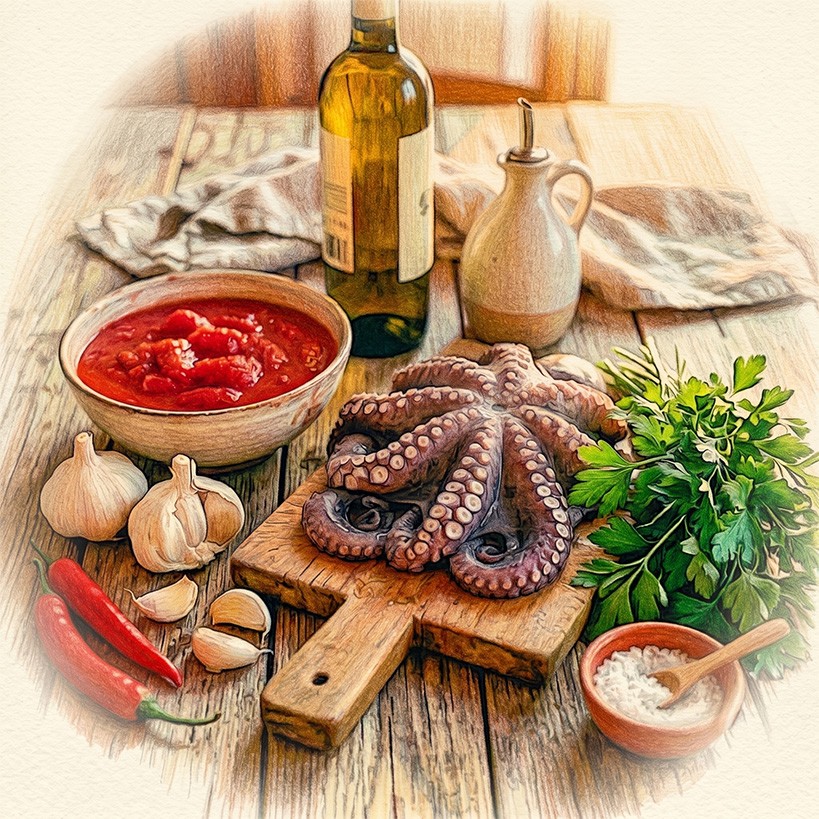
OCTOPUS RAGÙ
Octopus, peeled tomatoes, white wine, parsley
Moderate
Campania
75 minutes
320 Calories
OCTOPUS RAGÙ
Octopus, peeled tomatoes, white wine, parsley
Moderate
Campania
75 minutes
320 Calories
OCTOPUS RAGÙ
Octopus, peeled tomatoes, white wine, parsley
Moderate
Campania
75 minutes
320 Calories
GENESIS
Octopus ragu00f9 is a culinary preparation deeply rooted in the maritime traditions of the Italian Mezzogiorno, winding particularly along the historic coasts of Campania and Apulia. This recipe represents a noble aquatic interpretation of the classic meat ragu00f9, wherein the brininess and dense texture of the mollusk replace the terrestrial proteins, creating a rich, intensely fragrant sauce. The culinary technique closely mirrors that of the celebrated octopus u201calla lucianau201d, native to the ancient seaside hamlet of Santa Lucia in Naples, where fishermen were wont to simmer the octopus slowly in terracotta vessels alongside tomatoes, garlic, and fiery chili.
From a historical perspective, the practice of dressing pasta with octopus arose from the necessity to elevate the local catch through prolonged, gentle simmering, which coaxes the notoriously stubborn flesh of the cephalopod into tender submission. The secret of this preparation lies in the timeless adage that the octopus must cook in its own wateru2014a savory, violet liquor released during the initial phase of cooking, which serves as the soulful aromatic foundation of the sauce. Peeled tomatoes, introduced subsequently, meld with the mollusk's natural juices to create a sublime synergy of flavors that evokes the essence of the sea.
This dish is historically bound to the seasons of maritime abundance and the ripening of summer tomatoes. Despite its apparent simplicity, octopus ragu00f9 demands meticulous care in cleansing the mollusk and infinite patience during its slow simmer. The final texture must emerge velvety, with the morsels of octopus retaining a faint, pleasing resistance to the bite while remaining exquisitely tender. A final touch of fresh parsley and a drizzle of raw extra virgin olive oil complete the aromatic tapestry, rendering this sauce the perfect companion for artisanal pasta shapes designed to cradle its rich sauce.
PORTIONS (FOR 4 PERSONS)
THE RECIPE
Fresh octopus
Peeled plum tomatoes
Garlic
Fresh chili pepper
Dry white wine
Extra virgin olive oil
Fresh flat-leaf parsley
Sea salt
800 gr
500 gr
2 cloves
1
100 ml
4 tablespoons
1 small bunch
As needed
CURATION
For the purification of the octopus:
Begin your preparation by attending to the cleansing of the octopus. Rinse it meticulously under a stream of cold water, freeing its suckers of any impurities. Remove the eyes, the central beak nestled amongst the tentacles, and empty the mantle. Once purified, rest the cephalopod upon a wooden board and carve it into delicate morsels or cubes of roughly one centimetre, preserving the smallest tentacles whole to grace the final presentation with visual elegance.For the seasoning:
Select a grand casserole, preferably of terracotta or boasting a heavy base, and pour in a generous thread of extra virgin olive oil. Introduce the gently crushed cloves of garlic and the finely minced fresh chili. Permit them to simmer over a gentle flame until the garlic turns golden, then remove it should you desire a more subtle essence. Elevate the heat slightly and introduce the pieces of octopus. Let them sear for a few moments until they transform in hue, blushing to a delicate rose as the tentacles begin to curl.
Pour in the dry white wine and allow the spirits to evaporate over a lively flame. Once the aroma of alcohol has dissipated, add the peeled tomatoes, previously crushed with a fork or coarsely torn. Stir the pot with care to interlace the flavours, reduce the flame to its absolute minimum, and crown the casserole with its lid. Allow the ragù to simmer slowly for about 45 to 50 minutes. In this time, the octopus will surrender its natural juices, softening in a slow, gentle alchemy.For the finishing touch:
Inquire from time to time into the density of the sauce; should it dry too much, you may bestow upon it a ladle of warm water. As the cooking nears its end, taste and adjust the salt, mindful that the octopus possesses a natural, sea-born salinity. When it yields to the touch and the sauce is richly reduced and lustrous, extinguish the flame. Complete the masterpiece with a scattering of finely chopped fresh parsley and a final, raw thread of extra virgin olive oil.
aspiration
Should the mollusk possess the supreme freshness of the sea, you may enfold it in a frozen slumber for twenty-four hours prior to cooking, thus gently breaking its fibers and awakening a sublime tenderness upon the hearth.
To cultivate a more profound and resonant flavor, introduce a scattering of dark olives from Gaeta or capers, meticulously purged of their salt, to bloom alongside the tomatoes.
Be mindful to withhold salt from the nectar at the genesis of its cooking, for the slow reduction of the octopus's natural waters may render the finished masterpiece excessively saline.



GENESIS
Octopus ragu00f9 is a culinary preparation deeply rooted in the maritime traditions of the Italian Mezzogiorno, winding particularly along the historic coasts of Campania and Apulia. This recipe represents a noble aquatic interpretation of the classic meat ragu00f9, wherein the brininess and dense texture of the mollusk replace the terrestrial proteins, creating a rich, intensely fragrant sauce. The culinary technique closely mirrors that of the celebrated octopus u201calla lucianau201d, native to the ancient seaside hamlet of Santa Lucia in Naples, where fishermen were wont to simmer the octopus slowly in terracotta vessels alongside tomatoes, garlic, and fiery chili.
From a historical perspective, the practice of dressing pasta with octopus arose from the necessity to elevate the local catch through prolonged, gentle simmering, which coaxes the notoriously stubborn flesh of the cephalopod into tender submission. The secret of this preparation lies in the timeless adage that the octopus must cook in its own wateru2014a savory, violet liquor released during the initial phase of cooking, which serves as the soulful aromatic foundation of the sauce. Peeled tomatoes, introduced subsequently, meld with the mollusk's natural juices to create a sublime synergy of flavors that evokes the essence of the sea.
This dish is historically bound to the seasons of maritime abundance and the ripening of summer tomatoes. Despite its apparent simplicity, octopus ragu00f9 demands meticulous care in cleansing the mollusk and infinite patience during its slow simmer. The final texture must emerge velvety, with the morsels of octopus retaining a faint, pleasing resistance to the bite while remaining exquisitely tender. A final touch of fresh parsley and a drizzle of raw extra virgin olive oil complete the aromatic tapestry, rendering this sauce the perfect companion for artisanal pasta shapes designed to cradle its rich sauce.
PORTIONS (FOR 4 PERSONS)
THE RECIPE
Fresh octopus
Peeled plum tomatoes
Garlic
Fresh chili pepper
Dry white wine
Extra virgin olive oil
Fresh flat-leaf parsley
Sea salt
800 gr
500 gr
2 cloves
1
100 ml
4 tablespoons
1 small bunch
As needed
CURATION
For the purification of the octopus:
Begin your preparation by attending to the cleansing of the octopus. Rinse it meticulously under a stream of cold water, freeing its suckers of any impurities. Remove the eyes, the central beak nestled amongst the tentacles, and empty the mantle. Once purified, rest the cephalopod upon a wooden board and carve it into delicate morsels or cubes of roughly one centimetre, preserving the smallest tentacles whole to grace the final presentation with visual elegance.For the seasoning:
Select a grand casserole, preferably of terracotta or boasting a heavy base, and pour in a generous thread of extra virgin olive oil. Introduce the gently crushed cloves of garlic and the finely minced fresh chili. Permit them to simmer over a gentle flame until the garlic turns golden, then remove it should you desire a more subtle essence. Elevate the heat slightly and introduce the pieces of octopus. Let them sear for a few moments until they transform in hue, blushing to a delicate rose as the tentacles begin to curl.
Pour in the dry white wine and allow the spirits to evaporate over a lively flame. Once the aroma of alcohol has dissipated, add the peeled tomatoes, previously crushed with a fork or coarsely torn. Stir the pot with care to interlace the flavours, reduce the flame to its absolute minimum, and crown the casserole with its lid. Allow the ragù to simmer slowly for about 45 to 50 minutes. In this time, the octopus will surrender its natural juices, softening in a slow, gentle alchemy.For the finishing touch:
Inquire from time to time into the density of the sauce; should it dry too much, you may bestow upon it a ladle of warm water. As the cooking nears its end, taste and adjust the salt, mindful that the octopus possesses a natural, sea-born salinity. When it yields to the touch and the sauce is richly reduced and lustrous, extinguish the flame. Complete the masterpiece with a scattering of finely chopped fresh parsley and a final, raw thread of extra virgin olive oil.
aspiration
Should the mollusk possess the supreme freshness of the sea, you may enfold it in a frozen slumber for twenty-four hours prior to cooking, thus gently breaking its fibers and awakening a sublime tenderness upon the hearth.
To cultivate a more profound and resonant flavor, introduce a scattering of dark olives from Gaeta or capers, meticulously purged of their salt, to bloom alongside the tomatoes.
Be mindful to withhold salt from the nectar at the genesis of its cooking, for the slow reduction of the octopus's natural waters may render the finished masterpiece excessively saline.
ultimate alchemies
GENESIS
Octopus ragu00f9 is a culinary preparation deeply rooted in the maritime traditions of the Italian Mezzogiorno, winding particularly along the historic coasts of Campania and Apulia. This recipe represents a noble aquatic interpretation of the classic meat ragu00f9, wherein the brininess and dense texture of the mollusk replace the terrestrial proteins, creating a rich, intensely fragrant sauce. The culinary technique closely mirrors that of the celebrated octopus u201calla lucianau201d, native to the ancient seaside hamlet of Santa Lucia in Naples, where fishermen were wont to simmer the octopus slowly in terracotta vessels alongside tomatoes, garlic, and fiery chili.
From a historical perspective, the practice of dressing pasta with octopus arose from the necessity to elevate the local catch through prolonged, gentle simmering, which coaxes the notoriously stubborn flesh of the cephalopod into tender submission. The secret of this preparation lies in the timeless adage that the octopus must cook in its own wateru2014a savory, violet liquor released during the initial phase of cooking, which serves as the soulful aromatic foundation of the sauce. Peeled tomatoes, introduced subsequently, meld with the mollusk's natural juices to create a sublime synergy of flavors that evokes the essence of the sea.
This dish is historically bound to the seasons of maritime abundance and the ripening of summer tomatoes. Despite its apparent simplicity, octopus ragu00f9 demands meticulous care in cleansing the mollusk and infinite patience during its slow simmer. The final texture must emerge velvety, with the morsels of octopus retaining a faint, pleasing resistance to the bite while remaining exquisitely tender. A final touch of fresh parsley and a drizzle of raw extra virgin olive oil complete the aromatic tapestry, rendering this sauce the perfect companion for artisanal pasta shapes designed to cradle its rich sauce.
PORTIONS (FOR 4 PERSONS)
THE RECIPE
Fresh octopus
Peeled plum tomatoes
Garlic
Fresh chili pepper
Dry white wine
Extra virgin olive oil
Fresh flat-leaf parsley
Sea salt
800 gr
500 gr
2 cloves
1
100 ml
4 tablespoons
1 small bunch
As needed
CURATION
For the purification of the octopus:
Begin your preparation by attending to the cleansing of the octopus. Rinse it meticulously under a stream of cold water, freeing its suckers of any impurities. Remove the eyes, the central beak nestled amongst the tentacles, and empty the mantle. Once purified, rest the cephalopod upon a wooden board and carve it into delicate morsels or cubes of roughly one centimetre, preserving the smallest tentacles whole to grace the final presentation with visual elegance.For the seasoning:
Select a grand casserole, preferably of terracotta or boasting a heavy base, and pour in a generous thread of extra virgin olive oil. Introduce the gently crushed cloves of garlic and the finely minced fresh chili. Permit them to simmer over a gentle flame until the garlic turns golden, then remove it should you desire a more subtle essence. Elevate the heat slightly and introduce the pieces of octopus. Let them sear for a few moments until they transform in hue, blushing to a delicate rose as the tentacles begin to curl.
Pour in the dry white wine and allow the spirits to evaporate over a lively flame. Once the aroma of alcohol has dissipated, add the peeled tomatoes, previously crushed with a fork or coarsely torn. Stir the pot with care to interlace the flavours, reduce the flame to its absolute minimum, and crown the casserole with its lid. Allow the ragù to simmer slowly for about 45 to 50 minutes. In this time, the octopus will surrender its natural juices, softening in a slow, gentle alchemy.For the finishing touch:
Inquire from time to time into the density of the sauce; should it dry too much, you may bestow upon it a ladle of warm water. As the cooking nears its end, taste and adjust the salt, mindful that the octopus possesses a natural, sea-born salinity. When it yields to the touch and the sauce is richly reduced and lustrous, extinguish the flame. Complete the masterpiece with a scattering of finely chopped fresh parsley and a final, raw thread of extra virgin olive oil.
aspiration
Should the mollusk possess the supreme freshness of the sea, you may enfold it in a frozen slumber for twenty-four hours prior to cooking, thus gently breaking its fibers and awakening a sublime tenderness upon the hearth.
To cultivate a more profound and resonant flavor, introduce a scattering of dark olives from Gaeta or capers, meticulously purged of their salt, to bloom alongside the tomatoes.
Be mindful to withhold salt from the nectar at the genesis of its cooking, for the slow reduction of the octopus's natural waters may render the finished masterpiece excessively saline.