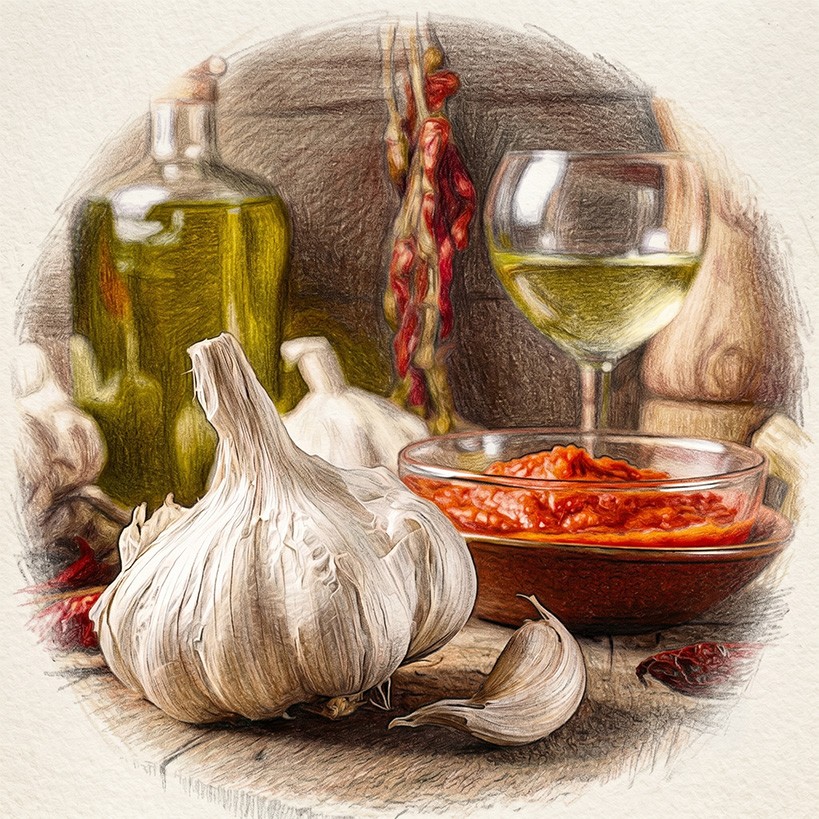
Aglione Nectar
Aglione della Valdichiana, peeled tomatoes, chili pepper.
Effortless
Tuscany
A prelude of forty minutes
180 Calories
Aglione Nectar
Aglione della Valdichiana, peeled tomatoes, chili pepper.
Effortless
Tuscany
A prelude of forty minutes
180 Calories
Aglione Nectar
Aglione della Valdichiana, peeled tomatoes, chili pepper.
Effortless
Tuscany
A prelude of forty minutes
180 Calories
GENESIS
Sugo all'aglione stands as one of the most emblematic recipes of the Tuscan rural tradition, hailing specifically from the Valdichiana, a fertile expanse cradled between the provinces of Siena and Arezzo. The undisputed protagonist of this dish is the Aglione della Valdichiana (Allium ampeloprasum var. holmense), a PAT-designated agro-food treasure that, despite its name, belongs to the leek species rather than that of common garlic. It is distinguished by its grand proportions, with a single bulb capable of exceeding 800 grams, and above all by its unique organoleptic virtues. Its flavor, indeed, is surprisingly delicate, aromatic, and sweet, entirely devoid of alliin and its derivatives—the compounds that bestow upon common garlic its pungent, sulfurous edge and render it difficult to digest. By virtue of this sublime quality, it is affectionately dubbed "the garlic of lovers" or "the garlic of the kiss," as it leaves the breath untainted. The lineage of this sauce is rooted in a humble peasant economy, where the fruits of the kitchen garden were elevated to create rich and flavorful condiments. Traditionally, this sauce marries "pici," a rustic, hand-rolled fresh pasta crafted solely of water and flour, native to the region. The preparation is swift yet soulful, relying on the slow poaching of the aglione which, crushed and gently stewed in olive oil, melts into a velvety, fragrant pomade before the tomatoes are introduced. This recipe, which once risked vanishing alongside the cultivation of the aglione itself, has—hallelujah—been rediscovered and exalted in recent decades, emerging as a luminous symbol of Tuscan biodiversity and gastronomic heritage.
PORTIONS (FOR 4 PERSONS)
THE RECIPE
Aglione della Valdichiana
Peeled plum tomatoes
Extra virgin olive oil
Fresh chili pepper
Dry white wine
Salt
100 gr
800 gr
4 tablespoons
1
Half a glass
to taste
CURATION
For the condiment:
Begin by preparing the cloves of Aglione: peel them and remove the central germ, if present. Slice them finely or, to achieve an even pool of velvety texture, crush them with the flat of a knife or bruise them in a mortar.
In a spacious pan, ideally of terracotta or with a heavy base, pour the liquid gold of extra virgin olive oil, adding the crushed Aglione and the finely minced fresh chili. Allow them to sweat over an exceedingly gentle flame for some 10 to 15 minutes. The Aglione must not take on color but rather stew in languid repose, almost dissolving into grease. To aid this transformation, you may introduce a ladle or two of water, stirring from time to time.
Once the Aglione has softened into a translucent, velvety cream, raise the flame ever so slightly and deglaze with the dry white wine. Allow the spirit of the alcohol to evaporate entirely.
At this threshold, join the peeled tomatoes, which you have beforehand crushed with a fork or gently passed through a food mill. Season with salt, stir mindfully, and return the flame to its lowest whisper.
Cover the pan with a lid and let the sauce simmer for at least 20 to 25 minutes, until it has thickened and attained a rich, body-full, and harmonious consistency. If required during the cooking, you may add a small ladle of hot water to keep it from drying too much. Taste, and if necessary, adjust the salt. Your sugo all'aglione is now ready to grace your table.
aspiration
For a more profound, heightened flavor, you may employ ripe, fresh tomatoes (such as the noble San Marzano or the sweet datterini) in place of the preserved San Marzanos.
Should you desire a sauce of sublime smoothness and velvety grace, you may pass it through a food mill upon the completion of its gentle simmer.
This sauce is exquisite not only to crown your pasta (traditionally the rustic pici), but also to be spread upon slices of toasted artisanal Tuscan bread, evoking the charm of a rustic antipasto.



GENESIS
Sugo all'aglione stands as one of the most emblematic recipes of the Tuscan rural tradition, hailing specifically from the Valdichiana, a fertile expanse cradled between the provinces of Siena and Arezzo. The undisputed protagonist of this dish is the Aglione della Valdichiana (Allium ampeloprasum var. holmense), a PAT-designated agro-food treasure that, despite its name, belongs to the leek species rather than that of common garlic. It is distinguished by its grand proportions, with a single bulb capable of exceeding 800 grams, and above all by its unique organoleptic virtues. Its flavor, indeed, is surprisingly delicate, aromatic, and sweet, entirely devoid of alliin and its derivatives—the compounds that bestow upon common garlic its pungent, sulfurous edge and render it difficult to digest. By virtue of this sublime quality, it is affectionately dubbed "the garlic of lovers" or "the garlic of the kiss," as it leaves the breath untainted. The lineage of this sauce is rooted in a humble peasant economy, where the fruits of the kitchen garden were elevated to create rich and flavorful condiments. Traditionally, this sauce marries "pici," a rustic, hand-rolled fresh pasta crafted solely of water and flour, native to the region. The preparation is swift yet soulful, relying on the slow poaching of the aglione which, crushed and gently stewed in olive oil, melts into a velvety, fragrant pomade before the tomatoes are introduced. This recipe, which once risked vanishing alongside the cultivation of the aglione itself, has—hallelujah—been rediscovered and exalted in recent decades, emerging as a luminous symbol of Tuscan biodiversity and gastronomic heritage.
PORTIONS (FOR 4 PERSONS)
THE RECIPE
Aglione della Valdichiana
Peeled plum tomatoes
Extra virgin olive oil
Fresh chili pepper
Dry white wine
Salt
100 gr
800 gr
4 tablespoons
1
Half a glass
to taste
CURATION
For the condiment:
Begin by preparing the cloves of Aglione: peel them and remove the central germ, if present. Slice them finely or, to achieve an even pool of velvety texture, crush them with the flat of a knife or bruise them in a mortar.
In a spacious pan, ideally of terracotta or with a heavy base, pour the liquid gold of extra virgin olive oil, adding the crushed Aglione and the finely minced fresh chili. Allow them to sweat over an exceedingly gentle flame for some 10 to 15 minutes. The Aglione must not take on color but rather stew in languid repose, almost dissolving into grease. To aid this transformation, you may introduce a ladle or two of water, stirring from time to time.
Once the Aglione has softened into a translucent, velvety cream, raise the flame ever so slightly and deglaze with the dry white wine. Allow the spirit of the alcohol to evaporate entirely.
At this threshold, join the peeled tomatoes, which you have beforehand crushed with a fork or gently passed through a food mill. Season with salt, stir mindfully, and return the flame to its lowest whisper.
Cover the pan with a lid and let the sauce simmer for at least 20 to 25 minutes, until it has thickened and attained a rich, body-full, and harmonious consistency. If required during the cooking, you may add a small ladle of hot water to keep it from drying too much. Taste, and if necessary, adjust the salt. Your sugo all'aglione is now ready to grace your table.
aspiration
For a more profound, heightened flavor, you may employ ripe, fresh tomatoes (such as the noble San Marzano or the sweet datterini) in place of the preserved San Marzanos.
Should you desire a sauce of sublime smoothness and velvety grace, you may pass it through a food mill upon the completion of its gentle simmer.
This sauce is exquisite not only to crown your pasta (traditionally the rustic pici), but also to be spread upon slices of toasted artisanal Tuscan bread, evoking the charm of a rustic antipasto.
ultimate alchemies
GENESIS
Sugo all'aglione stands as one of the most emblematic recipes of the Tuscan rural tradition, hailing specifically from the Valdichiana, a fertile expanse cradled between the provinces of Siena and Arezzo. The undisputed protagonist of this dish is the Aglione della Valdichiana (Allium ampeloprasum var. holmense), a PAT-designated agro-food treasure that, despite its name, belongs to the leek species rather than that of common garlic. It is distinguished by its grand proportions, with a single bulb capable of exceeding 800 grams, and above all by its unique organoleptic virtues. Its flavor, indeed, is surprisingly delicate, aromatic, and sweet, entirely devoid of alliin and its derivatives—the compounds that bestow upon common garlic its pungent, sulfurous edge and render it difficult to digest. By virtue of this sublime quality, it is affectionately dubbed "the garlic of lovers" or "the garlic of the kiss," as it leaves the breath untainted. The lineage of this sauce is rooted in a humble peasant economy, where the fruits of the kitchen garden were elevated to create rich and flavorful condiments. Traditionally, this sauce marries "pici," a rustic, hand-rolled fresh pasta crafted solely of water and flour, native to the region. The preparation is swift yet soulful, relying on the slow poaching of the aglione which, crushed and gently stewed in olive oil, melts into a velvety, fragrant pomade before the tomatoes are introduced. This recipe, which once risked vanishing alongside the cultivation of the aglione itself, has—hallelujah—been rediscovered and exalted in recent decades, emerging as a luminous symbol of Tuscan biodiversity and gastronomic heritage.
PORTIONS (FOR 4 PERSONS)
THE RECIPE
Aglione della Valdichiana
Peeled plum tomatoes
Extra virgin olive oil
Fresh chili pepper
Dry white wine
Salt
100 gr
800 gr
4 tablespoons
1
Half a glass
to taste
CURATION
For the condiment:
Begin by preparing the cloves of Aglione: peel them and remove the central germ, if present. Slice them finely or, to achieve an even pool of velvety texture, crush them with the flat of a knife or bruise them in a mortar.
In a spacious pan, ideally of terracotta or with a heavy base, pour the liquid gold of extra virgin olive oil, adding the crushed Aglione and the finely minced fresh chili. Allow them to sweat over an exceedingly gentle flame for some 10 to 15 minutes. The Aglione must not take on color but rather stew in languid repose, almost dissolving into grease. To aid this transformation, you may introduce a ladle or two of water, stirring from time to time.
Once the Aglione has softened into a translucent, velvety cream, raise the flame ever so slightly and deglaze with the dry white wine. Allow the spirit of the alcohol to evaporate entirely.
At this threshold, join the peeled tomatoes, which you have beforehand crushed with a fork or gently passed through a food mill. Season with salt, stir mindfully, and return the flame to its lowest whisper.
Cover the pan with a lid and let the sauce simmer for at least 20 to 25 minutes, until it has thickened and attained a rich, body-full, and harmonious consistency. If required during the cooking, you may add a small ladle of hot water to keep it from drying too much. Taste, and if necessary, adjust the salt. Your sugo all'aglione is now ready to grace your table.
aspiration
For a more profound, heightened flavor, you may employ ripe, fresh tomatoes (such as the noble San Marzano or the sweet datterini) in place of the preserved San Marzanos.
Should you desire a sauce of sublime smoothness and velvety grace, you may pass it through a food mill upon the completion of its gentle simmer.
This sauce is exquisite not only to crown your pasta (traditionally the rustic pici), but also to be spread upon slices of toasted artisanal Tuscan bread, evoking the charm of a rustic antipasto.